Boarding Bonded Pairs: Can Your Two Cats Share a Suite?
Published on August 26, 2026
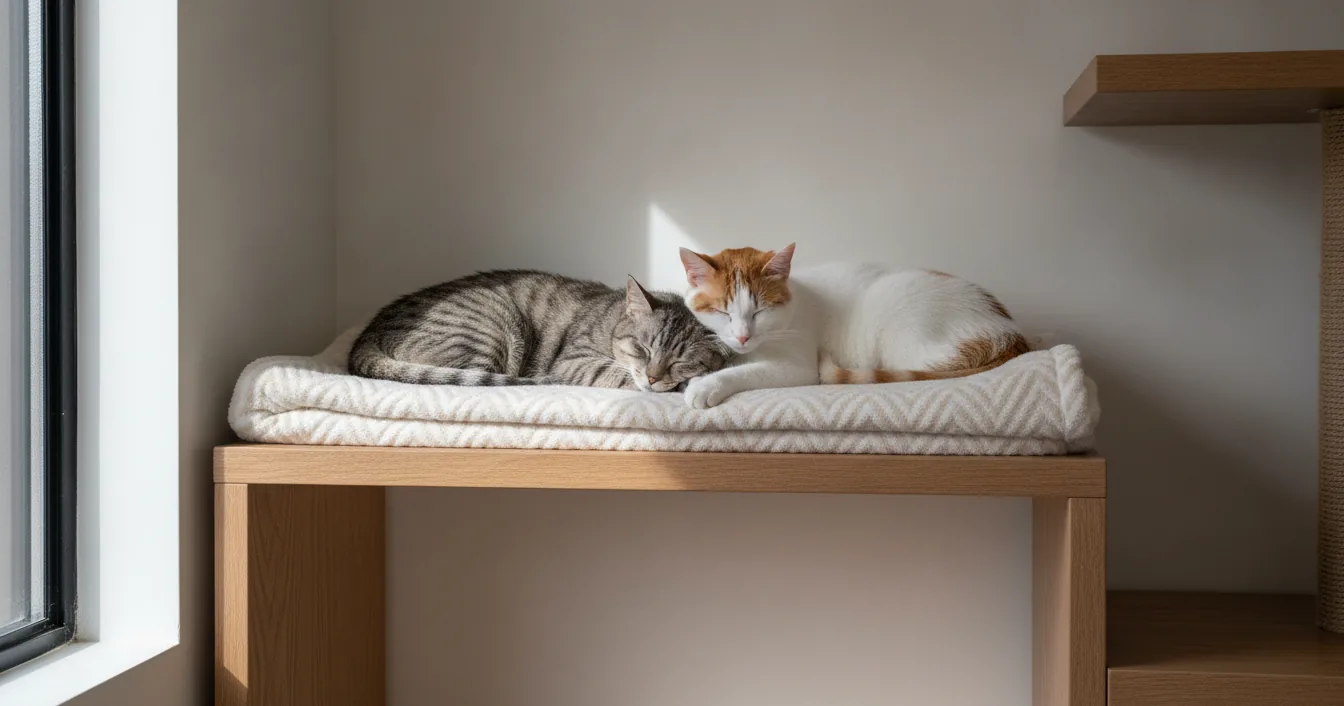
It is the most common question at a cattery booking desk, and it is almost always asked the same way: “They live together at home, so they can share a room, right?”
Sometimes yes. Often yes, in fact, and when the answer is yes it is genuinely better for the cats than two separate suites would be. But the question hides an assumption worth pulling apart, because “they live together” and “they are a bonded pair” are two different claims, and only one of them predicts how a stay will go. A shared suite is a bet that a social relationship built over years in a large, resource-rich territory will survive being compressed into a room the size of a walk-in closet, with a stranger’s smell on the walls and no way out.
This guide is for owners deciding what to book, and for operators writing a shared-suite policy that will not leave a staff member improvising at nine on a Sunday night.
What “Bonded” Actually Means
Cats are facultatively social. They can live in groups and form real attachments, but they do not have to, and the fact that two cats have coexisted peacefully for six years does not tell you they are attached to each other. It may only tell you they have negotiated a workable truce with enough space to keep it.
The behavioral markers of a genuine social bond are specific and observable:
- Allogrooming. They lick each other’s head and neck, the areas a cat cannot reach itself. This is the strongest single signal.
- Allorubbing. They rub heads, flanks, and tails against each other in passing, exchanging scent and maintaining a shared group odor.
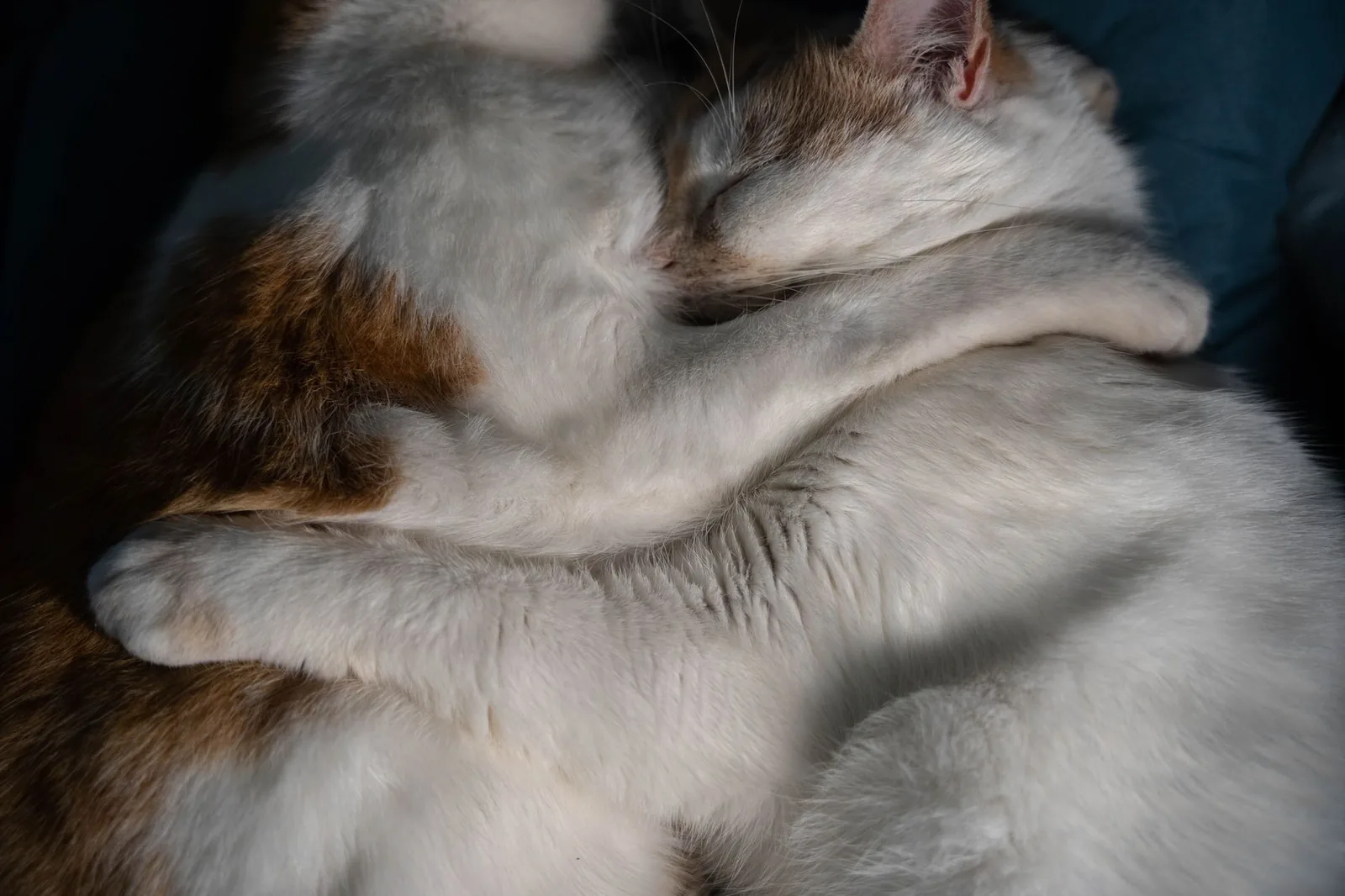
- Sustained contact resting. Not sleeping in the same room, but sleeping touching, curled together, for hours at a time. Cats do not sleep in physical contact with an animal they do not trust.
- Synchronized behavior. They eat, groom, and play at roughly the same times, and one will come looking when the other is out of sight.
- Relaxed proximity to resources. One can walk past the other’s food bowl or use the tray next to it without either changing posture.
Now the markers of tolerance, which owners routinely read as friendship:
- They sleep in the same room but always a few feet apart, and each has a favored spot the other does not use.
- One consistently waits for the other to leave the bowl before approaching.
- There is occasional hissing or a swat at doorways, on stairs, or in hallways, brushed off as “they just bicker.”
- One does most of the moving. Cats that avoid each other are doing active work to stay apart, and in a big house that work is invisible.
That last point is the one to sit with. In a home, a cat has vertical routes, multiple rooms, and time-sharing as tools for avoiding a housemate. Boarding removes every one of them at once.
The Home Test and the Boarding Test Are Different
A four-by-six suite has no hallways. There is no upstairs to retreat to, no third room, no ten minute wait for the other cat to move on. Two cats who were managing a relationship by staying out of each other’s way now cannot.
Stack that on top of the ordinary stressors of a stay: unfamiliar smells, unfamiliar sounds, unfamiliar hands, a disrupted feeding schedule, and for the first day or two the residual scent of whichever cats used the suite last. Stress narrows a cat’s tolerance for everything, including its housemate. The relationship is not being tested at home difficulty. It is being tested at the hardest setting the cat will ever meet.
There is one more wrinkle, familiar to anyone who has taken one cat to the vet and brought it home to a hissing sibling. Cats identify each other substantially by scent, and when one cat’s smell changes, the other may treat it as an intruder. This is non-recognition aggression, and boarding produces the same conditions: medicated shampoo, a vet visit mid-stay, or simply one cat being handled far more than the other. Bonds that hold perfectly well can wobble when the scent profile stops matching.
Redirected Aggression Is the Failure Mode Nobody Books For
When a shared suite goes badly, redirected aggression is usually the mechanism. The Cornell Feline Health Center lists it among the classic feline aggression types, and it is the one that catches operators off guard, because the trigger and the target are different animals.
The sequence is predictable. Cat A sees, hears, or smells something it cannot reach and cannot control: a cat in the opposite suite, a dog barking two rooms away, a bird outside the window. Arousal spikes. There is nothing to do with it, and the only body in reach belongs to Cat B, who has done nothing at all. The attack that follows can be severe, and the aroused cat may stay over threshold for hours after the original trigger is gone.
The damage is not only physical. A single serious incident can permanently break a bond between cats who lived together happily for years, because Cat B now associates Cat A with real danger. Facilities that treat a shared suite as set-and-forget occasionally send home two cats who will need weeks of reintroduction at the owner’s expense.
Resource guarding is the slower version of the same problem. A stressed cat’s territorial behavior sharpens, and in a small room the food bowl, the tray, and the single warm high shelf become contested in a way they never were across a whole house. This is worth reading alongside the wider behavior playbook in our guide to house soiling, aggression, and other behavior problems at boarding, because the de-escalation rules are the same.
The Resource Maths Inside One Suite
The single most useful principle in multi-cat housing is that every essential resource should be available to every cat without any cat having to pass, confront, or wait for another. That means duplication and distribution, not just more space.
For a two cat suite, the working numbers are:
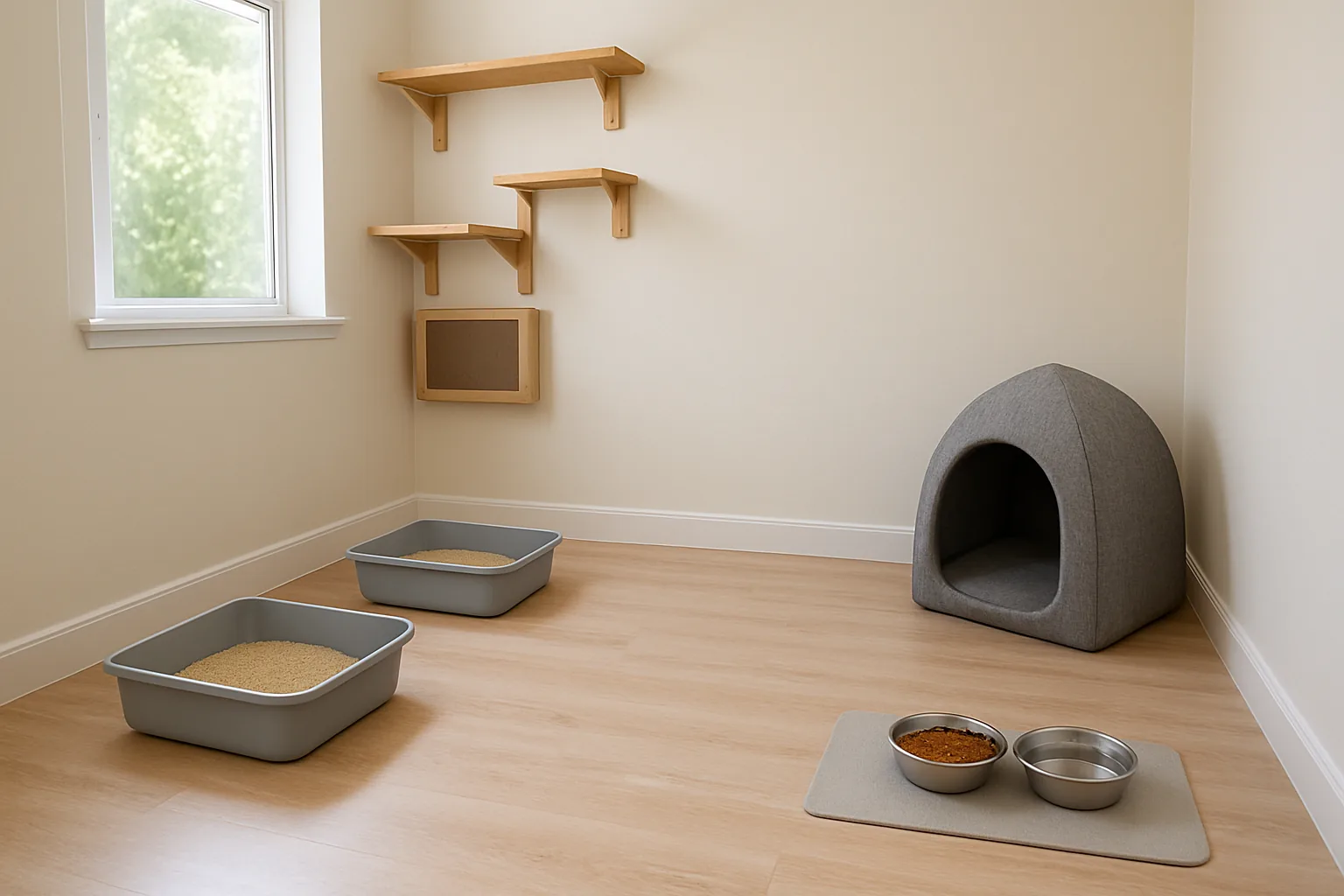
- Litter trays: one per cat plus one, so three for two cats where the suite allows it, two minimum. Place them apart rather than side by side. Two trays touching function as one tray with a wide entrance, and a guarding cat can block both.
- Food and water: separate stations, visibly apart. Not two bowls on one mat. Water should be well away from food, and each cat should be able to eat without the other in its line of sight. This matters most for the cat that is already inclined to skip meals under stress, a risk covered in what to do when a cat will not eat at the hotel.
- Hiding places: at least one per cat, in different parts of the suite. A covered bed, a box, an enclosed shelf. Two cats and one hide is a resource conflict waiting to happen, and access to hiding is one of the most reliable stress reducers there is.
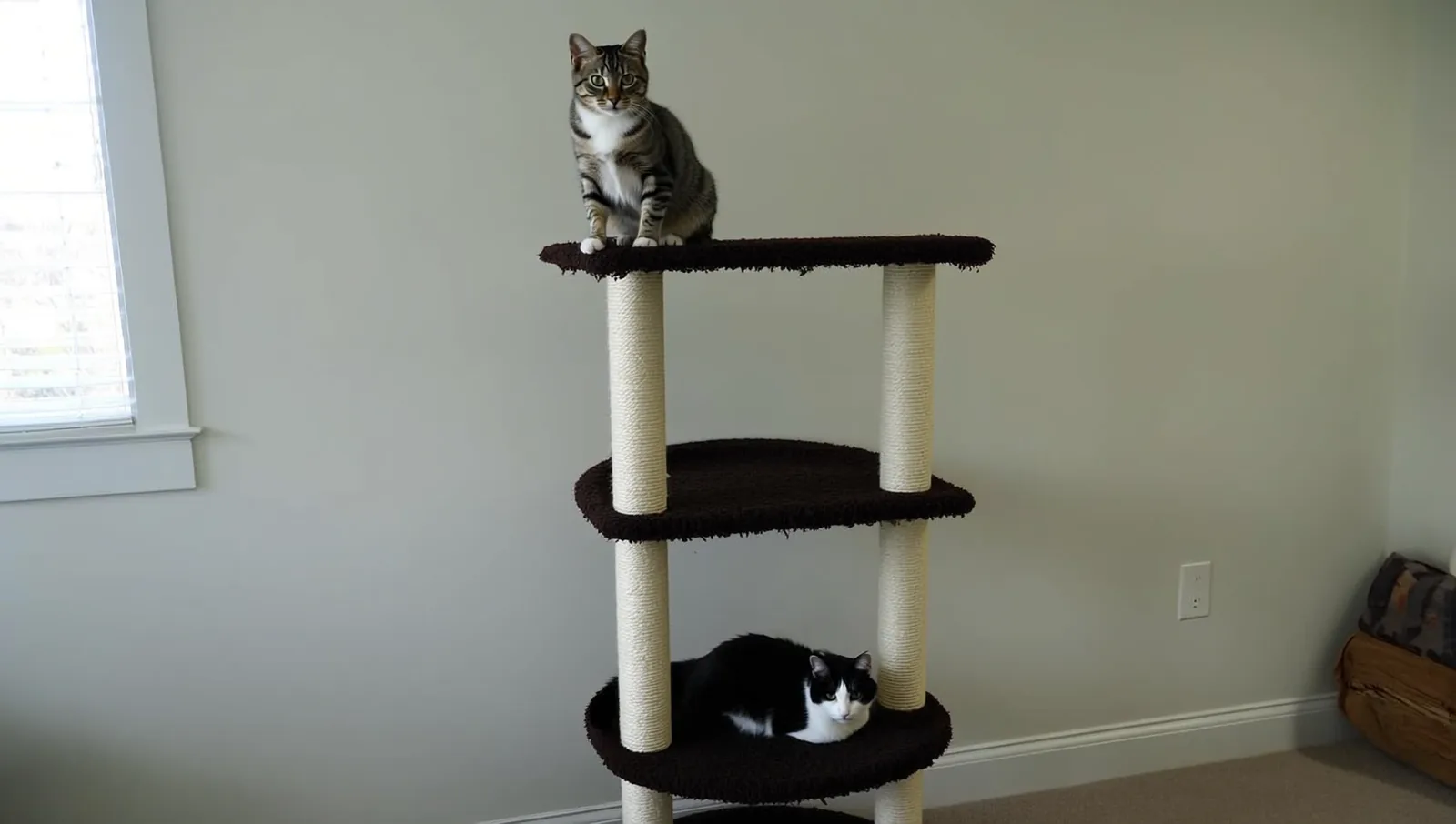
- Vertical perches: at least two, at different heights. Height is how cats de-escalate. Given a high shelf and a low one, a pair will often self-sort into an upstairs cat and a downstairs cat and stay comfortable that way all week.
- Bedding: two beds, and no washing them all on the same day. The shared group scent living in that bedding is part of what holds the pair together. Rotate laundry so some familiar smell always remains.
Any facility that will not describe its shared-suite setup in this level of detail is describing a cage with two cats in it. Purpose-built cat-only facilities tend to be furnished this way as standard, one of several reasons cat-only boarding has been growing so fast.
Signs That Should Trigger a Mid-Stay Separation
Separation is not a failure of the booking. It is the correct response to information the facility did not have on day one, and every shared-suite policy should name the triggers in advance so nobody has to make the call from scratch.
Separate immediately for any of these:
- Any physical fight, regardless of injury. One is not “just a scuffle.”
- Sustained growling, yowling, or one cat holding another still in a stare.
- One cat blocking access to the tray, the food, or the only hide.
- One cat not eating for 24 hours while the other eats normally, which is the classic quiet sign that the subordinate cat is being kept from the bowl.
- One cat confined to a single spot, pressed low, not moving even when staff enter.
- Soiling outside the tray by either cat.
- Injuries, scratches, or bite wounds noted at a routine check.
Those last few are easy to miss because they are silent. Feline conflict is often entirely postural, and the loser simply stops moving. If reading those signals is unfamiliar territory, our guide to feline stress signals and body language at boarding covers exactly what to watch for.
How a Good Separation Is Done
The move is not “put one cat in a spare cage.” Done properly, separation keeps as much of the pair’s shared world intact as possible.
Use adjacent suites so the cats can still smell and hear each other. Split the bedding between the two rooms rather than replacing it, so each keeps a piece of the shared scent, and duplicate the full resource set on both sides. If the conflict was redirected aggression from an outside trigger, deal with the trigger too, since moving the cats without breaking the sightline just relocates the problem. Wait at least 24 hours before considering a reunion, longer if there was a real fight, and call the owner the same day. They will want to know, and they can often name the trigger from experience.
A facility should also be honest with itself about capacity. If the shared-suite discount means there is no spare room to separate into on a holiday weekend, the policy is not a policy.
What the Shared-Suite Discount Really Saves
Two cats in one suite almost always cost less than two suites. The typical structure is full price for the first cat and a reduced rate for the second, commonly 10 to 25 percent off, with additional cats discounted further. On a rate of 45 dollars a night, that is somewhere between 4 and 11 dollars a night saved, or roughly 30 to 80 dollars on a week’s stay. Our complete cat boarding pricing guide breaks down how those rates stack across facility tiers.
Two things to check before treating that as settled. Ask what happens to the price if the cats have to be separated mid-stay, because some facilities absorb it and some bill the second suite at full rate from that night. Then weigh the saving against the cost of a broken bond. Thirty dollars is not much set against a course of reintroduction at home, or a vet visit for a bite abscess.
For genuinely bonded cats the discount is a bonus, not the reason. They settle faster, they sleep better, and the familiar body next to them is the strongest piece of home they can bring. For cats who merely tolerate each other, two suites is not an upsell. It is the correct booking.
What to Disclose and What to Ask
Owners, tell the facility the truth: how much your cats actually interact, whether they groom each other, whether there has ever been a fight, and whether one is clearly dominant at the bowl. A facility that knows a pair is tolerant rather than bonded will set the suite up differently from day one.
Then ask four questions. How many trays, hides, and perches will be in the shared suite? What are your triggers for separating cats mid-stay? Do you have a free adjacent suite to separate into on my dates? And what does separation cost me if it happens?
Any operator who has run shared suites for a season has answers ready. The hesitation is the information.
Further reading (sources)
- Cornell Feline Health Center on the aggression types that show up between cats sharing space
- Duffield Institute for Animal Behavior for treating feline social conflict as clinical medicine rather than a personality clash
- International Cat Care on how cats actually form and maintain social groups
- AAFP and ISFM set out handling principles for a cat that is already over threshold
- Kessler and Turner on scoring feline stress before a shared suite goes wrong
- National Law Review on how cat-only operators size and furnish shared suites