Stress Cystitis and Urinary Blockage at Boarding: The Complete Guide
Published on September 6, 2026
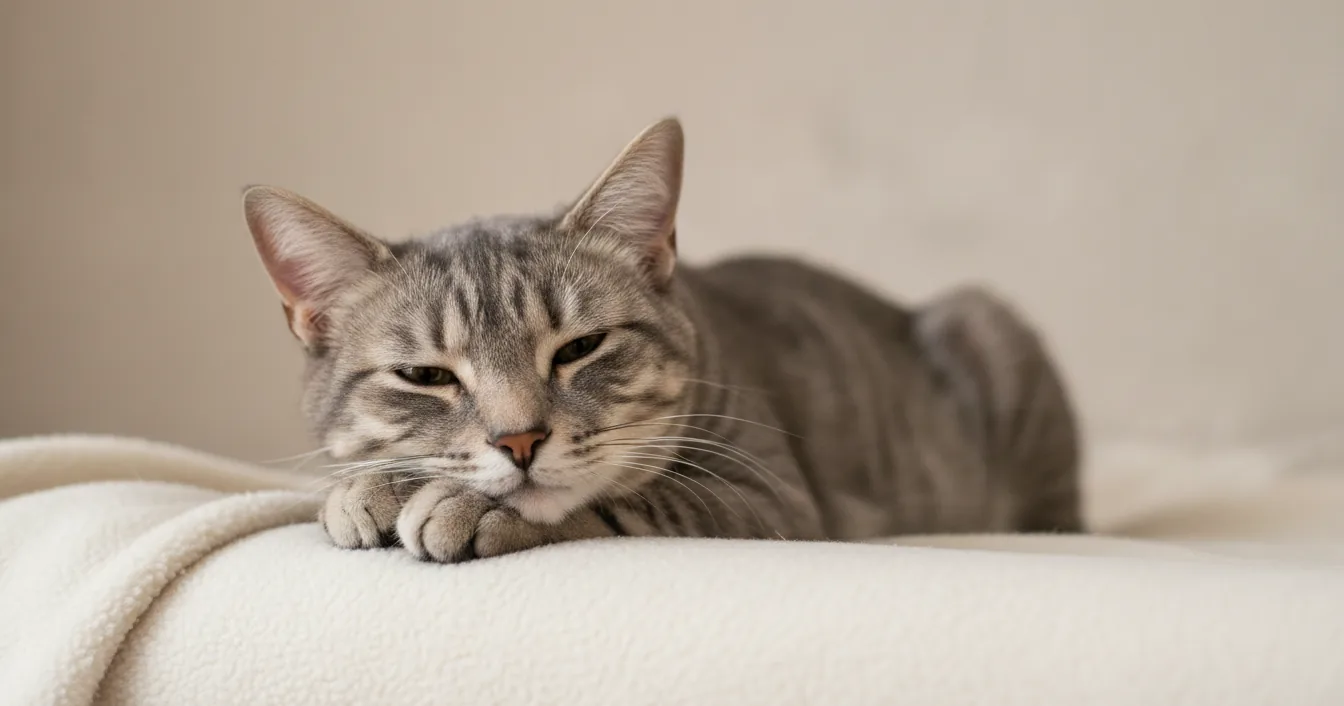
Most boarding emergencies announce themselves slowly. A cat goes off its food, a cold works its way through a wing, a senior gets stiff and needs a softer bed. Lower urinary tract trouble does not work like that. A cat can arrive perfectly healthy on Friday, develop a painful bladder by Sunday, and, if it is a male cat and the urethra plugs, be in genuine danger of dying by Tuesday. It is the one common boarding problem where the clock is measured in hours rather than days.
Feline idiopathic cystitis, usually shortened to FIC, is a stress-driven inflammation of the bladder wall, and stress is precisely what a boarding stay supplies. Most cases resolve on their own and simply make a cat miserable for a week. A small share of them, almost always in males, progress to a urethral obstruction that is a true emergency. This guide covers both: why the boarding environment drives cystitis, what raises and lowers the risk inside a suite, the signs staff must catch on a round, and the escalation protocol for the moment a cat has not passed urine.
Why a Strange Room Inflames a Cat’s Bladder
The name idiopathic means “we do not know the cause,” which is honest but undersells what the research has actually pinned down. The best work on this comes from Ohio State, where Tony Buffington and colleagues spent two decades showing that FIC is less a bladder disease than a whole-cat stress response that happens to show up in the bladder.
Cats with FIC have an overactive sympathetic nervous system, the fight-or-flight branch, paired with a blunted cortisol response. Under stress they release the stress chemistry but not the brake that normally shuts it off. In the bladder, that sustained sympathetic drive appears to thin the protective glycosaminoglycan layer lining the bladder wall, letting urine irritate the tissue underneath and setting off neurogenic inflammation. The result is a bladder that hurts, spasms, and signals urgency even when it holds almost nothing.
The most telling finding came from the control group. In one Ohio State study, healthy cats and cats with FIC were both subjected to a disrupted routine, unfamiliar caretakers, and changed feeding times. The healthy cats showed sickness behaviors, vomiting, food refusal, and eliminating outside the box, at nearly the same rate as the cats with diagnosed bladder disease. Routine disruption alone made ordinary cats act sick. A boarding facility is, by definition, a disrupted routine: new smells, new people, new sounds, and other cats within earshot. This is the same stress-and-immunity axis that drives the spike in respiratory illness right after drop-off, pointed at a different organ.
Cystitis or Blockage: The Distinction That Decides Everything
Every cat with lower urinary tract signs looks roughly the same at first glance. It strains, it goes in and out of the box, it may cry. The question that matters is not how much it strains, it is whether anything comes out.
Cystitis without obstruction produces small, frequent urinations, often bloody, often outside the box. The cat is uncomfortable and may be vocal, but it is passing urine. This is urgent enough to warrant a call to the owner and a veterinary appointment, and it needs pain relief, but it is not a same-hour crisis. Uncomplicated FIC episodes typically settle within five to seven days whether or not they are treated, though they recur in a substantial share of cats.
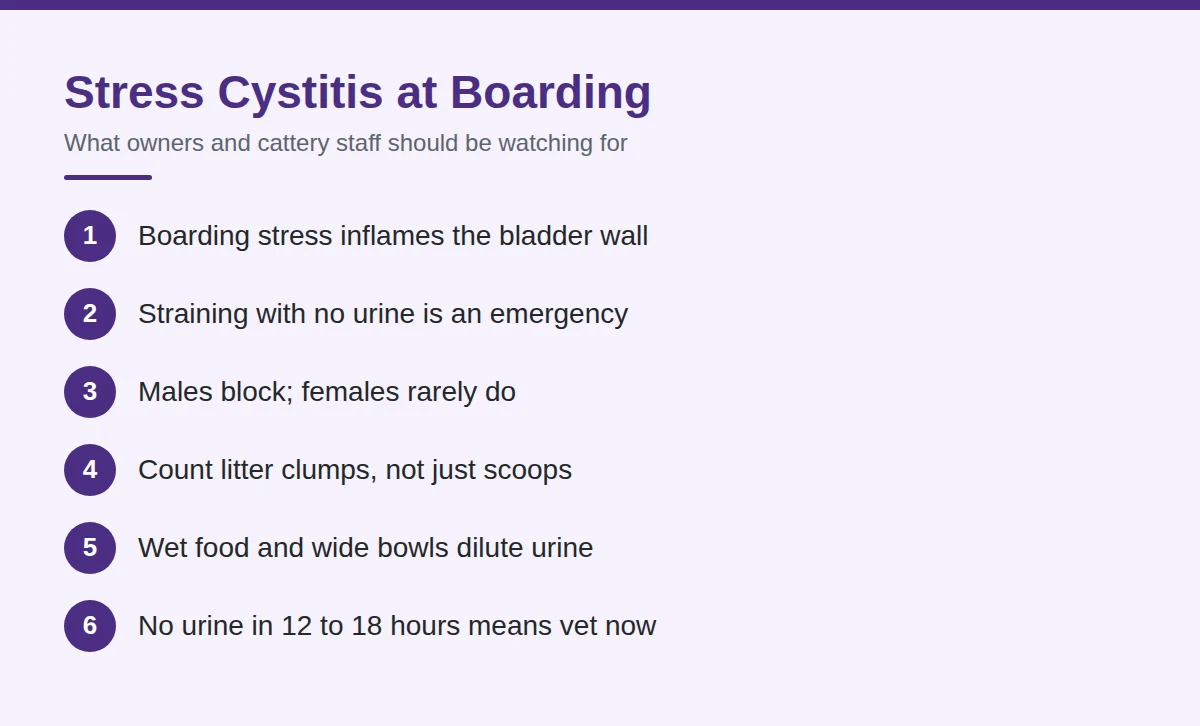
Cystitis with obstruction produces nothing. The cat squats, strains hard, and the litter stays dry. Male cats have a long, narrow urethra that tapers toward the tip, and inflammatory debris, crystals, mucus, and small stones can plug it completely. Once the plug is in, urine backs up, the bladder distends into a hard painful ball, and kidney function begins to fail within hours. Potassium climbs in the blood, which slows and destabilizes the heart. An untreated blocked cat commonly dies within about 24 to 72 hours, and it is a bad death. A blocked cat is a genuine emergency in the same category as a dog hit by a car.
Two mistakes cause most of the harm here, and boarding staff make both. The first is reading a straining cat as constipated. A constipated cat and a blocked cat adopt an almost identical posture, and the safe assumption is always blockage until a veterinarian says otherwise. The second is reading a blocked cat that has stopped straining as a cat that got better. Late in an obstruction, cats become quiet, weak, and collapsed, and they vomit. A cat that strained yesterday and is now flat in the back of the suite is not recovered, it is deteriorating.
The Cats Most Likely to Block
Risk is not evenly spread, and a facility can flag the high-risk bookings before they arrive.
- Male cats, neutered or not. Anatomy is the single largest risk factor. Females get cystitis at similar rates but rarely obstruct.
- Young to middle-aged adults, roughly two to seven years old. FIC is a disease of cats in their prime, which is exactly the opposite of what most owners expect.
- Overweight and indoor-only cats. Both are associated with higher FLUTD risk, and both describe a large share of boarding guests.
- Dry-food-only diets, which produce more concentrated urine than a wet or mixed diet.
- Multi-cat households, where baseline social tension is already elevated before a stay adds more.
- Any cat with a previous episode. A history of cystitis or, above all, a previous blockage is the strongest predictor there is. A cat that has blocked once can block again, and that history belongs on the intake form in bold.
One useful counterpoint for operators fielding worried owners: bacterial urinary infection is uncommon in cats under ten, accounting for a small minority of lower urinary tract cases. In cats over ten, especially those with kidney disease, hyperthyroidism, or diabetes, real infections become considerably more likely. This is why antibiotics are usually the wrong reflex in a young straining cat, and why an older boarding guest with urinary signs deserves a different diagnostic path than a five-year-old.
What Staff Should Be Catching on a Round
Litter box output is a vital sign, and most facilities record it far less carefully than food intake. The fix is cheap.
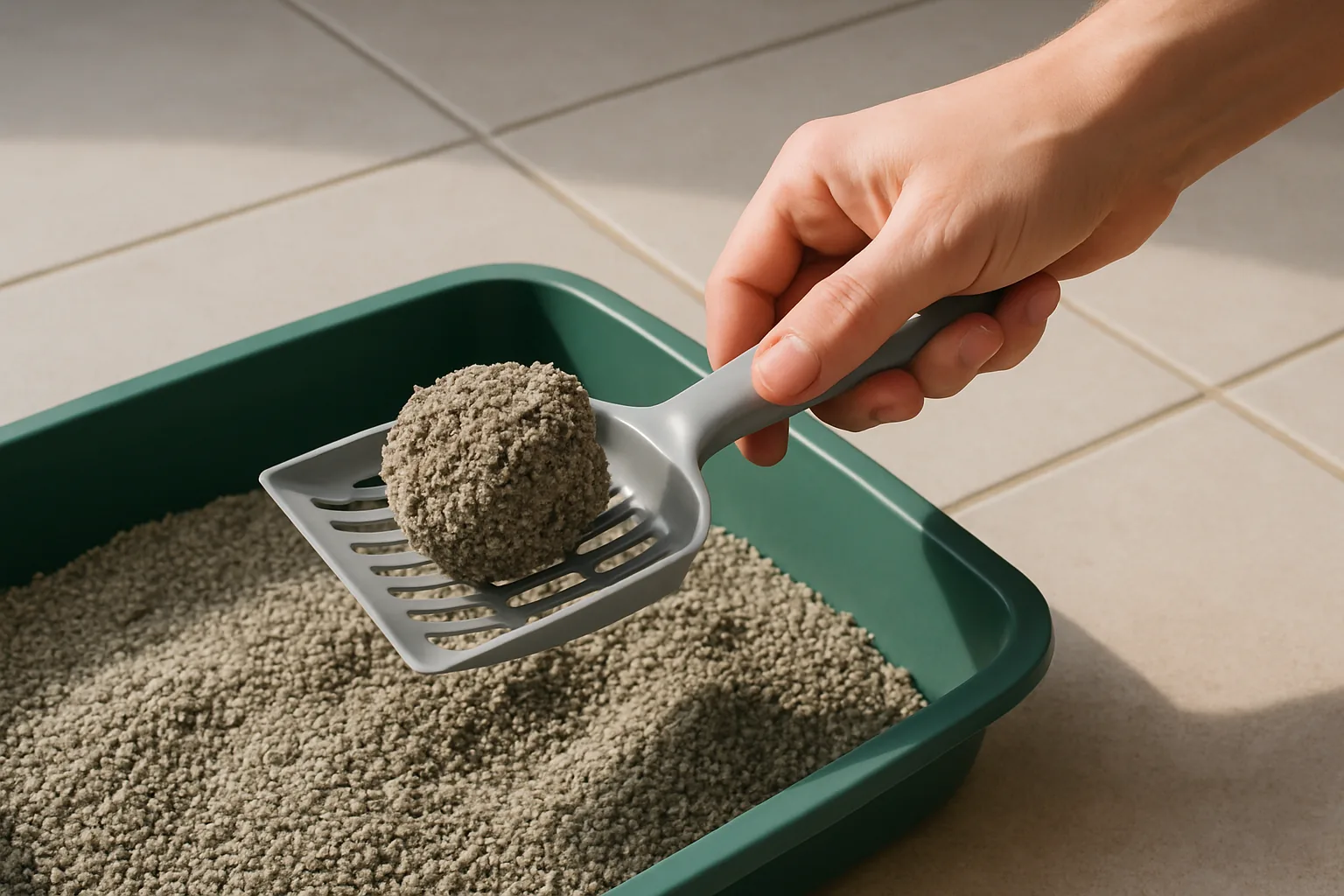
Count and log urine clumps, not just “box scooped.” A healthy cat urinates roughly two to four times a day. A daily count on the care card turns a vague impression into a trend, and it is the only way anyone notices that yesterday’s three clumps became today’s none.
Use clumping litter and light-colored litter where you can. This is a genuine clinical argument for a litter choice. Clumping litter makes urine volume visible and countable; crystals, pellets, and absorbent pads hide it. Light litter makes blood obvious. A facility that cannot tell you how many times a cat urinated yesterday is not watching the thing that matters.
Establish the day-one baseline, and do not dismiss it. Many cats will not use the box for the first several hours in a new suite, so a quiet first evening is not automatically alarming. What is alarming is a cat that has settled, eaten, and drunk, and still produces nothing.
The signs that should stop a staff member mid-round:
- Straining or squatting repeatedly with little or no result
- Frequent tiny urinations, in or out of the box
- Pink, red, or brown staining in the litter or on bedding
- Crying, growling, or howling while in the tray
- Excessive licking of the genital area
- Urinating on bedding, in the bed, or on a flat surface away from the box
- A tense, hunched posture, or flinching when the belly is touched
- Any of the above in a male cat, which raises the priority immediately
Several of these overlap with ordinary feline stress signals and body language, and one of them, going outside the box, overlaps with the behavior problems that surface in any boarding suite. That is exactly the trap. Litter box avoidance in a boarding cat gets filed as a behavior issue, when in a male cat it may be the first visible sign of a bladder that is about to become an emergency. Medical rule-out comes first, always.
Suite, Litter, and Water: The Factors You Can Actually Control
Buffington’s group tested whether changing the environment changes the disease, and it does. Cats managed with multimodal environmental modification, a package of enrichment, litter management, water access, and stress reduction, had significantly fewer recurrent episodes over the following ten months than cats left as they were. Almost all of that package is reproducible in a well-run cattery.
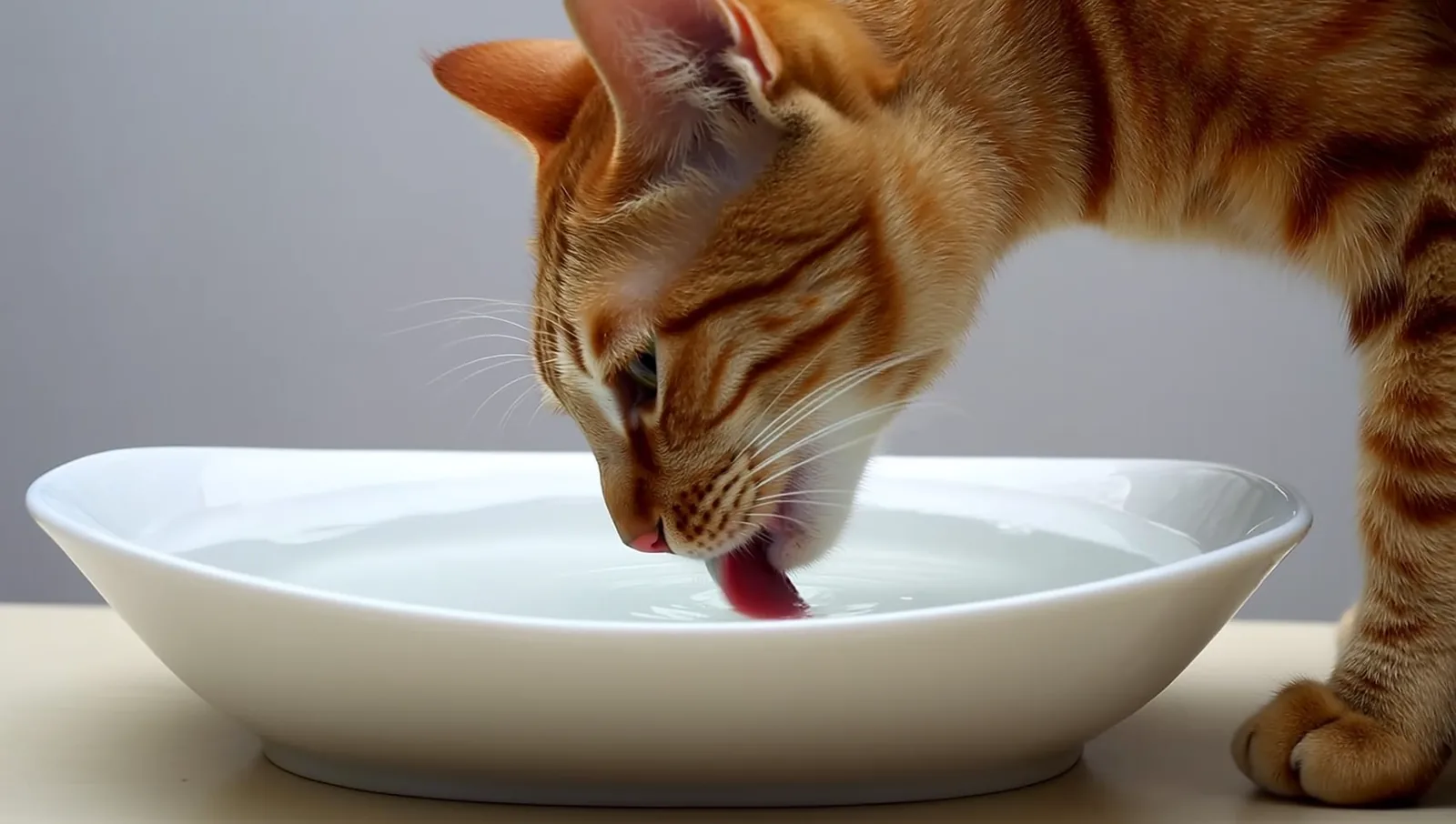
Water intake is the single most useful lever. Dilute urine is less irritating and less likely to form a plug. Canned food is roughly three-quarters water, so a cat eating wet food takes in dramatically more fluid than a kibble-only cat. Offer wide, shallow bowls, since narrow ones press on the whiskers and put some cats off drinking, and site water well away from the litter box. Multiple water stations per suite, a fountain for cats that prefer moving water, and a splash of water added to wet food all move the needle.
Litter setup matters as much as litter volume. One large, uncovered box per cat at minimum, scooped at least twice daily, with unscented clumping litter at a depth of about an inch and a half. Scent and covers put cats off, and a cat that holds its urine because it dislikes the box concentrates that urine further. In a shared suite the maths gets stricter still, since two cats and one tray is a recipe for one of them holding on.
Design the suite so the cat can stop being vigilant. A hiding box, a raised perch, and no direct sightline to another cat do more for a bladder than any supplement. Site the litter box away from the suite door and out of the traffic lane so the cat is not forced to toilet in the open. Synthetic feline pheromone in the room is inexpensive and reasonable to run.
Keep the routine boring. Same staff member, same order on rounds, same feeding times. Predictability is the active ingredient in every environmental protocol that has been tested.
The Escalation Protocol When a Cat Has Not Passed Urine
Every facility needs this written down before the day it is needed, because in the moment nobody should be improvising or waiting for a manager to call back.
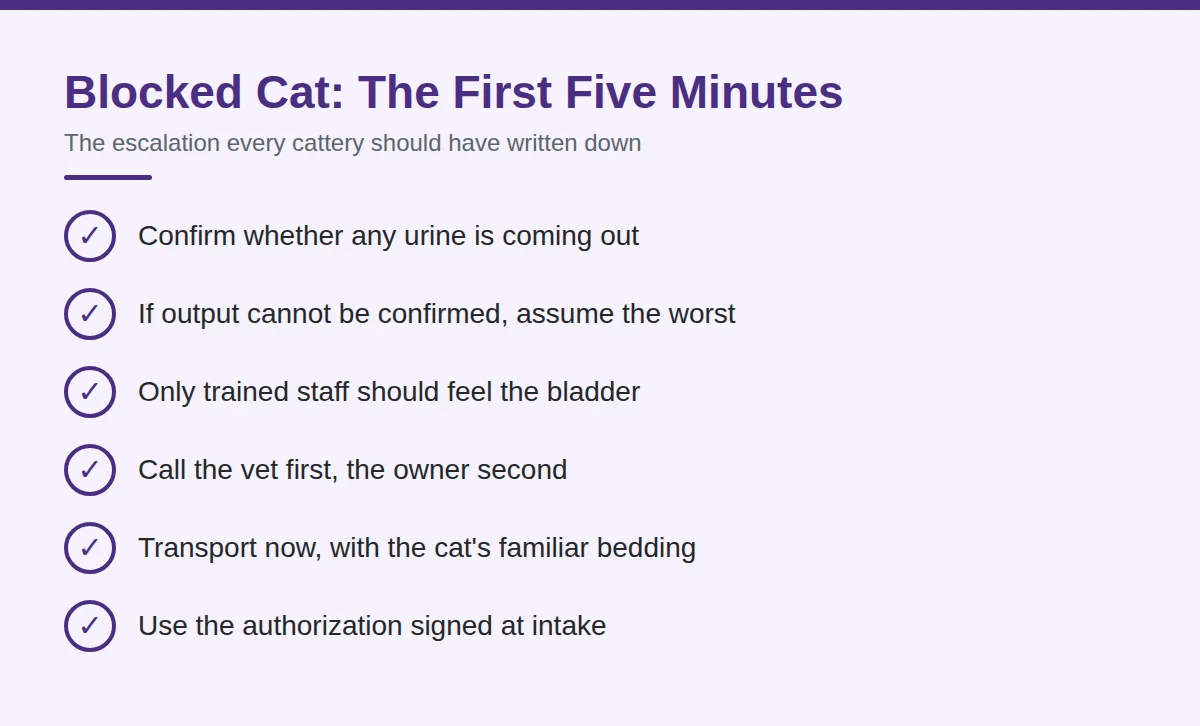
- Check whether anything is coming out. Straining with production means urgent. Straining with nothing means emergency. If staff cannot confirm output, assume the worst case.
- Palpate only if trained. A firm, grape-to-orange sized bladder that the cat resents strongly suggests obstruction. An untrained hand pressing hard on an obstructed bladder can rupture it, so if in doubt, skip this and go straight to step three.
- Do not delay for the owner. Call the veterinarian first and the owner second, in that order. A blocked cat measures its margin in hours.
- Transport now. Carry the cat in a carrier with the bedding it already has. Do not withhold water, and do not try home remedies, painkillers from the shelf, or any human medication.
- Have the paperwork already signed. Intake forms should carry emergency veterinary authorization, a named clinic, an after-hours clinic, and a spending limit the owner has agreed to in advance. Unblocking a cat typically means sedation, urinary catheterization, intravenous fluids, treatment for high potassium, and a day or two of hospitalization. It is expensive, and a facility that has to chase authorization at two in the morning loses the time the cat does not have.
The threshold worth writing into policy: no confirmed urination in 12 to 18 hours in a cat that is otherwise settled and drinking, or any straining with no output at all, triggers a veterinary call immediately. That is deliberately conservative. The cost of an unnecessary vet visit is a consultation fee. The cost of a missed obstruction is the cat.
What Owners Should Do Before Drop-Off
Disclose the history, all of it. A previous blockage, a previous cystitis episode, a prescription urinary diet, or a cat that has ever been described as “a straining cat” changes how a facility should watch that guest. Send the therapeutic diet in labeled portions and make clear it is not optional. Bring familiar bedding, because scent is genuinely calming and a calm bladder is the goal. Keep the litter type consistent with home if the facility will allow it.
If your cat is a known blocker, have the conversation with your veterinarian before you book, not after you land. Ask whether a short course of anxiety medication around the stay is appropriate, since the evidence on calming medication for boarding cats is reasonably good and the goal is stress reduction rather than sedation. Ask your vet to speak to the facility directly if the history is complicated. And be honest with yourself about whether a high-risk cat should board at all during a trip where you are unreachable.
Questions to Ask the Facility
- Do you log litter box output for each cat, and can you tell me how many times my cat urinated yesterday?
- What litter do you use, and will you use clumping litter for a cat with a urinary history?
- How many water sources are in a suite, and will you feed wet food?
- At what point does a straining cat trigger a call to a vet rather than a note in the file?
- Which clinic do you use after hours, and how quickly can you get a cat there?
- Do you take emergency veterinary authorization at intake, with a spending limit?
A facility that answers these crisply has thought about urinary emergencies before. One that has not will tell you so in the vagueness of its answers.
Most boarded cats never have a urinary problem, and most that do simply have an uncomfortable few days. What separates a good outcome from a bad one is not luck. It is a staff member who counts clumps, a suite that lets a cat relax, and a written rule about the hour at which somebody picks up the phone.
Further reading (sources)
- Cornell Feline Health Center on what feline lower urinary tract disease covers and when it turns urgent
- Ohio State Veterinary Medical Center for the Indoor Pet Initiative work on environmental stress and bladder disease
- Journal of Feline Medicine and Surgery with the 2014 AAFP and ISFM guidelines on lower urinary tract signs
- Journal of the American Veterinary Medical Association covers sickness behaviours in healthy cats and cats with idiopathic cystitis after routine disruption
- International Cat Care notes why a blocked male cat cannot wait until morning