Cat Boarding Vaccinations Explained: The Complete FVRCP, Rabies, and FeLV Guide
Published on May 25, 2026
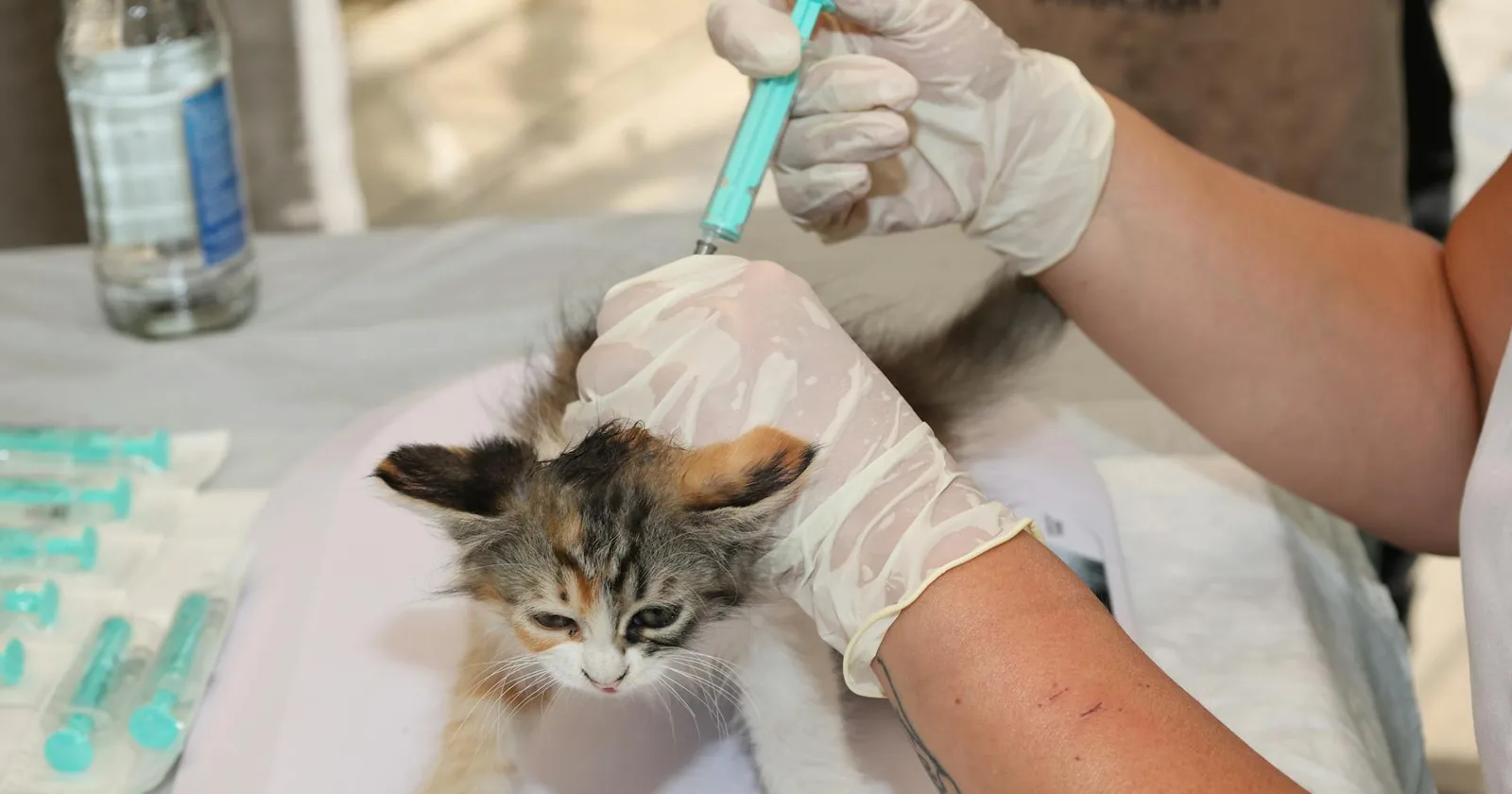
The vaccine requirements for cat boarding can feel like a moving target. One facility insists on FVRCP, rabies, and FeLV. Another waives FeLV but adds Bordetella. A third accepts a titer test in place of a recent booster. Owners of strictly indoor cats arrive with a record that has not been updated since the kitten series, only to learn that the cat hotel will not take them.
The variation is not random. Behind it sits a consistent piece of clinical reasoning: in a high-density environment, a partially vaccinated cat puts every other cat at risk, and a few diseases are dangerous enough that any boarding operator has to draw a hard line. This guide explains every vaccine a cat hotel may ask for, why each one matters in a boarding setting, the timing rules around drop-off, the formats facilities accept as proof, and the narrow circumstances where exemptions and titer tests apply.
Why Vaccines Matter More at Boarding Than at Home
A cat that lives alone at home has a known viral world: its own vaccination history, the household’s exposure, and very little else. A cat hotel mixes histories. Even with separate suites, shared HVAC, shared corridors, and shared human handlers create routes for pathogens to move. The American Association of Feline Practitioners (AAFP) puts boarding in the same risk tier as shelters and multi-cat colonies when recommending which optional vaccines to consider (AAFP, 2020).
Stress amplifies the problem. Cortisol suppresses mucosal immunity and can reactivate latent herpesvirus carriers, turning a quiet passenger into an active shedder. We covered that biology in detail in how stress drives cat colds at boarding. The takeaway here is that boarding is precisely the environment where waning vaccine titers turn into clinical disease, so up-to-date shots are not just a paperwork formality.
FVRCP: the Core, Non-Negotiable Vaccine
FVRCP is shorthand for feline viral rhinotracheitis (feline herpesvirus-1), calicivirus, and panleukopenia. Every reputable cat hotel requires a current FVRCP because two of its three components, FHV-1 and calicivirus, are the leading causes of feline upper respiratory infection at boarding, and the third, panleukopenia, is a frequently fatal parvovirus. The AAFP classifies all three as core vaccines for every cat, regardless of lifestyle (AAFP, 2020).
FVRCP boosters do not produce sterilizing immunity. Vaccinated cats can still pick up FHV-1 and calicivirus and shed them. What the vaccine does is reduce the severity of disease and shorten the shedding window, which keeps a single sneezing guest from triggering a facility-wide outbreak. The complete URI prevention guide walks through the other layers of defence that sit on top of vaccination.
Typical facility rule: FVRCP must be current per the manufacturer’s label, which usually means a booster every one to three years after the initial kitten series. Many cat hotels want the booster within the last 12 months for adults boarding for the first time.
Rabies: the Universal Legal Requirement
Rabies is the one vaccine your facility cannot waive even if it wants to. In nearly every U.S. state and Canadian province, rabies vaccination is a legal requirement for any cat in commercial boarding. The reason is public health, not feline health. A boarded cat that bites a staff member or another guest’s owner is a reportable incident, and an unvaccinated cat involved in a bite can trigger a mandatory quarantine of up to six months at the owner’s expense.
The clinically meaningful detail is that rabies vaccines come in one-year and three-year formulations. A facility may accept either, but the date on the certificate must be current. If the cat is overdue, the booster restarts the clock as a “primary” rabies vaccination in many jurisdictions, even if the cat has been vaccinated annually for a decade. That matters for boarding because a primary rabies dose is not legally considered protective until 28 days after administration in most states.
FeLV: the Asterisk Vaccine
Feline leukemia virus (FeLV) sits in an awkward middle ground. The AAFP recommends FeLV vaccination as core for kittens under one year, then becomes lifestyle-based for adults (AAFP, 2020). A strictly indoor adult cat with no other-cat exposure may not have received an FeLV booster in years.
Boarding facilities split on the rule. Cat-only hotels with private suites and no cat-to-cat contact often do not require FeLV. Facilities with shared play rooms, communal time, or any direct nose-to-nose contact between guests usually do. The reason is that FeLV transmits through prolonged close contact, mutual grooming, and shared food and water bowls, not casual air movement.
If you board a strictly indoor cat in a private-suite facility, ask whether FeLV is required before you book the vet appointment. A booster for a cat that has not had FeLV in three years is essentially a primary series, which is two doses three to four weeks apart, and that takes weeks to organise.
Bordetella and Chlamydia: The Situational Add-Ons
Some facilities, especially those with cattery-style group housing or a recent outbreak history, require Bordetella bronchiseptica and Chlamydia felis vaccines. Both pathogens contribute to URI but cause milder disease than FHV-1 or calicivirus, so the AAFP classifies them as non-core. They are most often required for cats that are frequent boarders, that have had prior URI episodes, or that will be housed with unfamiliar cats.
If a facility requires these and your cat does not have them, plan four weeks ahead. Both vaccines need time to produce a useful immune response, and starting them the week before drop-off is too late.
Timing: How Far Before Drop-Off Shots Must Be Given
The single rule most owners get wrong is timing. Vaccinating the day before boarding does not protect the cat, and many facilities will reject a same-week vaccination on the record.
A practical timeline:
- Booster of a previously current vaccine: at least 7 days before drop-off, with 14 days preferred.
- Primary series or restart: at least 28 days before drop-off for rabies, FeLV, and FVRCP if the previous vaccination has lapsed.
- Bordetella and Chlamydia (if required): 7 to 14 days before drop-off.
These windows are not arbitrary. The immune system needs roughly two weeks to produce a protective antibody response to a booster, and longer for a primary series. A facility that accepts a vaccine certificate dated the same week as the stay is not enforcing a real protective standard.
Proof of Vaccination: What Facilities Actually Accept
Cat hotels do not accept the verbal “she’s up to date.” Standard formats are:
- A signed vaccination certificate from your veterinarian on clinic letterhead, listing vaccine name, manufacturer, lot number, date administered, and next-due date.
- A copy of the rabies tag certificate (the tag itself is not enough, the paper certificate has the legally required details).
- An emailed PDF from the clinic, sent directly from the clinic’s email domain. Photographs of records taken on a phone are sometimes refused because the date stamps and lot numbers must be legible.
Ask the facility what they accept before drop-off, not on the day. A cat turned away at intake for a paperwork issue still owes the deposit at most facilities, and the deposit is a small loss compared with finding emergency boarding at the last minute.
Titer Tests as an Alternative
A titer test measures the level of antibodies a cat has against a specific virus. If the titer is high enough, it suggests existing immunity without the need for another booster. The AAFP and AAHA accept titers as an alternative to FVRCP boosters in adult cats with a confirmed prior vaccination history (AAFP, 2020).
The catch: titers do not work for every vaccine. Rabies titers are scientifically valid but not legally accepted in lieu of a current rabies vaccine in nearly all U.S. jurisdictions. FeLV titers do not correlate well with protection. So titers can replace an FVRCP booster but not the rabies certificate, which is the one most often at issue.
Most cat hotels accept FVRCP titers from a reference lab (IDEXX, Antech) with the result dated within the last 12 months. Practice varies, so confirm before assuming.
Medical Exemptions and the Indoor-Only Cat
A small number of cats genuinely cannot be vaccinated. Cats with confirmed vaccine-induced sarcoma history, cats with severe immune-mediated disease, and cats undergoing chemotherapy or high-dose steroid therapy are the most common exemption categories. The exemption requires a letter from the treating veterinarian, not a verbal claim, and even with the letter most facilities will require a private suite, no shared air handling, and a clear medical risk acknowledgement signed by the owner.
The much more common scenario is the strictly indoor cat whose owner skipped FeLV and stopped doing rabies boosters after age 10. There is no exemption for “she never goes outside.” Boarding is itself the exposure event the vaccines are designed to cover, and the facility’s risk pool includes every other guest.
If your cat is in this position, see a vet four to six weeks before the planned stay, not the week of. A lapsed vaccination usually means a primary restart, not a single booster, and the timing rules above apply.
Boarding a FeLV-Positive Cat: The Isolation Question
A FeLV-positive cat is not unboardable, but it is not boardable everywhere. Facilities split into three categories:
- No FeLV-positive cats accepted. Common at multi-cat group-housing facilities and any operation without true isolation.
- Isolation boarding only. A dedicated suite, separate ventilation, separate handlers, often a separate entrance, at a premium price.
- Cat-only facilities with strict suite separation. Some private-suite cat hotels accept FeLV-positive cats as a normal booking because no direct cat-to-cat contact occurs in the building.
The right facility for a FeLV-positive cat is one that has explicitly worked through the protocols, not one that says “it should be fine.” Ask about the suite location, who handles the cat and in what order during the day, how shared items (food bowls, scoops, toys) are managed, and whether other FeLV-negative cats are housed adjacent. Cat-only boarding setups are usually the only realistic option here.
A Pre-Booking Vaccination Checklist
Before you book, work through these in order:
- Get a copy of your cat’s current vaccination record from your vet.
- Confirm the facility’s exact requirement list and the maximum age of each vaccine record.
- Confirm the timing rule: how many days before drop-off must each shot be given.
- Ask what proof format they accept (clinic certificate, emailed PDF, etc.).
- If a titer is on the table, confirm which vaccines they will accept it for.
- If your cat has any medical reason to skip a vaccine, request the exemption process in writing.
- Book the vet appointment at least four to six weeks before drop-off if anything is lapsed.
A well-run cat hotel will walk you through these without complaint. A facility that gets impatient with vaccination questions is also a facility that will not push back hard on the next owner’s incomplete paperwork. Our wider guide to choosing the right cat hotel covers the rest of what to look for on a tour, beyond the paperwork itself.
Further reading (sources)
- AAHA and AAFP on the 2020 joint feline vaccination guidelines
- American Association of Feline Practitioners for the practice summary on core and non-core feline vaccines
- Cornell Feline Health Center with an overview of feline leukemia virus, transmission, and management
- American Veterinary Medical Association on rabies vaccination policy and post-exposure quarantine rules
- WSAVA for the global vaccination guidelines covering core, non-core, and titer testing
Feature photo by Tahir Xəlfə on Pexels.