Chemical and Toxic Hazards in a Cat Boarding Facility: Disinfectants, Diffusers, Plants, and Medication Errors
Published on September 9, 2026
A cat comes back from a suite turnover drooling. By evening its tongue is ulcerated and it has stopped eating. The natural conclusion in a boarding facility is calicivirus, so the cat gets isolated, the wing gets a deep clean, and the owner gets a worrying phone call. Sometimes that is the right call. Often it is not. Those exact signs are the classic presentation of quaternary ammonium disinfectant exposure, and shelters have repeatedly mistaken a cleaning-product injury for a viral outbreak. The cat did not catch anything. It walked across a floor that had not finished drying and then groomed its paws.
Cats Are Not Small Dogs, Chemically
Almost every hazard in this article exists because of one metabolic quirk. Cats are deficient in the liver enzyme UDP-glucuronosyltransferase, which is what dogs, humans, and most mammals use to conjugate and clear phenols and related aromatic compounds. Without that pathway working properly, compounds that a dog processes and excretes uneventfully sit in a cat’s circulation and accumulate. It is the same deficiency behind the well-known paracetamol danger, and it is why a product line can be genuinely safe in a dog kennel and genuinely dangerous in the cattery next door.
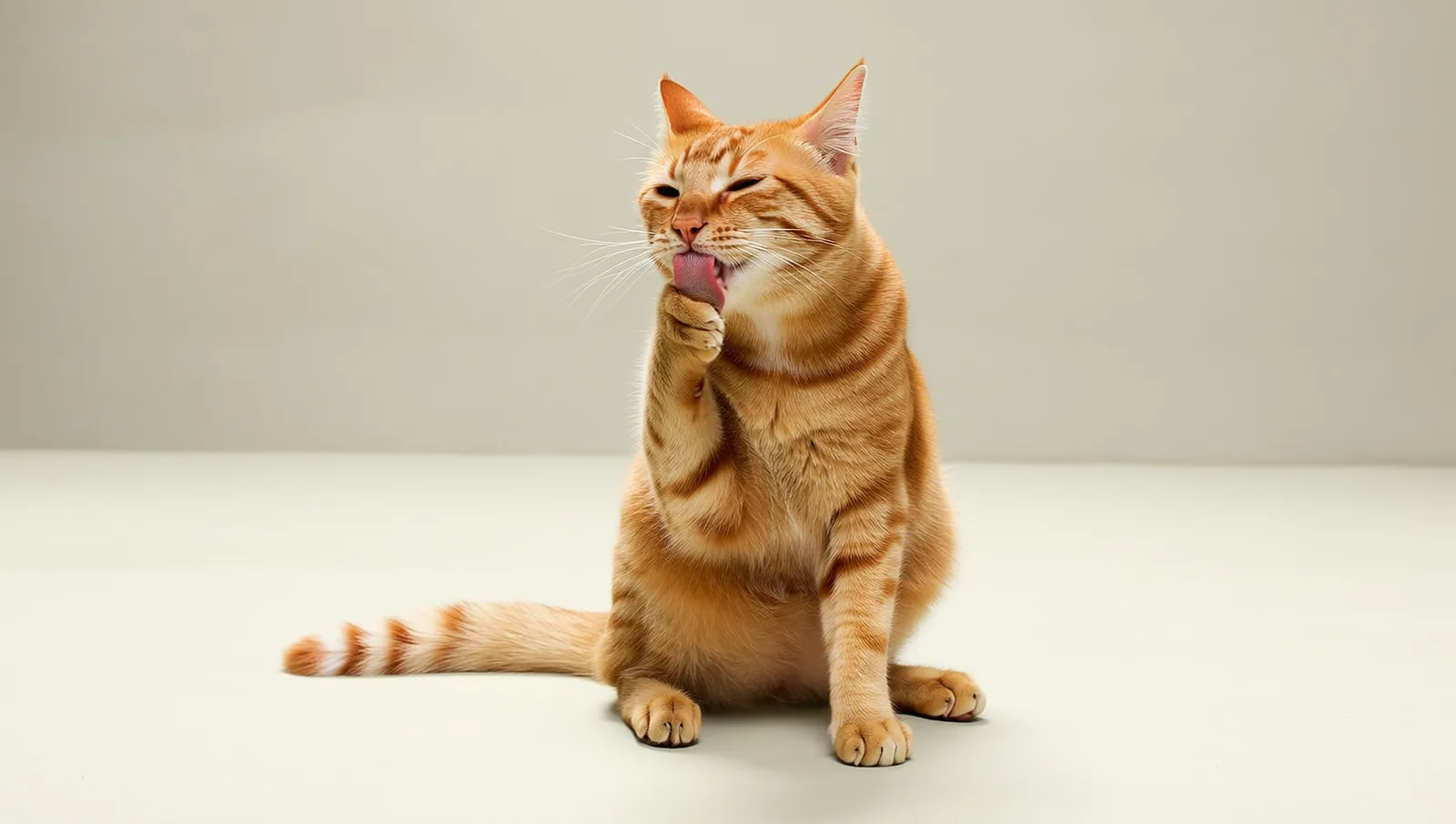
Three behavioural facts stack on top of the enzyme problem. Cats groom obsessively, which converts any surface residue into an oral dose. They are small, so a splash that a labrador would shrug off is a meaningful exposure by body weight. And they spend their day at floor level, on the exact surfaces that get mopped. A cattery is not a hazardous place because operators are careless. It is hazardous because the routine work of keeping it clean and calm involves products that were designed with the wrong species in mind.
Disinfectants: What Belongs in the Building
Disinfection is not optional. Panleukopenia and calicivirus are both non-enveloped and stubborn, and no amount of ventilation substitutes for a product that actually kills them. The question is which chemistry does that job without injuring the guests.
Quaternary ammonium compounds (quats, usually benzalkonium chloride). Cheap, widely sold, and the single most common cause of chemical injury in catteries. Cats show oral ulceration, stomatitis, and pharyngitis at concentrations of 2 percent or lower, which is well inside normal working-dilution territory. The Veterinary Poisons Information Service reviewed 245 feline benzalkonium chloride exposures and found hypersalivation in 53.9 percent, tongue ulceration in 40.4 percent, hyperthermia in 40.4 percent, and oral ulceration in 22.9 percent. Deaths were rare at 1.2 percent, but recovery was slow and painful, and some cats needed feeding tubes. Quats are also unreliable against non-enveloped viruses, so they are underpowered for panleukopenia anyway. If you use them, they belong on surfaces cats never touch, applied at label dilution and left to dry completely.
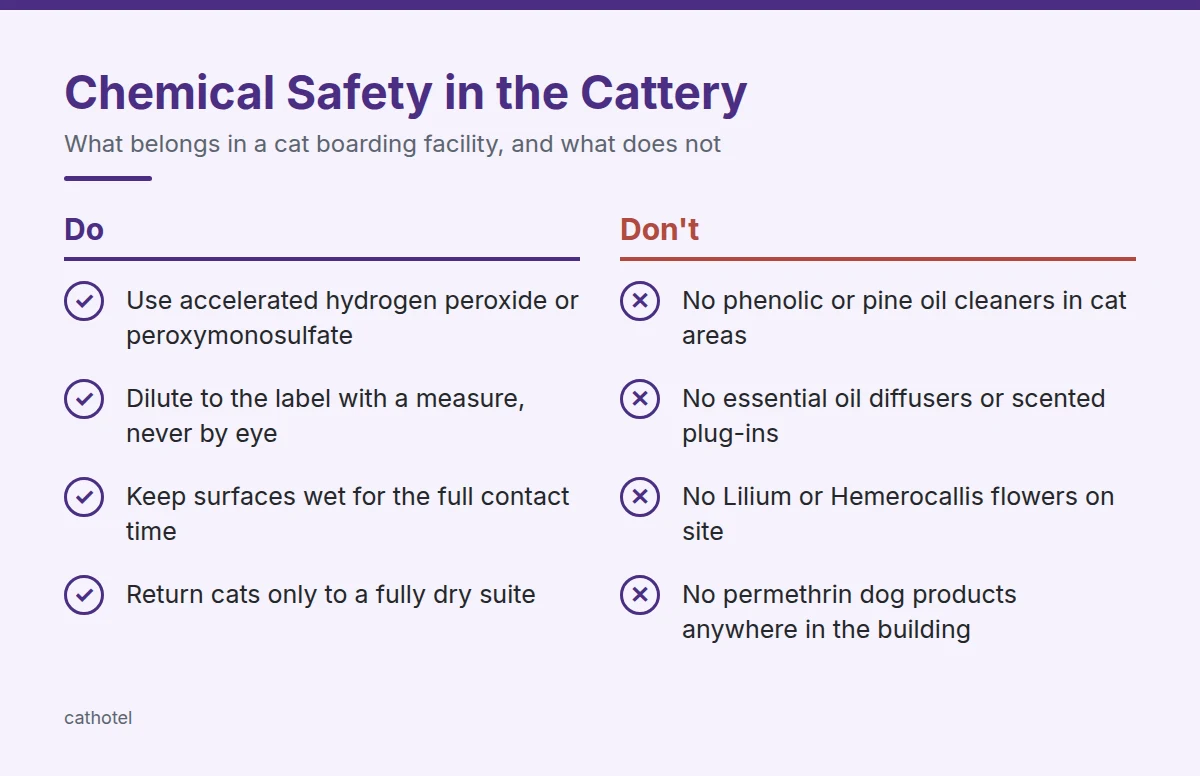
Phenolics and pine oil. Straightforwardly contraindicated. Phenol-based products are the ones cats metabolise worst, and cats are more susceptible to pine oil toxicosis than other species. Ingestion or inhalation can produce hypersalivation, vomiting, ataxia, CNS depression, and respiratory compromise. A complicating detail worth knowing: many pine-scented cleaners sold in the US contain little or no actual pine oil, so read the ingredient panel rather than the fragrance claim. Either way, phenolics have no place in a feline housing area.
Accelerated hydrogen peroxide and potassium peroxymonosulfate. These are the shelter-medicine standards for good reason. They keep working in the presence of organic debris, they are far gentler on animals and staff, and they handle the viruses that matter. Published guidance for the accelerated hydrogen peroxide product Rescue puts it at 1:64 with a five-minute contact time for general virucidal use, and 1:32 with a ten-minute contact time for parvovirus, which is the benchmark that also covers feline panleukopenia.
Sodium hypochlorite (bleach). Effective and cheap, but it is inactivated by organic material, so it only works on a surface that has already been cleaned. It also needs real contact time and thorough rinsing, and the fumes are an irritant in a poorly ventilated room.
The Four Rules That Make a Safe Product Safe
Choosing the right chemistry is half the job. The other half is procedure, and this is where most facilities actually fail.
Dilute to the label, every time. “A bit stronger for the sick wing” is how a working dilution becomes a caustic one. Use a dosing pump or a marked measure, not a glug.
Respect the contact time. A disinfectant that is wiped dry after thirty seconds has not disinfected anything. Contact time means the surface stays visibly wet for the full stated period, which usually means reapplying rather than waiting.
Rinse when the label says to rinse. Quats and bleach both leave residue. On any surface a cat will lick, walk on, or lie against, rinse with clean water after the contact time has elapsed.
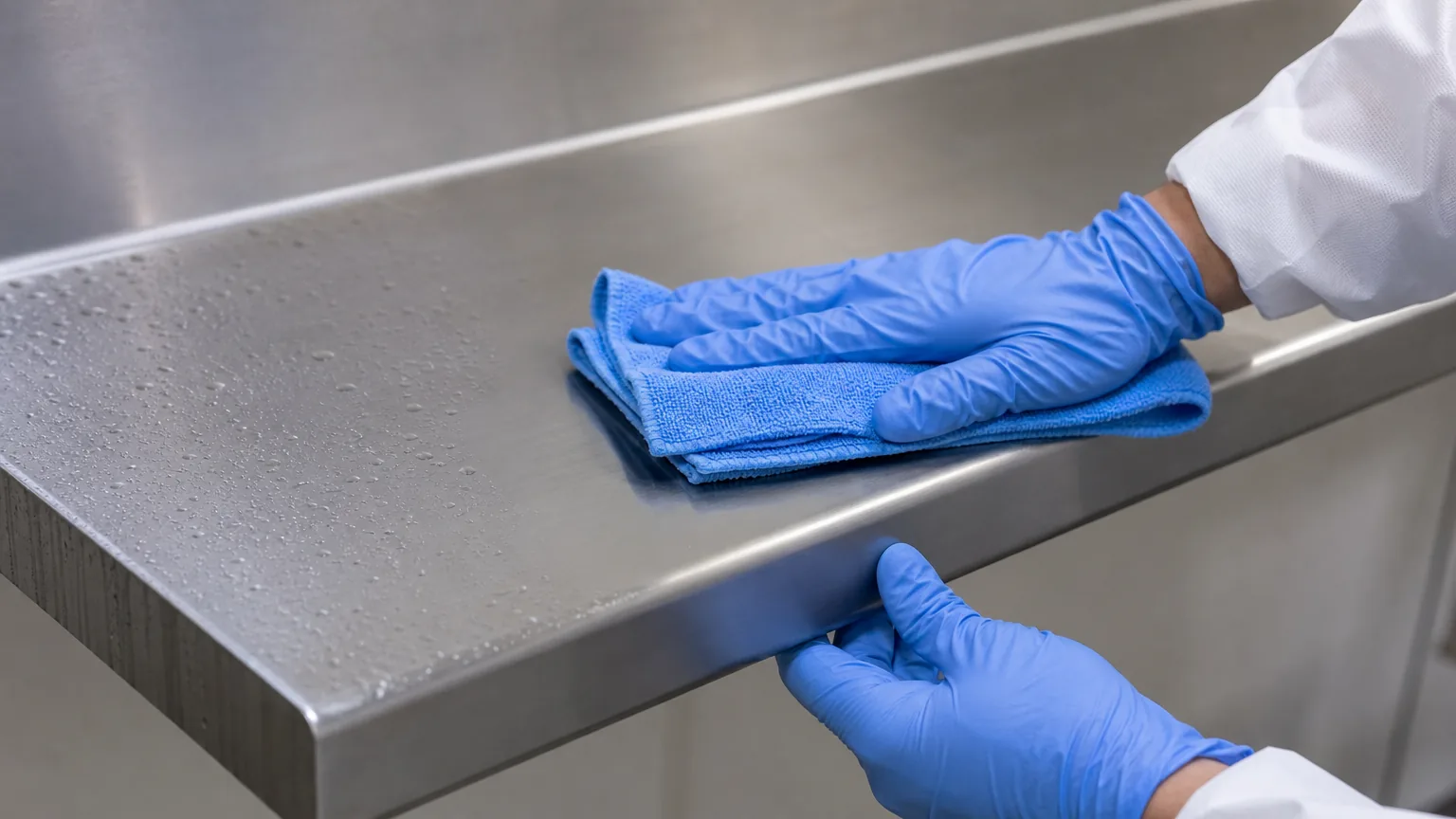
Never return a cat to a wet suite. This is the rule that prevents most real-world injuries. Surfaces must be dry, not damp. Build it into the turnover checklist as a signed-off step, not a habit.
Clean first, then disinfect. Organic soil blocks nearly every product on the list, which is why the sequence matters as much as the chemistry. If you are also building a biosecurity protocol around this, our URI prevention guide covers where disinfection sits among the other prevention pillars.
Diffusers, Sprays, and Products Sold as Calming
Essential-oil diffusers have quietly become common in pet businesses because they read as wellness. For cats they are a genuine hazard, and the marketing does nothing to flag it. Oils repeatedly implicated in feline poisoning include tea tree (melaleuca), wintergreen, sweet birch, pine, cinnamon, citrus, peppermint, pennyroyal, and ylang ylang. The mechanism is the enzyme deficiency again: many of these are phenolic or metabolised through glucuronidation, and menthol alone is several times more toxic to a cat than to a rat.
The exposure route people miss is that an active diffuser does not just scent a room. It deposits a fine film of oil on every surface, including the cat. The cat then grooms it off and swallows it. Liquid potpourri warmers are worse still, because they combine essential oils with cationic detergents that burn mucous membranes on contact.
None of this applies to feline pheromone diffusers, which are a completely different product class and are not essential oils. If a facility wants an ambient calming intervention, that is the one with evidence behind it. Everything else marketed as aromatherapy should be off the premises. The same caution extends to scented plug-ins, air fresheners, scented litter additives, and any “natural” cleaner whose selling point is its smell.
A Banned-Substances List for the Building
Every cattery should have a written list of what is not permitted on site, in the staff room, or in the lobby. At minimum:
- Lilies of the genera Lilium and Hemerocallis. Every part of the plant is nephrotoxic to cats, pollen included, and there are documented cases of acute kidney injury from pollen exposure alone. The treatment window is brutally short: renal damage may be irreversible if treatment starts more than 18 hours after exposure. One survey found 73 percent of owners whose cats were exposed had no idea the plant was toxic. A lobby bouquet or a thank-you arrangement from a client is a realistic route in, so the rule has to cover gifts.

- Permethrin and other pyrethroid dog products. Permethrin spot-ons are contraindicated in cats and cause hyperaesthesia, generalised tremors, hyperthermia, and seizures. Signs can appear within hours or be delayed up to 72 hours. In a mixed-species facility the exposure route is usually indirect: a cat contacts a recently treated dog, or a surface the dog rested on. This is one more reason cat-only facilities carry structurally less risk.
- Rodenticides and slug bait, anywhere on the property including outbuildings.
- Antifreeze (ethylene glycol), including in staff vehicles parked where runoff reaches a cat area.
- Human medications in any unsecured location, particularly paracetamol, ibuprofen, and antidepressants.
- Phenolic cleaners, pine oil cleaners, and essential-oil diffusers, per the sections above.
Post the list where cleaning supplies are stored, and make it part of induction rather than something new staff absorb by osmosis.
Medication Errors Between Suites
Boarding facilities administer a lot of medication and almost none of them treat it as a clinical risk. It is one. Across veterinary medicine, medication errors account for somewhere between 55 and 69 percent of all reported errors, and one analysis of 508 veterinary prescriptions found error rates of 66 percent for verbal orders and 88 percent for written ones. A cattery at full occupancy, with several diabetic or hyperthyroid guests and a shift change mid-round, has every ingredient for a wrong-patient dose.
The controls are unglamorous and they work. Keep each cat’s medication in its own labelled container with the cat’s name, the drug, the dose, and the timing, and never store two cats’ drugs in one tub. Require a second person to verify drug, dose, and patient before administration for anything with a narrow margin, insulin above all. Log every dose at the time it is given, not at the end of the round, and log refusals and partial doses too. Photograph the owner’s written instructions at intake so there is no reliance on memory of a verbal handover. And be clear about the boundary of what a facility may legally give: prescription medication must be dispensed by the owner’s veterinarian for that specific cat, a line we cover in more detail in our guide to calming medication for boarding cats.
The First Ten Minutes of a Suspected Exposure
Speed matters more than diagnosis. Work in this order.
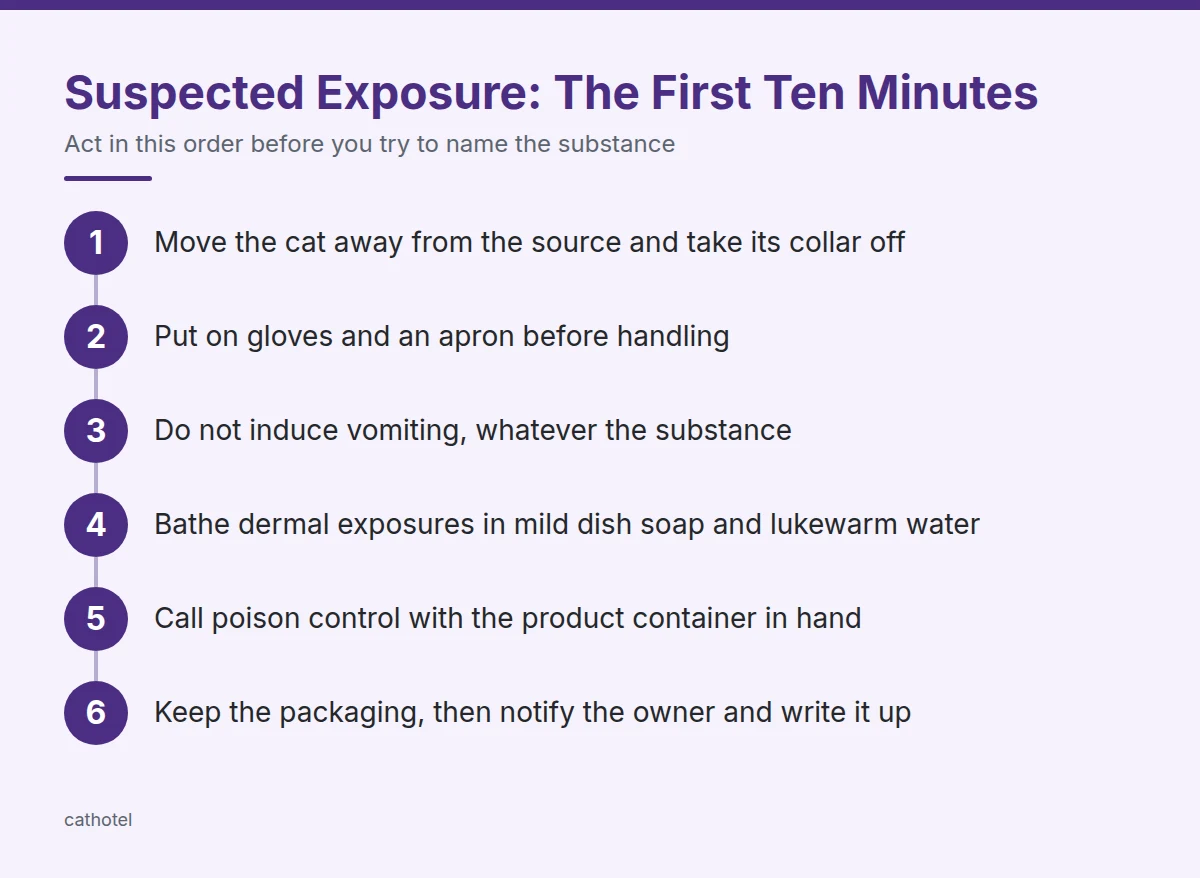
- Remove the cat from the source and move it somewhere clean and ventilated. Take the collar off, since it holds contaminant against the skin.
- Protect yourself. Gloves and an apron before handling, because most of these substances transfer readily from fur to human skin.
- Do not induce vomiting. Not for a corrosive, not for a petroleum product, and not on a cat generally. Leave that decision to a veterinarian.
- Decontaminate the coat if the exposure was dermal. Bathe with mild liquid dish soap and lukewarm water, avoiding eyes and ears, then rinse thoroughly until no residue remains. Towel dry, not blow dry.
- Call for advice while you work. The ASPCA Animal Poison Control Center is available around the clock on (888) 426-4435, and a consultation fee applies. Pet Poison Helpline is an alternative. Have the product container in hand so you can read the active ingredients and concentration.
- Keep the packaging and the label. Toxicology and diagnostic laboratories, including the veterinary diagnostic centres that run the panels described in our overview of lab tests in cat boarding, can identify household products and medications in a sick animal, but they work far better with a named suspect than a blind screen.
- Notify the owner immediately, then write the incident up while the details are fresh: product, concentration, route, estimated time of exposure, and everything you did.
The habit worth building is suspicion. If a cat presents with drooling and a sore mouth after a turnover, ask what it walked on before you assume it caught something. If a cat is tremoring in a mixed-species facility, ask what the dog next door was treated with. Chemical injuries look like infectious disease often enough that a facility which never considers them will keep misdiagnosing them.
What Owners Should Ask on a Tour
Four questions separate a facility that has thought about this from one that has not. Which disinfectant do you use, by product name? How long do surfaces dry before a cat goes back in? Do you run any diffusers or scented products in the cat areas? And how do you store and log medication for individual cats? A good operator will answer all four without hesitation, and if you are assembling a broader checklist, these sit naturally alongside the questions in our cat hotel fire safety guide.
Nothing here requires a bigger budget. It requires a named product, a timer, a dry suite, a locked cupboard, and a list on the wall.
Further reading (sources)
- Acta Veterinaria Scandinavica on a severe benzalkonium chloride poisoning in a cat and the wider VPIS case series
- Koret Shelter Medicine Program for dilution and contact times of accelerated hydrogen peroxide in animal housing
- VCA Animal Hospitals with which essential oils and potpourri products poison cats and how
- ASPCA Pro on telling nephrotoxic lilies apart and the 18-hour treatment window
- International Society of Feline Medicine for why permethrin dog products are contraindicated in cats
- Merck Veterinary Manual covering phenols and related compounds as disinfectants in animals
- Plumb’s with practical controls that cut veterinary medication errors
- ASPCA on decontaminating a pet at home after a chemical exposure