Boarding a Cat After Surgery: Can a Cat Hotel Handle Post-Op Recovery, and When Is Vet-Clinic Boarding the Safer Choice?
Published on October 28, 2026
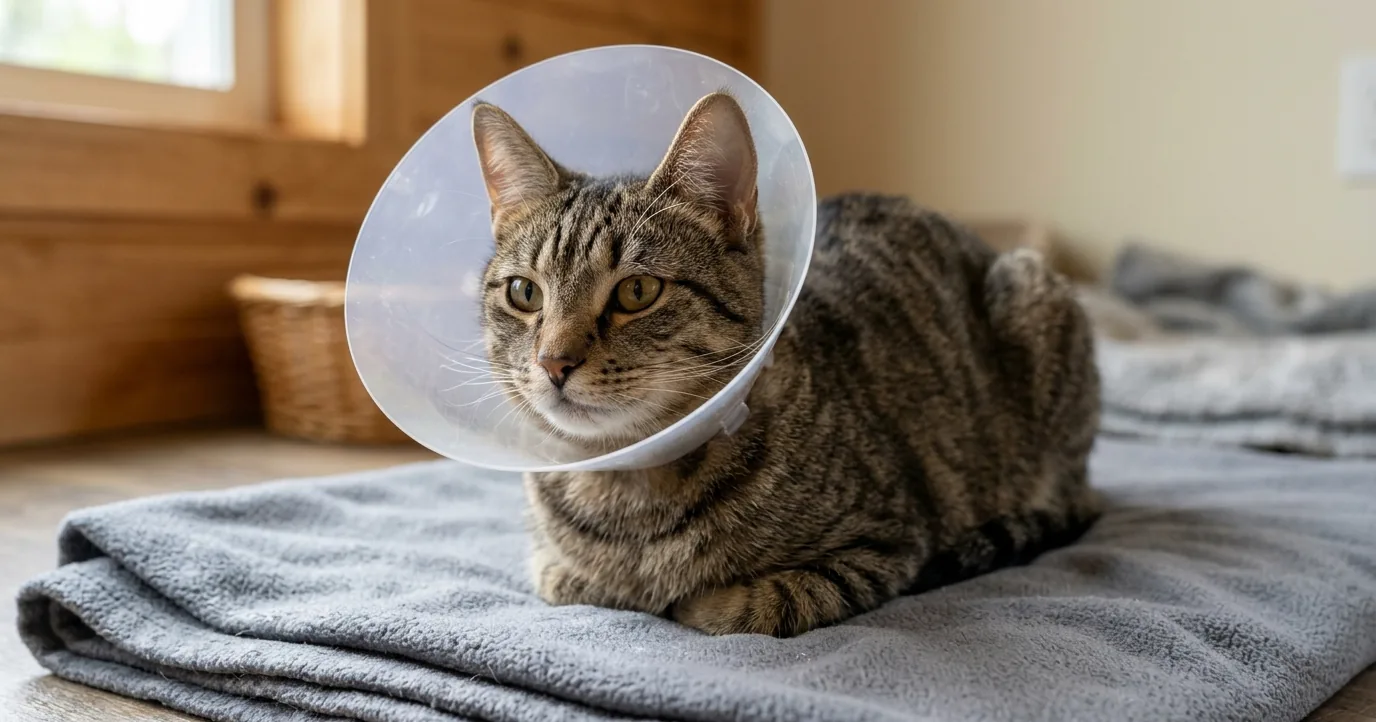
The timing is rarely anyone’s fault. The spay was booked weeks ago, and then a work trip landed four days after it. The vet found three teeth that need to come out, and the only free slot is the week before a family wedding. The lump was small, but the vet would rather not wait. Then comes the phone call to the cattery: can you take a cat with stitches?
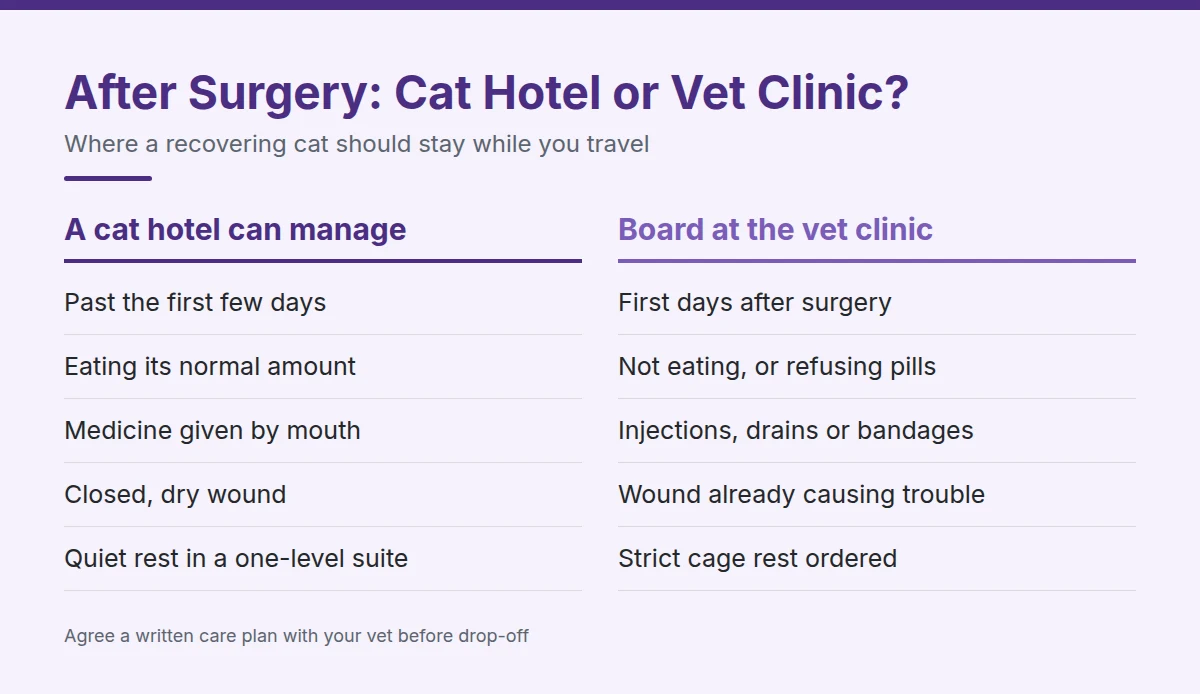
Often the honest answer is yes, but not yet. A good cat hotel can look after a cat in the later part of recovery, once it is eating, comfortable on medicine given by mouth, and has a closed, dry wound. It is the wrong place for the first few days, when pain relief is still being judged, appetite is returning and the wound is still fresh. This guide draws on the anesthesia, pain and dental guidelines of the American Association of Feline Practitioners (now the Feline Veterinary Medical Association) and the International Society of Feline Medicine (ISFM). It sets out where that line falls for common operations, what a non-veterinary facility can responsibly do, which signs staff must act on the same day, and the written plan to agree with your vet before drop-off. It covers the short recovery after a one-off operation. Long-term conditions such as kidney disease or arthritis raise different questions.
Why the First Days Belong to the Vet
Anesthetic risk comes early. The AAFP’s 2018 feline anesthesia guidelines report that 60 percent of anesthetic-related deaths in cats happen during recovery, especially in the first three hours. That figure traces to the UK’s Confidential Enquiry into Perioperative Small Animal Fatalities, which tracked 79,178 cats anesthetized or sedated at 117 practices. Postoperative deaths made up 61 percent of the anesthetic-related deaths in cats, and the authors concluded that better care after surgery could prevent some of them.
Those hours pass under veterinary watch. After routine neutering most cats go home the same day, and International Cat Care says most are back to normal by the following day. So the rule is simple: never drive a cat from the clinic straight to a cattery. Spend the evening after surgery at home, or leave the cat at the clinic. Body temperature can drift low or climb high for some hours after an anesthetic, and the guidelines want it watched.
Pain is harder to see. The 2015 pain management guidelines from the American Animal Hospital Association and the AAFP call post-surgical pain “eminently predictable” and name behavior change as the main way to detect it. That means knowing the cat’s normal. In an expert consensus on feline pain, Merola and Mills listed 25 reliable signs, among them hiding, a hunched posture, reluctance to move, not grooming, eating less and licking one part of the body. The panel noted that judging a change in feeding behavior needs extensive knowledge of how the cat ate before. A cattery meets your cat on drop-off day. Worse, a frightened cat in a new suite also hides, stops grooming and picks at its food, so early pain and boarding stress can look the same.
Pain relief also runs through the first week. The 2025 FelineVMA dental guidelines say three to seven days of pain relief, using more than one type of drug or method, is generally adequate after most dental procedures, with the response checked on a validated pain scale. If a dose turns out to be too low, only a vet can change it.
Appetite is the third risk. The dental guidelines warn that some cats stop eating after surgery, especially after extensive work such as full-mouth extractions. The ISFM’s guidelines on hospitalized cats that will not eat add that cats are prone to stress in a clinic, which can cut how much they eat, and that poor nutrition delays recovery and slows wound healing. A cattery is a strange building too, so a sore cat there faces both pressures at once. A cat that eats too little for too long also risks fatty liver disease, which our guide to cats that won’t eat at boarding explains.
How Soon Is Too Soon?
No guideline sets a minimum number of days between surgery and boarding. Treat what follows as a starting point, and adjust it with your vet, who knows exactly what was done.
- Castration. The skin incisions are so small that stitches are not needed, according to International Cat Care. A young tom who is eating well can usually board a few days later if his vet agrees. Tell the cattery anyway so staff keep an eye on the area.
- Spay. Stitches, where used, come out after seven to ten days, and Cornell’s Feline Health Center advises keeping the cat as quiet as possible for a week or so, so the abdominal incision does not herniate. Our kitten boarding guide gives the simplest rule: finish the spay at least two weeks before the stay, or book it for after you get back.
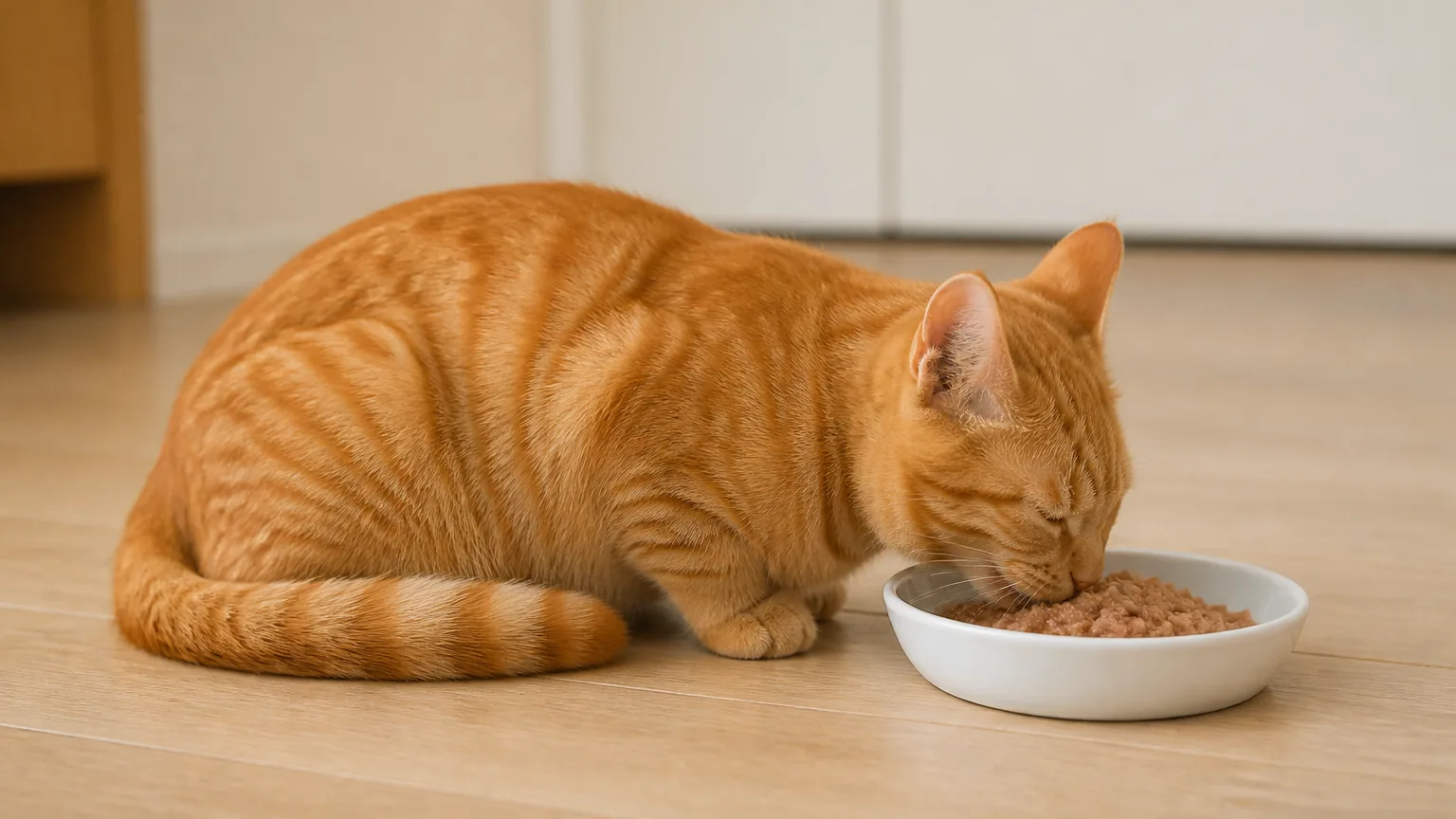
- Dental extractions. The first week carries both the pain relief course and the appetite risk. Board only once the cat is eating its usual amount of whatever food your vet recommends, and ideally after any recheck the vet has booked. After full-mouth extractions, plan on a longer gap or on the clinic.
- Lump removal. This varies more than anything else on the list. A small skin lump may heal much like a spay wound. A large mass, or one in an awkward place, can leave a drain or a bandage, and neither is cattery work. If tissue went to a laboratory, agree how you will hear the result while you are away.
- Major surgery. Abdominal surgery for a swallowed object, fracture repair, amputation or removal of an eye usually means several drugs, strict rest and sometimes a feeding tube. That belongs at the clinic, or calls for moving the trip.
What a Cat Hotel Can Responsibly Do
Once a cat is past those first days, a well-run cattery can do a great deal. These are fair things to expect, and to ask about before you book.
- Medicine by mouth, on schedule. Prescribed, labeled medicine given exactly as directed, with every dose logged. England’s licensing guidance for catteries requires prescribed medicines to be used as the vet instructs and every course to be completed.
- A single-level suite. Shelves, steps and hammocks out of reach, so a cat with an abdominal wound cannot leap. A compact suite is kinder here than a grand one.
- Room for the cone. In an owner survey by Shenoda and colleagues, 60 percent of pets had trouble drinking in an Elizabethan collar and 17 percent could not drink at all. About a quarter had a collar-related injury, mostly skin irritation but also collisions with walls and falls. The survey mixed dogs and cats, but the lessons carry over: wide shallow bowls, a low-sided tray, clear floor space and nothing for the rim to catch on.
- A wound check without handling. A look at least twice a day, compared against a photo you take on drop-off morning, tells staff whether anything has changed.
- A record of what goes in and comes out. Food offered and eaten, water, urine and stool, every day.
- An early call to your vet, and a ride there.
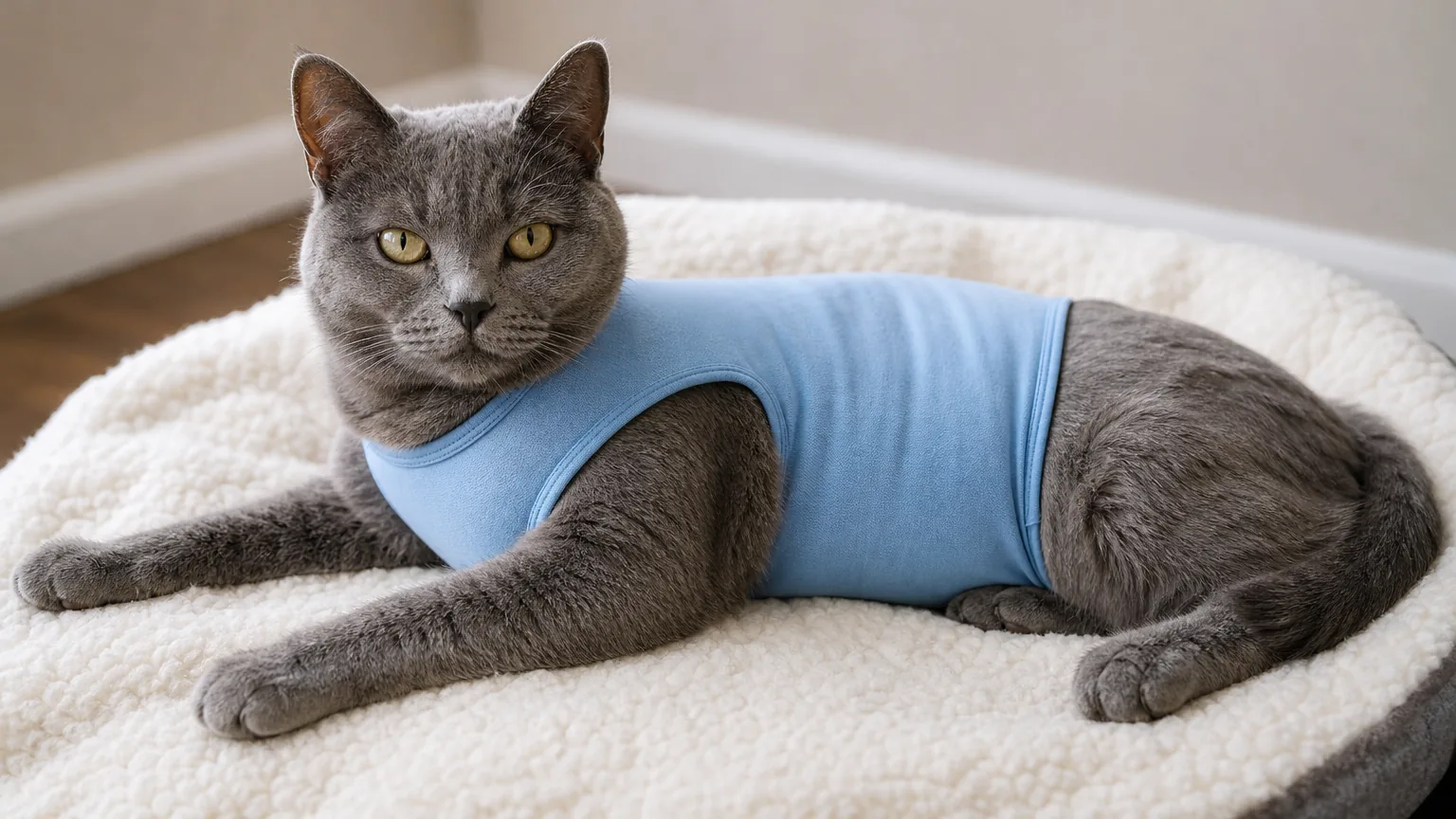
Ask your vet whether a surgical body suit could replace the cone. In a small 2025 trial after spays, cats in a body suit had the same pain scores as cats in cones, but 10 of the 13 coned cats shook their heads or pawed at the collar, and none of the 13 in suits did.
Staff can also learn to score pain. The Feline Grimace Scale rates five features of a cat’s face: ear position, how tightly the eyes are narrowed, muzzle tension, whisker position and head position. When Evangelista and Steagall compared raters, cat owners and veterinary nurses agreed closely with veterinarians, and a survey of 1,262 caregivers in 66 countries found their total scores had good reliability. A cattery that trains its team on the scale has a genuine tool. A high score still means a call to the vet, not a decision at the front desk.
What a Cat Hotel Cannot Do
- Change the plan. No one at a cattery can prescribe, adjust a dose or decide that a missed dose does not matter. That stays with the vet.
- Nursing work. Drains, dressings, feeding tubes and injected pain relief call for veterinary nursing skills.
- Watch all night. England’s minimum standard requires checks no more than three hours apart between 8am and 6pm. The higher standard adds a single check between 6pm and 8am, by a person or a camera. That schedule suits a healthy cat. A recovering cat that starts to bleed or strain at 9pm may not be seen until morning.
- Improvise pain relief. Nothing from the cattery’s own cupboard, ever. Cornell warns that aspirin, ibuprofen, acetaminophen and other over-the-counter medicines may be toxic to cats.
Red Flags: Call the Vet the Same Day
Every post-op plan should list the signs that mean a call to the vet that day, not a note for the owner at pickup. Your vet will add to this list for your cat.
- The wound. Swelling, spreading redness, any discharge, edges that have opened, or anything poking through. A cat licking or scratching hard at the site, or working its cone off. International Cat Care’s neutering advice singles out excessive licking or scratching and a wound that looks red or swollen.
- Food. England’s general rule asks for veterinary advice when a cat has had no appetite for 48 hours, and sooner for cats with known health problems. A cat a few days out of surgery is exactly that case, so agree a tighter trigger with your vet, such as no food at all in 24 hours. After dental work, also watch for dropped food, chewing on one side, drooling, pawing at the face or a swollen face, all signs the dental guidelines tell owners to report.
- The litter tray. Straining, crying in the tray, or no urine for 24 hours. Straining to urinate is on the experts’ list of reliable pain signs, and in a male cat it can mean a blocked bladder, which is an emergency. Our guide to urinary blockage at boarding covers what staff should look for.
- The whole cat. Hiding that does not ease, a hunched posture, reluctance to move, growling that is new, unusual quietness, repeated vomiting, or breathing with the mouth open, which the anesthesia guidelines associate with severe breathing trouble.
When staff suspect a cat is ill, England’s guidance requires them to contact a vet immediately, record the instructions and tell the owner. A good cattery anywhere works the same way.
The Written Care Plan
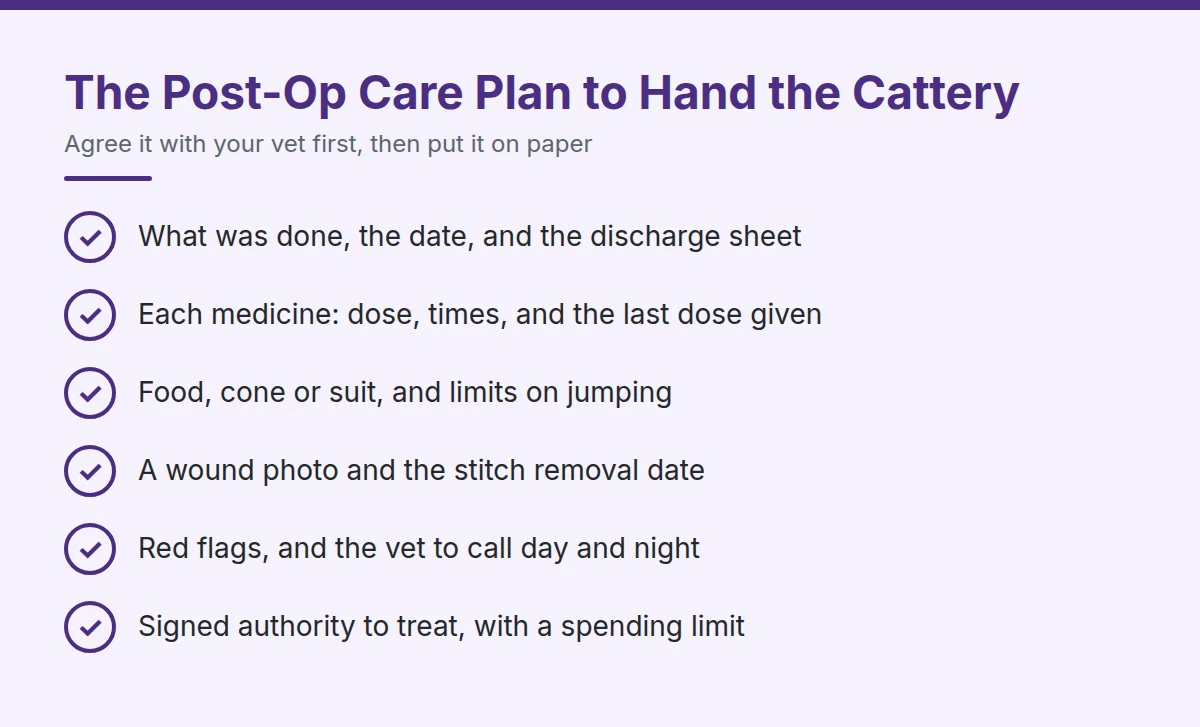
The 2015 pain guidelines describe pain management as a team effort that includes the owner. When you travel, the cattery joins that team, and the care plan is how it learns its part. Agree the plan with your vet first, then take it to the cattery on paper. A conversation at the desk on drop-off morning is not a plan. It should cover:
- The operation: what was done, the date, and a copy of the discharge sheet.
- Every medicine: name, dose, times, how to give it, when the last dose was given at home, and what to do if a dose is refused or brought back up.
- Food: what, how much and how often, including any soft-food period after dental work. Send the food with the cat.
- Activity: whether the cat needs a single-level suite, and for how long.
- Cone or suit: on at all times, or off only for supervised meals.
- The wound: a photo from that morning, what normal looks like, and when and where stitches come out.
- Triggers and contacts: the red flags above plus any your vet adds, which practice to call (ideally the one that did the surgery), its out-of-hours number, and how to reach you. England’s guidance already requires the owner’s written consent naming the vet the cattery will use.
- Authority to treat: written permission and a spending limit, so treatment is not delayed while staff try to reach you.
Pack a blanket or a worn T-shirt that smells of home as well. A recovering cat needs every source of calm it can get.
For cat hotels, the policy follows from all of this. Accept a post-op cat only with a vet’s note saying it is fit to board, plus a written plan. Give it the quietest single-level suite, away from the door, any sneezing cat and any dog. Name one person responsible for it on each shift, and price the extra time honestly. If the plan includes anything on the cannot list, say no and point the owner to the clinic.
When the Vet Clinic Is the Safer Choice
Board at the clinic, or rethink the trip, if any of these apply:
- the stay would start in the first few days after surgery
- the cat has a drain, a bandage or a feeding tube, or needs injections
- your vet has ordered strict cage rest
- the cat is not eating, or will not take medicine by mouth
- complications have already started
- the cat has another condition, such as kidney or heart disease, that your vet wants to watch alongside the recovery
Clinic boarding is not automatically better, though. Ask three questions before you agree to it.
Who is there overnight? The UK’s veterinary regulator, the Royal College of Veterinary Surgeons (RCVS), says owners should be told the level of supervision before they leave an animal at a practice, particularly outside normal working hours. Its guidance on continuity of care also anticipates some in-patients moving to a separate out-of-hours provider. Ask which arrangement applies to your cat.
Is there a cat ward? The ISFM and AAFP Cat Friendly Veterinary Environment Guidelines say cats should ideally be kept in a ward of their own, and that recovering cats belong in a warm, quiet area away from dogs and out of sight of other cats. Barking through the wall is no easier to bear at the vet than at a mixed kennel.
What will it cost? Ask for the daily rate in writing. The RCVS expects practices to tell clients what in-patient care will cost.
Two other routes are worth a thought. If the operation is elective, such as a routine spay or a planned dental, the simplest fix is often to move the date. And for a cat that copes badly away from home, a sitter who stays in your home may be the kinder option. Our comparison of an in-home sitter and a cat hotel weighs that choice.
When your cat does come home after a few days at a clinic, it will smell of the clinic, and a housemate may greet it with a hiss. Our guide to cats fighting after one comes home explains how to reintroduce them.
The Bottom Line
A cat hotel can care for a recovering cat once it is past the first few days, eating normally, comfortable on medicine by mouth and healing well. Before that point, or when the plan involves drains, injections or strict rest, a clinic with real overnight cover is the safer choice. Either way, agree a written plan with your vet, give staff clear triggers for picking up the phone, and never send a cat from the operating table to a cattery the same day.
Further reading (sources)
- Robertson and colleagues on the AAFP feline anesthesia guidelines, including when anesthetic deaths happen
- Brodbelt and colleagues with the CEPSAF study of anesthetic deaths in 79,178 cats
- Epstein and colleagues for the 2015 AAHA and AAFP pain management guidelines
- Lobprise and colleagues on the 2025 FelineVMA dental guidelines and pain relief after extractions
- Merola and Mills with an expert consensus on the reliable signs of pain in cats
- Evangelista and Steagall on how closely owners and nurses match vets on the Feline Grimace Scale
- Monteiro, Lee and Steagall for a global survey of caregivers scoring acute pain
- Taylor, Chan and colleagues on the ISFM guidelines for hospitalized cats that stop eating
- Shenoda and colleagues with what owners report about life in an Elizabethan collar
- Isil and colleagues for a trial of cones against body suits after spays
- Taylor, St Denis and colleagues on the ISFM and AAFP guidelines for cat friendly clinic wards
- International Cat Care about what to expect after neutering, from stitches to wound checks
- Cornell Feline Health Center for keeping a spayed cat quiet, and the painkillers to avoid
- Defra with England’s cattery rules on daily checks, appetite, medicines and sick cats
- Royal College of Veterinary Surgeons on telling owners how in-patients are supervised out of hours