Neighbours, Noise, and Planning Objections: Choosing a Site for a Cat Hotel
Published on September 29, 2026
In October 2025, after 15 months, two refusals and an appeal, a couple in St Lawrence, Jersey, won permission for a 13-pen cattery. Six weeks later, Moray councillors voted four to three to approve an eight-suite cat hotel in a Garmouth back garden that their own planning officers had refused. In February 2026 council planners approved a similar eight-suite block in a Norfolk village, and in June a Highland application was refused, not because of the cattery but because of the house planned beside it.
None of these decisions turned on the quality of the pens. Each turned on the land: what surrounds it, who walks the lane, and what planning policy says about building there. That makes the site the first real decision in opening a cat hotel, well ahead of suite design or booking software. This guide covers where a cattery is easiest and hardest to get approved, the noise, smell and traffic evidence that answers objectors, drainage, which objections carry planning weight, what to do after a refusal, and the risk that runs the other way: a noisy neighbour arriving after you. For everything else about opening a cat hotel, start with the founder’s playbook.
Read the Policy Before You Fall for the Plot
A boarding cattery is a business. The householder rules that let people put up a garden shed without an application only cover uses incidental to enjoying the house, so expect to need planning permission for any building that will take paying guests. Where the site sits decides which policies apply, and how hard the argument will be.
A garden in a village or town. Here the test is residential amenity: whether neighbours will suffer noise, disturbance or traffic they would not otherwise expect. The same kind of building can go either way. In Upwell, Norfolk, planners approved an eight-suite outbuilding in a resident’s garden. In Garmouth, officers refused a comparable block, then advised the council’s review body to do the same, describing it as “incompatible with the surrounding residential area” and of “poor design”. One councillor called it “the wrong location” in a conservation area. It won by a single vote.
Open countryside. In England, the revised National Planning Policy Framework, published in August 2026, lists the kinds of development that should normally be approved outside settlements. A rural business qualifies where it can show that a location outside a settlement is necessary, and so does the reuse of an existing building that is permanent, substantial and lawful. The framework’s rural business policy supports conversions and well-designed new buildings, but asks businesses to use previously developed land, or sites physically well related to existing development, where they can. Scotland’s National Planning Framework 4 likewise supports the diversification of existing rural businesses and the reuse of redundant buildings.
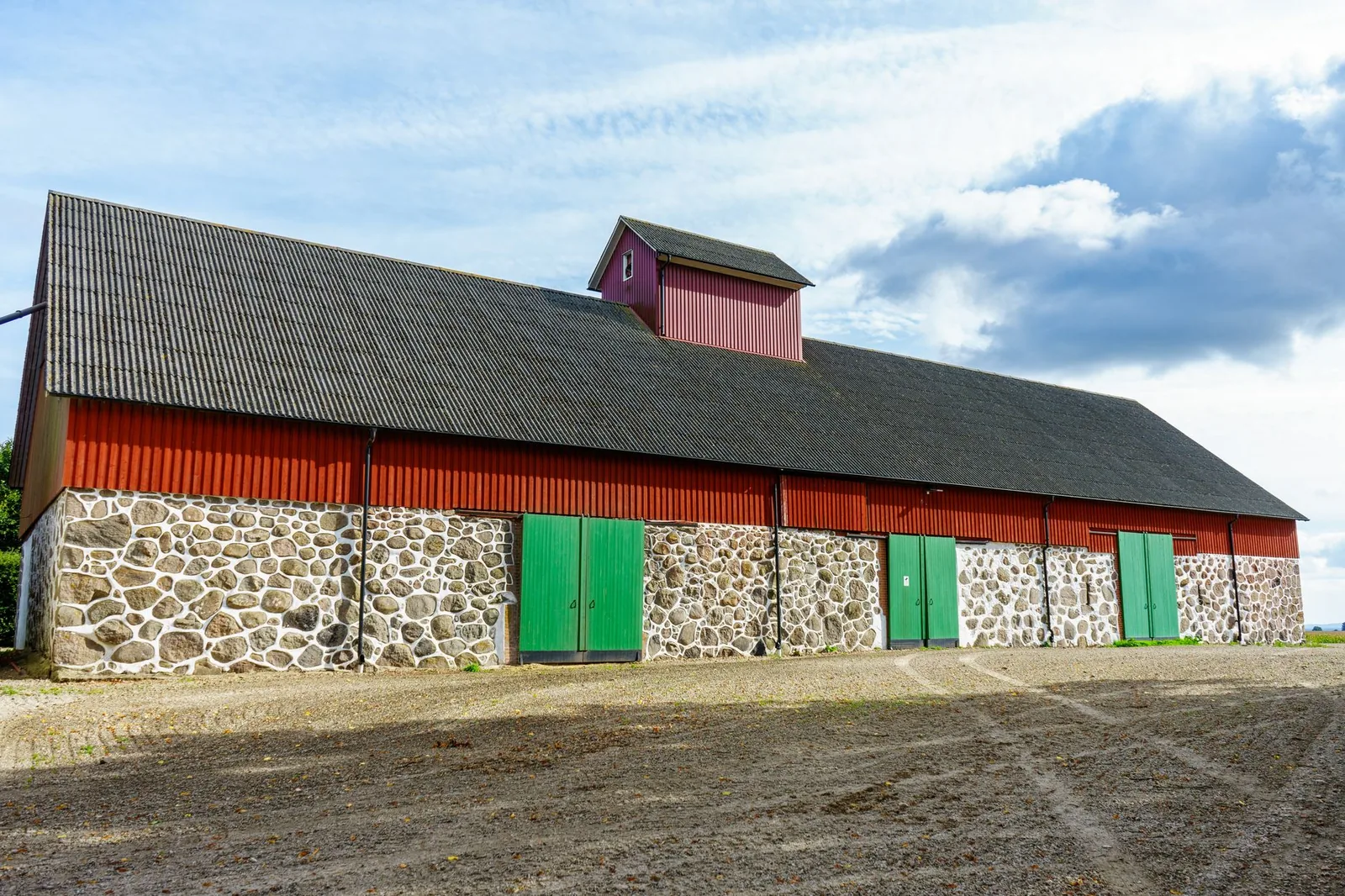
Green belt. This is the hardest ground. In England, development in the green belt is “inappropriate” unless it fits a listed exception, and inappropriate development should not be approved except in “very special circumstances”. The exceptions that matter to a cattery are the reuse of an existing permanent building, the redevelopment of previously developed land and, since the December 2024 revisions, “grey belt” land where, among other tests, there is an evidenced unmet need for that type of development and the location is sustainable. Scotland’s green belt policy supports a short list of uses, such as agriculture, outdoor recreation and tourism, and asks every applicant to explain why a green belt location is essential at all. In practice, a lawful stone barn or stable block to convert is worth far more than a pretty paddock.
The house. Many operators want to live on site, and with good reason, since someone needs to check the cats late at night. But a new house in open countryside is judged on its own merits. England’s framework supports isolated new homes only in narrow cases, the one relevant here being an essential need for a rural worker to live at or near their place of work, and Scotland’s rural housing policy uses a similar test. Near Tain in June 2026, Highland Council’s planners said a proposed cattery could be supported, but the house beside it was not “essential” to running it. The committee refused the application as “suburbanisation of the countryside”, even though no member of the public had objected. If you need to live on site, the simplest route is a site that already has a house.
In the US, the same questions arise under local zoning. Many codes treat a cattery as a kennel. San Diego County’s, for example, counts seven or more dogs or cats kept or boarded on a property as a kennel, and depending on the parcel allows one outright, only if fully enclosed, only with a minor or major use permit, or not at all. The same code requires daily waste removal to prevent offensive odour. Check the zoning, and the process it triggers, before you sign anything.
Noise and Smell: Answer With Evidence, Not Adjectives
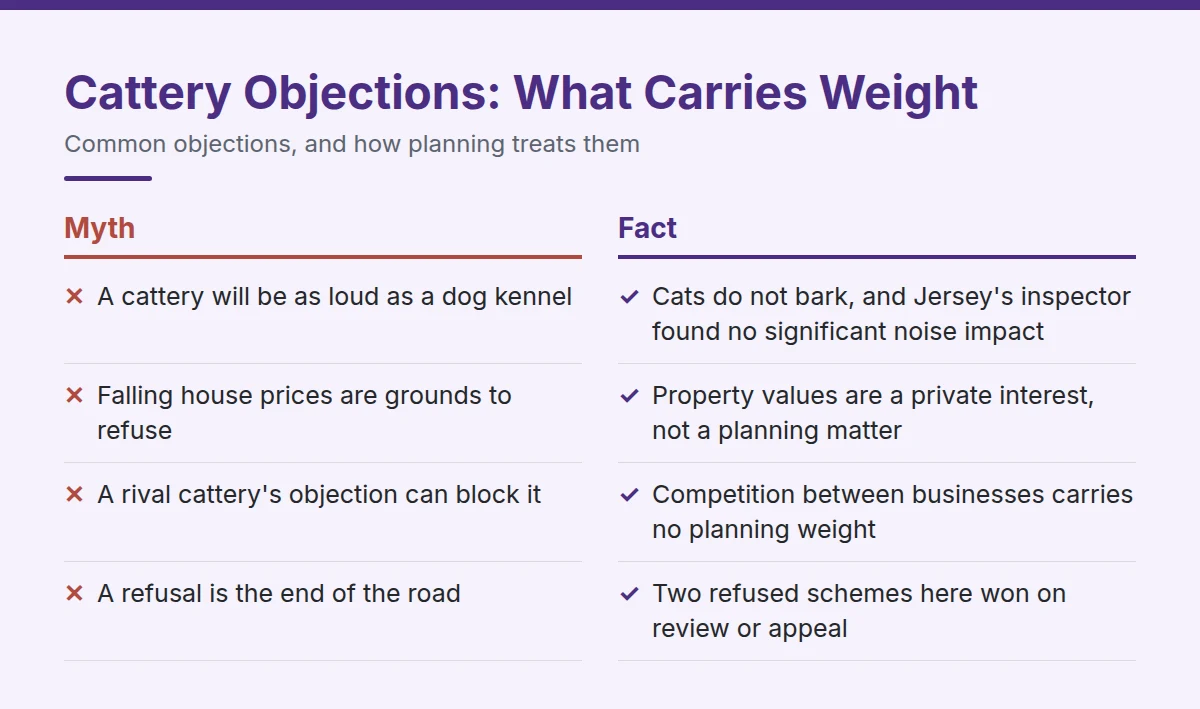
Neighbours imagining a boarding cattery usually picture a boarding kennel. Cats do not bark, and a cat-only site removes the sound most neighbours are really worried about. The Upwell application leaned on exactly that: the “quiet nature of cats”, and a promise to take no dogs.
What persuades a decision-maker is evidence. In Jersey the independent inspector concluded that the cattery was “unlikely to result in any significant impacts in respect of noise, disturbance, traffic, odours, vermin or waste disposal”. The Garmouth block had run for a decade at its previous site in West Sussex “with no issues or complaints” before being dismantled for the move north, which is exactly the kind of track record to put on paper. The Jersey applicants also cited a UK pen manufacturer’s figure of about 47 decibels for their building. Treat a figure like that as a starting point, not proof. Where noise is likely to be the fight, a site-specific assessment from an acoustic consultant is far harder to dismiss, and Scotland’s national policy says a noise impact assessment may be required where significant effects are likely.
Look honestly at what a neighbour would actually hear. It is rarely a cat. It is car doors at drop-off, voices, and the fans or heat pumps that hold suites within the temperatures licensing requires. Put that plant on the side away from the boundary and show it on the plans.
Smell comes from waste handling, not from cats, and the routine can be written into the application. In England, cattery licence conditions already require urine and faeces to go into a clearly marked bin that is emptied daily or when full, whichever is sooner, and stored away from food and animals. Describe the tray-change routine, sealed storage and a commercial waste collection, and specify impervious surfaces that do not hold odours; the Upwell application made that case for its UPVC building over traditional timber.
One siting rule is about welfare as much as planning. The same English conditions say cats must not be exposed to excessive or continuous noise, “such as dogs barking”. A plot beside a dog kennel or daycare is a poor cattery site whatever the planners think, and a mixed site needs real separation, which is one reason cat-only boarding keeps growing.
Access, Parking and the Trip Count
On a narrow rural lane, traffic is often the objection with the most traction. In Jersey, neighbours wrote about walkers, and about young children who had started using the lane on their own. Garmouth’s first refusal cited traffic alongside noise and visual impact.
Answer with numbers. The Upwell application promised visits by appointment only, 9am to 5pm Monday to Saturday, an average of one car a day, no commercial deliveries and no staff beyond the resident who runs it. The Garmouth plans limited drop-offs and pick-ups to the same hours and needed no outside staff. The Jersey applicants widened their driveway to take six vehicles, to reduce the need for parking on the road, and offered to collect and return up to half the cats themselves.
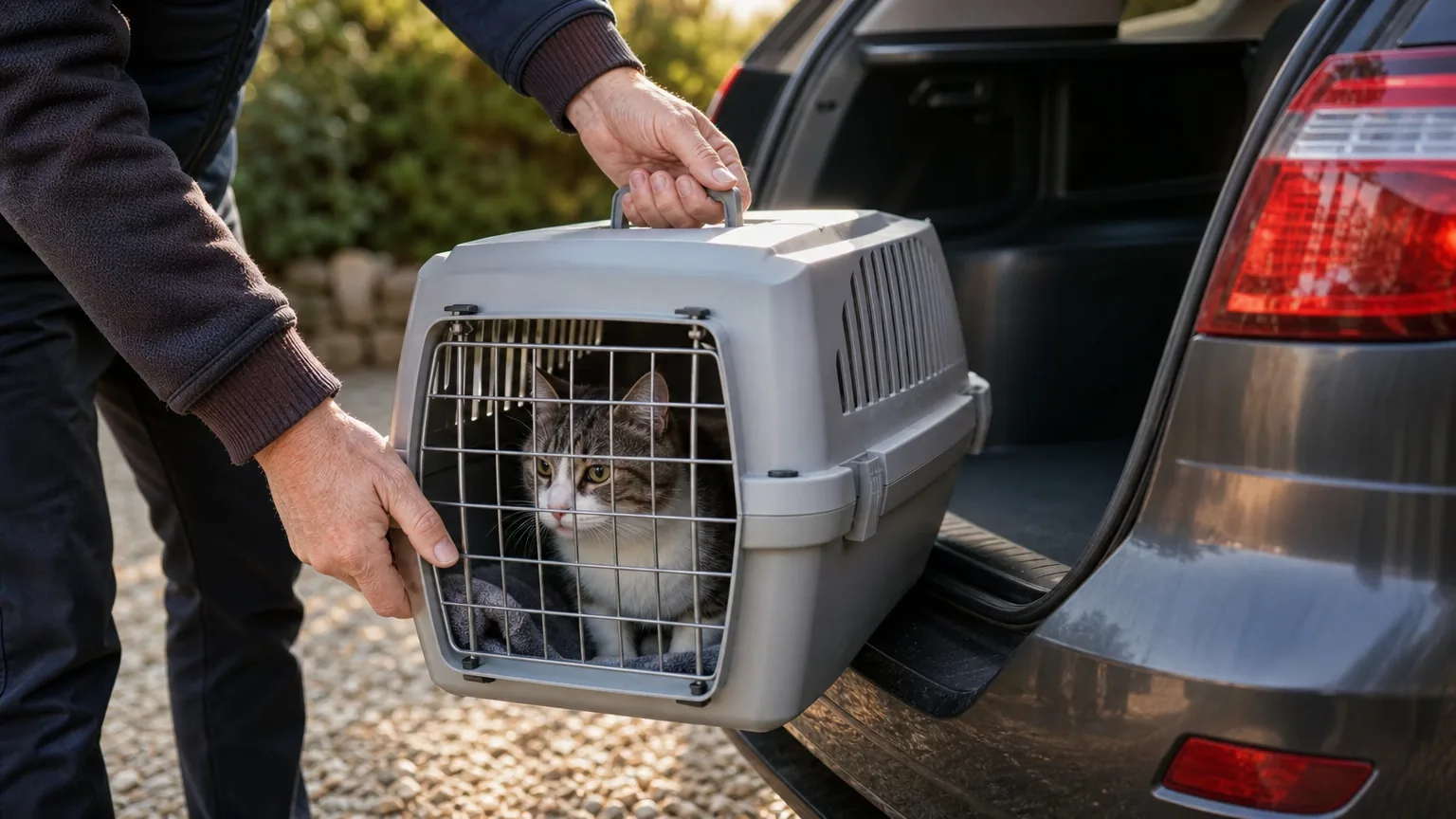
Then do the arithmetic for your own site. Eight suites turning over weekly means roughly eight arrivals and eight departures a week, two or three cars a day across a six-day week. Changeovers bunch up on busy holiday Saturdays, so show where cars will wait and turn. Opening hours, appointment-only visits and a cap on units are easy for a council to write into conditions, and offering them first shows you have thought like a neighbour.
Drainage and Waste Water
Planners treat the adequacy of sewerage and drainage as a material consideration, so settle it before you buy. Pen wash-down water carrying disinfectant is not ordinary household sewage, and a septic tank sized for a family home may not be allowed to take it. Where there is no public sewer, budget for a treatment plant and for the regulator’s rules on business effluent, which our guide to buying an existing cattery sets out for England and Scotland. Inside the units, English licensing guidance requires drainage that prevents pooling, advises a gradient of at least 1 in 80, and bars waste water from running into neighbouring units.
What Objectors Raise, and What Actually Counts
Across these cases the objections were remarkably consistent: the scale of a “commercial enterprise within a domestic back garden”, the loss of green land, traffic and pedestrian safety, noise and smell, and design in a sensitive setting.
Planning decides land use in the public interest, and that sorts objections into two piles. Noise, smell, traffic, highway safety, parking, design, landscape, heritage and drainage capacity are material planning considerations. So are the needs of the area. The government’s planning guidance for England says purely private interests, such as the effect on the value of a neighbouring property, could not be material. Planning Aid Scotland’s guidance adds loss of a view, competition between businesses, and issues covered by other legislation, such as licensing. So a rival cattery objecting that you will take its customers carries no planning weight, and neither does a neighbour’s worry about house prices. Welfare standards are a matter for the licensing inspector, not the planning committee.
Need deserves more effort than most applicants give it. The Jersey applicants showed that three island catteries had closed in five years as their owners retired, and that the last catteries approved were in 2013. Supporters wrote in too, including a retired cattery owner still fielding requests for recommendations. The inspector later found “evidence of demand for a cattery”.
Remember who decides. Committees are made up of elected members, and local feeling reaches them. Jersey’s committee refused the second application although its own officials had recommended approval, and Garmouth’s councillors split four to three. If your application goes to committee, ask to speak if your council allows it, and bring the numbers.
When the First Answer Is No
Three of the four applications in this piece were refused at least once, and two of those were later approved. The Jersey plans were rejected twice over the loss of green space and the building’s size and scale, and a retaining wall and concrete deck built without permission did not help: one committee member said they seemed “deliberately designed to accommodate the cattery”. The couple won on appeal after an independent inspector found the building would be “entirely hidden from public view”. It took 15 months, and the applicants said “the stress and financial implications” of the delay “should not be underestimated”. Garmouth’s refusal was reversed by the council’s local review body, the Scottish route for challenging a decision made by officers.
Three lessons follow. Build nothing before consent, because work done in advance reads as presumption and still has to be regularised. Budget time and money for a second round, including an appeal. And treat a refusal notice as a brief: each reason for refusal is a question your next submission must answer with evidence.
The Other Direction: What Could Arrive Next Door
Shetland’s only boarding cattery had been running for 40 years, licensed for 70 cats, when the business next door began shredding old salmon-farm pipes in October 2022. The owner described the noise as “continuous, loud oppressive thunder interspersed with loud bangs”, often until 8pm, and said many of the cats stopped eating while it ran (a boarding cat that stops eating is a serious problem in its own right). The firm had consent to store plant and materials on the former glasshouse site for five years, but not for industrial processing, and it stopped shredding once told it had no permission for that. It then planned to apply for permission to shred there. The owner objected, customers wrote to the council, so did a national trade body for catteries and kennels, and she warned she was likely to go out of business if the noise continued.

Before you commit to a site, study the land around it as hard as the land you are buying:
- the planning history of neighbouring plots, including temporary and unbuilt permissions
- land allocated in the local plan for employment, waste or minerals nearby
- empty yards, derelict glasshouses and other brownfield land that invites industrial reuse
- neighbouring farmland, where agricultural buildings can often go up under permitted development rights with only a limited prior approval check
Planning policy gives an established business some protection. England’s framework says existing businesses should not have unreasonable restrictions placed on them because of development approved after they were established, and puts the burden of mitigation on the newcomer, the “agent of change”. Scotland’s framework applies the same principle to noise-sensitive development. That shields a cattery against, say, new houses whose residents might later complain about it. It fits less neatly when the newcomer is the noisy one, because the standard British method for rating industrial and commercial sound, BS 4142, assesses its effect on people in or around homes, not on boarded cats. If you live on site, your house is a receptor, so put it at the front of any objection. Then spell out the welfare and licensing consequences: in England, cats must not be exposed to excessive or continuous noise, so a neighbour’s noise can threaten your ability to meet your licence conditions.
Recourse runs in rough order:
- Object to the application on material grounds, and if refusal looks unlikely, ask for conditions such as enclosed processing, restricted hours or acoustic screening.
- Report unauthorised activity to the council’s planning enforcement team. In Shetland, the shredding stopped once the firm was told it had no permission for industrial processing.
- Complain to environmental health. Noise emitted from premises can be a statutory nuisance, and councils must take reasonably practicable steps to investigate complaints from people living in their area.
- In England and Wales, take legal advice on private nuisance. The Supreme Court has held that a planning permission does not take away a neighbour’s right to object to what would otherwise be a nuisance, although its terms can be relevant.
The same judgment carries a warning for anyone still choosing a site. Moving in beside an existing activity is not, on its own, a defence for the noisy neighbour. But the court said a defence may exist, at least in some circumstances, where it is only because the claimant changed the use of their own land that the neighbour’s existing activity has become a nuisance. Turning a paddock beside a working yard into a cattery could be exactly that, so check the neighbours before you buy, not after.
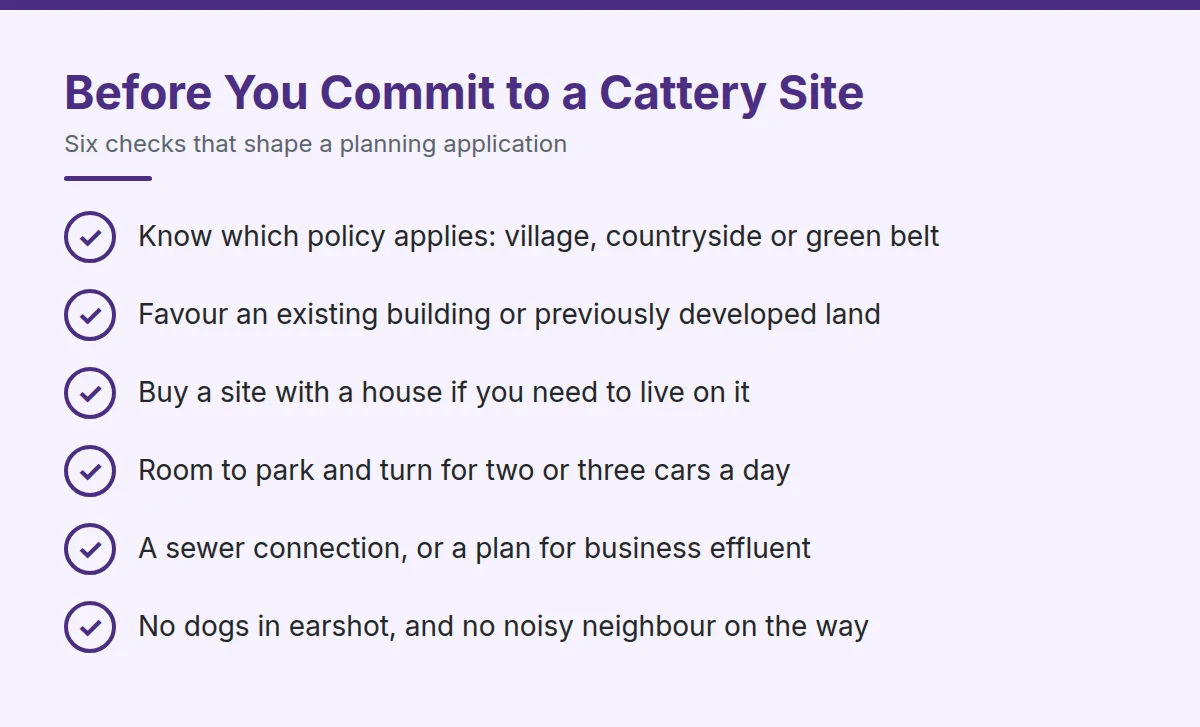
A cat hotel is judged by the ground it stands on long before anyone judges its suites. Choose a site a planning officer would read as sensible: an existing building or previously developed land, a lane that can take a few cars a day, no dogs within earshot, an answer on drainage, and neighbours whose plans you have checked. Then put numbers where objectors expect adjectives.
Further reading (sources)
- Bailiwick Express on the objections to a 13-unit cattery in St Lawrence
- Jersey Evening Post reported the second refusal, against officials’ advice, and the unauthorised retaining wall
- Bailiwick Express with the inspector’s findings on noise, odours, traffic and demand
- STV News on why the Garmouth cat hotel was first refused, and its decade without complaints
- Forres Gazette reported the local review body’s four to three vote
- Eastern Daily Press for the Upwell application’s visiting hours, trip numbers and odour claims
- Lynn News on West Norfolk planners approving the Upwell outbuilding
- Ross-shire Journal on a cattery and house near Tain refused because the house was not essential
- Shetland News with a cattery owner’s objection to pipe shredding next door
- Ministry of Housing, Communities and Local Government for the 2026 framework’s policies on the countryside, green belt, isolated homes and the agent of change
- Planning Practice Guidance explains why private interests such as property values are not material considerations
- Planning Aid Scotland lists what is and is not a material consideration
- Scottish Government sets out NPF4 policies on green belts, rural homes, noise and rural development
- Defra on cattery licence conditions for noise exposure, waste storage and unit drainage
- BSI describes what BS 4142 assesses and whose exposure it measures
- Environmental Protection Act 1990 for the statutory nuisance list, including noise from premises
- UK Supreme Court with its summary of Coventry v Lawrence on planning permission and nuisance
- San Diego County on when a kennel is allowed and what its zoning code requires