Boarding an Overweight Cat: Suite Access, Grooming Help, and Keeping the Diet on Track
Published on October 3, 2026
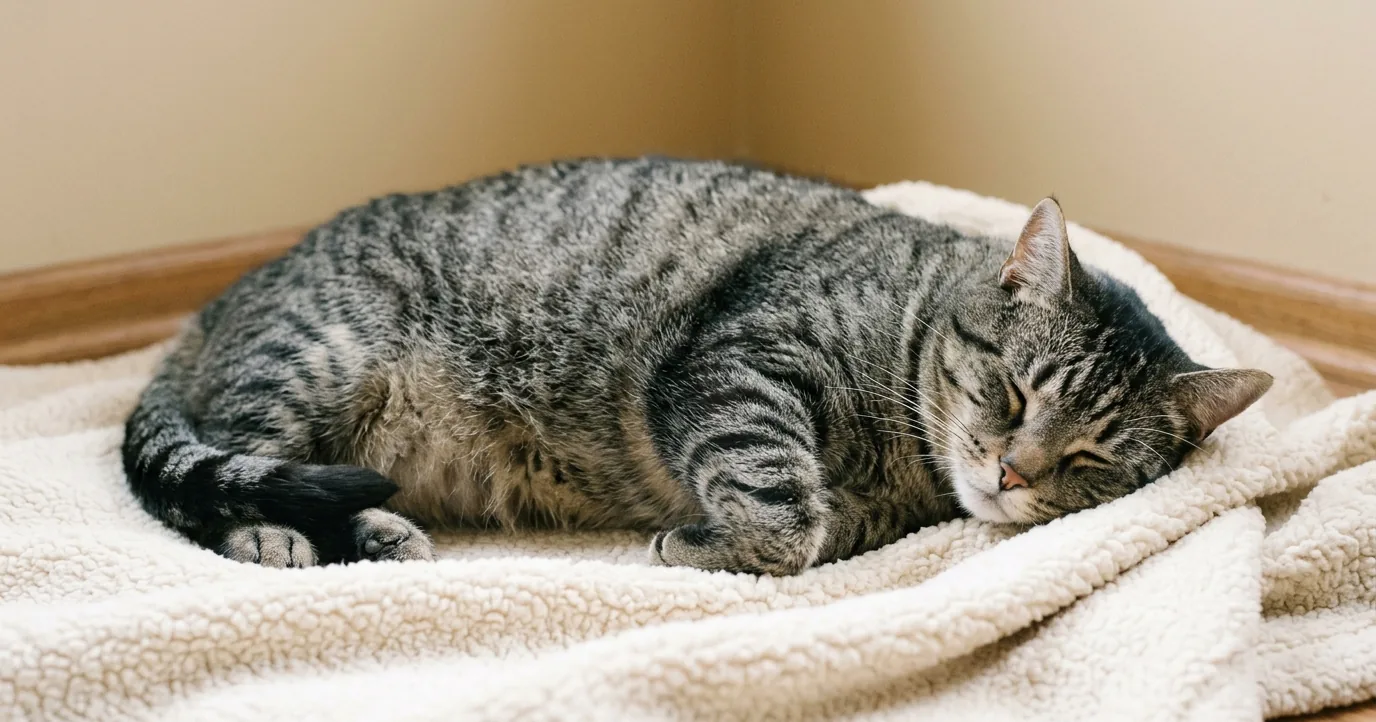
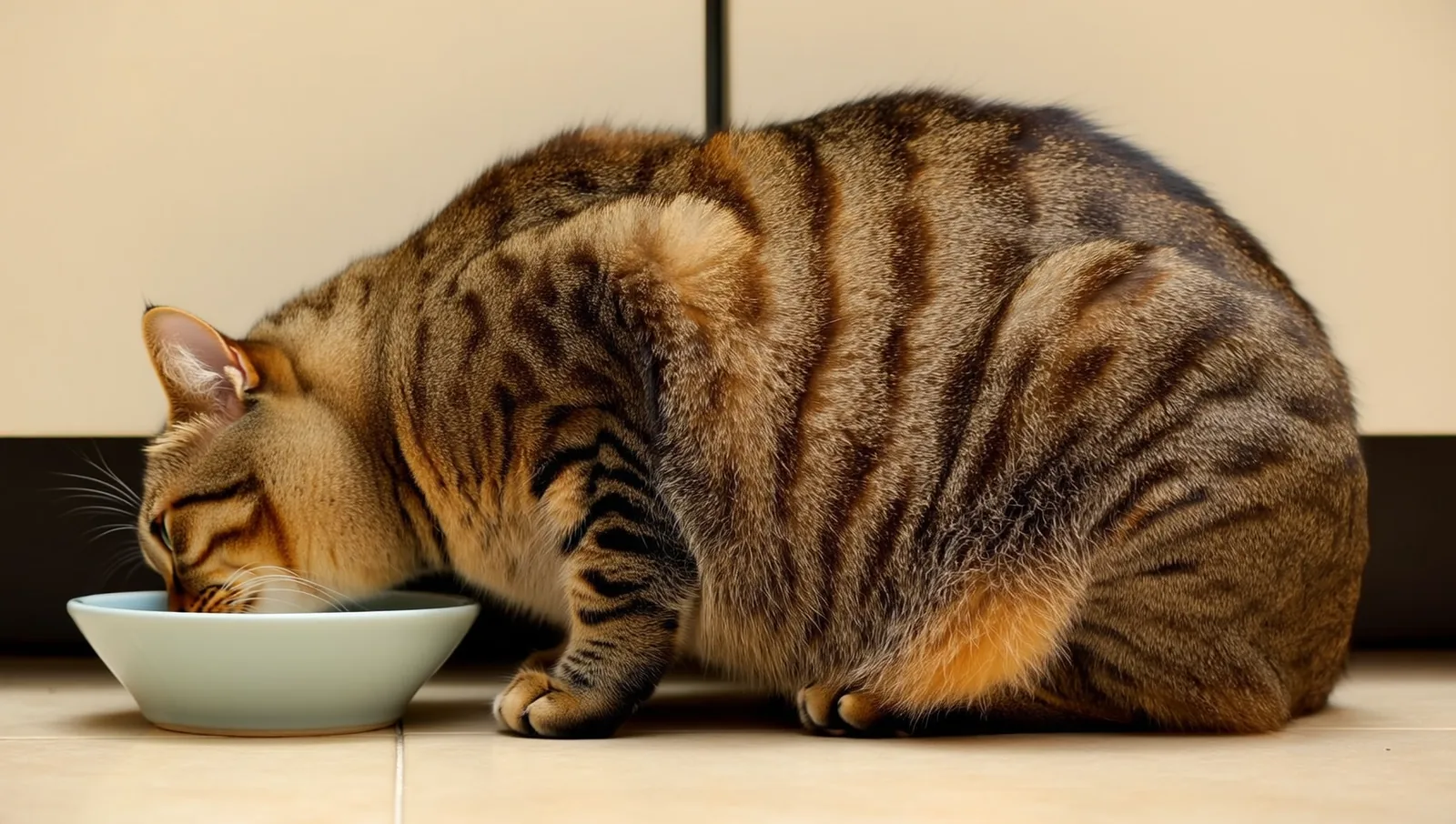
Catster recently profiled a sanctuary that takes in only severely overweight cats, and its opening lines describe that body better than any clinical definition: walking is exhausting, stairs feel impossible, and grooming is simply out of reach. Those cats sit at the far end of a very crowded scale. When Royal Veterinary College researchers went through a random sample of 18,249 UK cats in veterinary care in 2019, obesity was the second most commonly recorded disorder, at 11.6 percent, behind only periodontal disease. That counts only the cats whose vet wrote the word down.
A standard cattery suite is designed around a lean, athletic cat. The bed is on a shelf, the run is through a flap, the tray has a lip to step over, and the enrichment assumes a cat that wants to leap. For a heavy cat each of those is a small daily obstacle, and a stay of a week or two is long enough for small obstacles to become a sore joint, a matted back, or a diet that quietly falls apart. This guide is for both sides of the booking: owners choosing a suite, and operators kitting one out. It covers access, grooming, heat, play, and the prescribed diet, with a short section on fatty liver risk at the end.
What Extra Weight Changes
Cornell’s Feline Health Center defines feline obesity as body weight 20 percent or more above normal. On the nine-point body condition scale most vets use, 5 is ideal and 8 or 9 is severely overweight or obese: ribs you cannot feel under the fat, heavy deposits over the lower back, no visible waist.
The weight matters at boarding because of what comes with it. In a Cornell study that followed 1,457 cats for four and a half years, obese cats were 4.9 times as likely as cats of optimal weight to need veterinary care for lameness, 2.3 times as likely to develop non-allergic skin conditions, and 3.9 times as likely to develop diabetes. A Sydney study of a decade of clinic records found that cats scoring 7 or more on the nine-point scale had higher odds of arthritis, skin disease, respiratory conditions and asthma, among others.
Read those findings as a suite brief. Lameness means the cat should not have to jump. Skin trouble means somebody has to groom it. Breathing trouble means heat matters more. And diabetes means a heavy cat may arrive with insulin, which is a medication question before it is a suite question; the medication checklist in our guide to boarding a senior cat applies at any age. If your cat has a diagnosed condition, or has not been weighed by a vet in the last year, a check-up before you book is worth more than anything else on this page.
The Suite: Trays, Flaps, and Steps Instead of Leaps
England’s statutory guidance for licensed cat boarding is the most detailed published standard on suite construction, and it makes a useful baseline wherever you are.
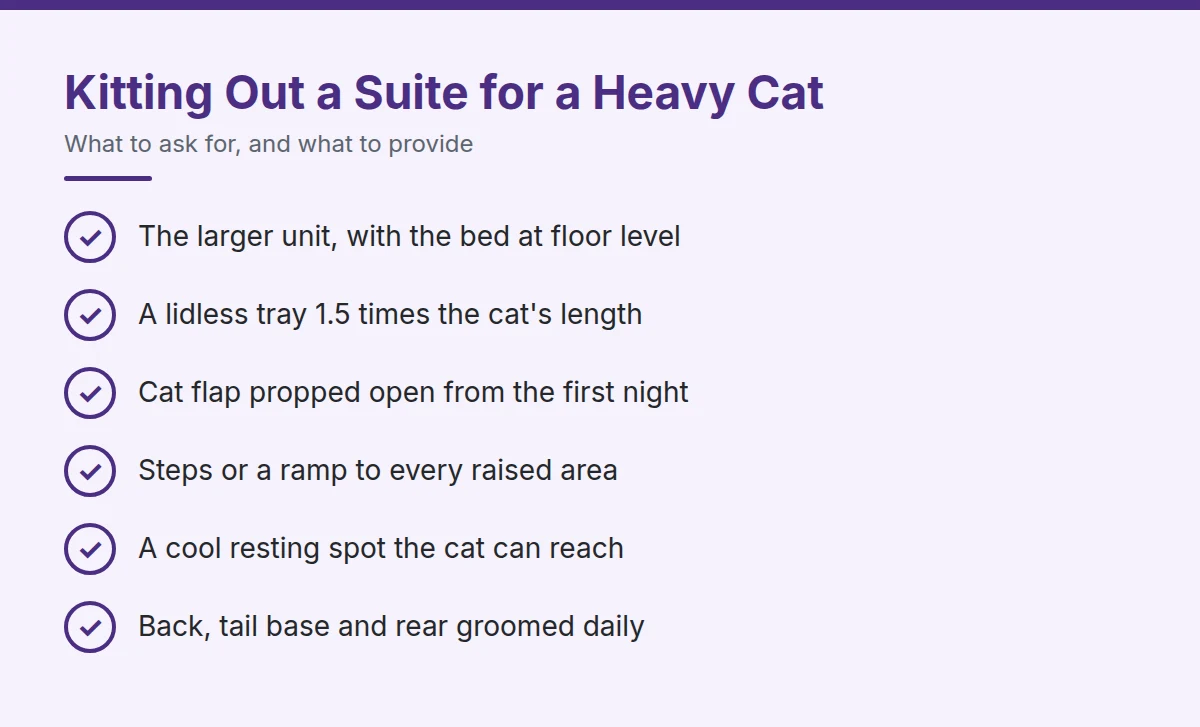
The litter tray. The legal minimum in England is a tray large enough for the cat to turn around in, at least 30 by 42 centimetres. Treat that as a floor, not a target. The University of Illinois veterinary teaching hospital puts the rule of thumb at one and a half times the cat’s length from nose to the base of the tail, and notes that many commercial boxes are too small. A big cat needs a big tray with a low way in: Illinois suggests a low-sided concrete mixing tray or a storage box, with one side cut down for a cat that struggles to step in. Skip the hood. Lidded boxes can make cats anxious, and for a heavy cat the doorway in a hood is the narrowest point of the whole tray. The English guidance also requires 60 centimetres between tray, bed and food, so a properly sized tray is one more reason a heavy cat needs the larger unit.
The flap. In a unit with a sleeping house and a run, the two connect through a cat flap, and the English guidance requires it to be suitably sized and capable of being securely propped open. For a heavy cat, prop it open from the first night. International Cat Care gives the same advice for stiff, arthritic cats: tie the flap open so the cat does not have to push through. A cat that cannot get through the flap easily spends the stay on one side of it, and that may be the side without the tray. If the flap sits above floor level, check the step up to it as well.
Steps, not leaps. Every unit in England must include an elevated area big enough for a cat to lie on, and the guidance goes further: there must be safe, easy access to elevated areas for any elderly, ill, very young or disabled cat. A cat too heavy to jump safely belongs on that list in all but name. Heavy cats like a lookout as much as any other cat, so the answer is not to remove the shelf but to build a staircase to it, a series of steps or a ramp as International Cat Care recommends for arthritic cats, so every move is a short step up. Do not forget the way down. International Cat Care lists reluctance to jump down, not just up, among the signs of arthritis, and a heavy cat dropping off a high shelf lands with the most weight behind it. Cover steps and ramps in carpet or another grippy surface; English rules already require non-slip floors.
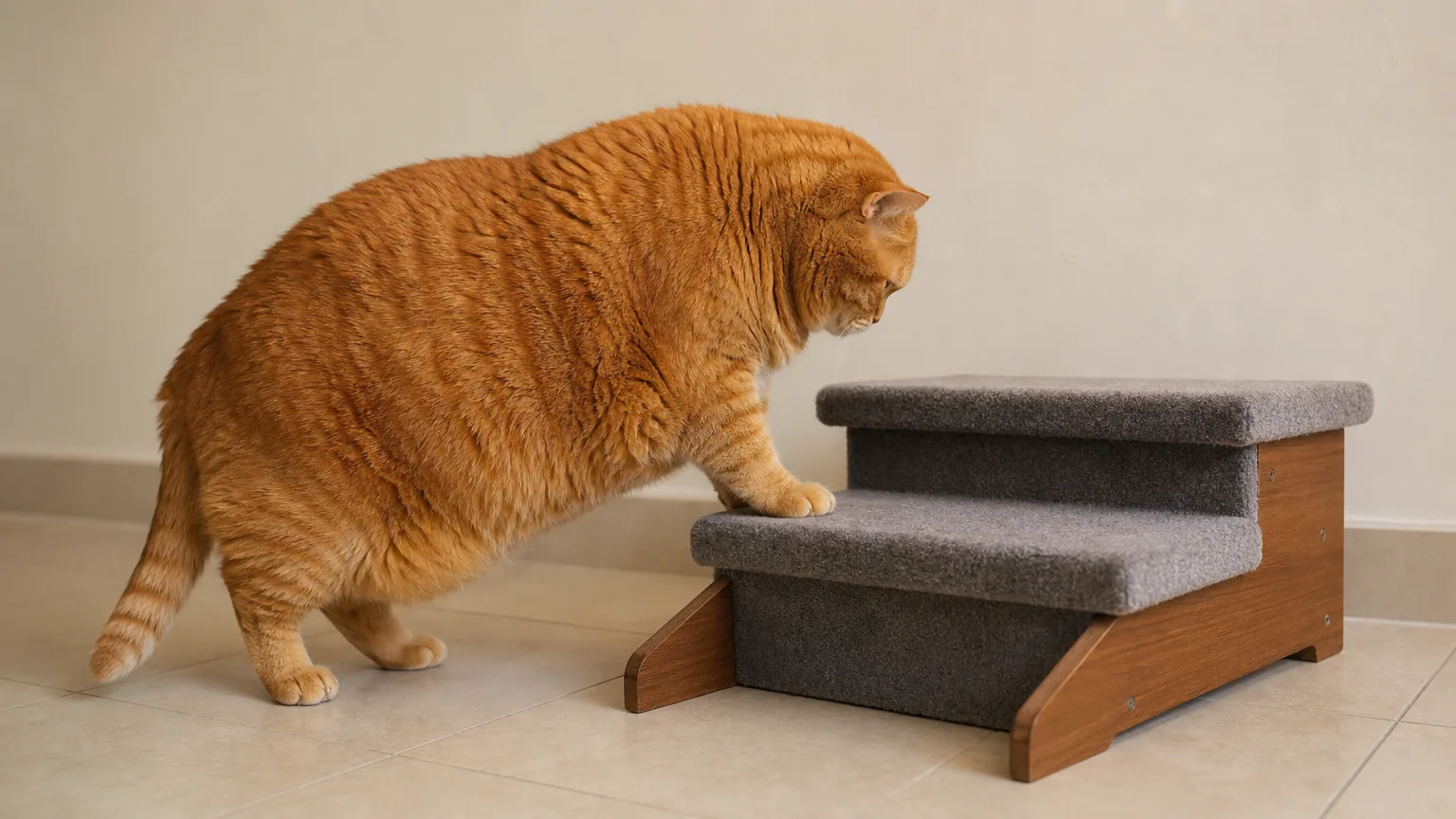
The bed and the space. The English rules require a unit big enough for the cat to lie fully stretched out without touching its walls, and soft bedding adapted where needed for old, young or infirm cats. A heavy cat stretched out takes more floor than the average guest, and older catteries are still allowed one-cat units built to the old, smaller sizes. Ask for the larger unit even for a single cat, put the bed at floor level, and skip any igloo bed whose entrance is a squeeze. A bigger suite usually costs more, one of the line items covered in our cat boarding cost guide.
Grooming the Parts a Heavy Cat Cannot Reach
A healthy cat grooms by folding itself almost in half to reach every part of its coat. A heavy cat cannot fold that far. When Cornell first announced the results of that study in 1997, the researchers’ explanation for all that extra skin disease was simply that obese cats cannot reach all parts of their bodies to groom themselves properly. The unreached areas are predictable: the lower back, the base of the tail, and the rear end. Expect scurf and greasy or matted fur along the spine, and soiled fur under the tail that the cat cannot clean for itself.
England’s guidance treats grooming as part of a boarded cat’s routine health care, including keeping long fur from matting. For a heavy cat, grooming moves from optional extra to daily care, and it belongs in the booking:
- Brush the lower back, flanks and tail base every day, in short sessions that end before the cat objects.
- Check under the tail on every round, and clean soiled fur gently with a damp cloth before it irritates the skin.
- Leave mats that sit close to the skin to clippers, a groomer or the vet. Scissors and a matted cat are how skin gets cut.
- Check the claws at intake. A cat that moves and scratches less wears its claws down less, and International Cat Care warns that in less active cats they can overgrow and curl into the pad. A flat or low scratcher suits a cat that cannot stretch up a tall post.
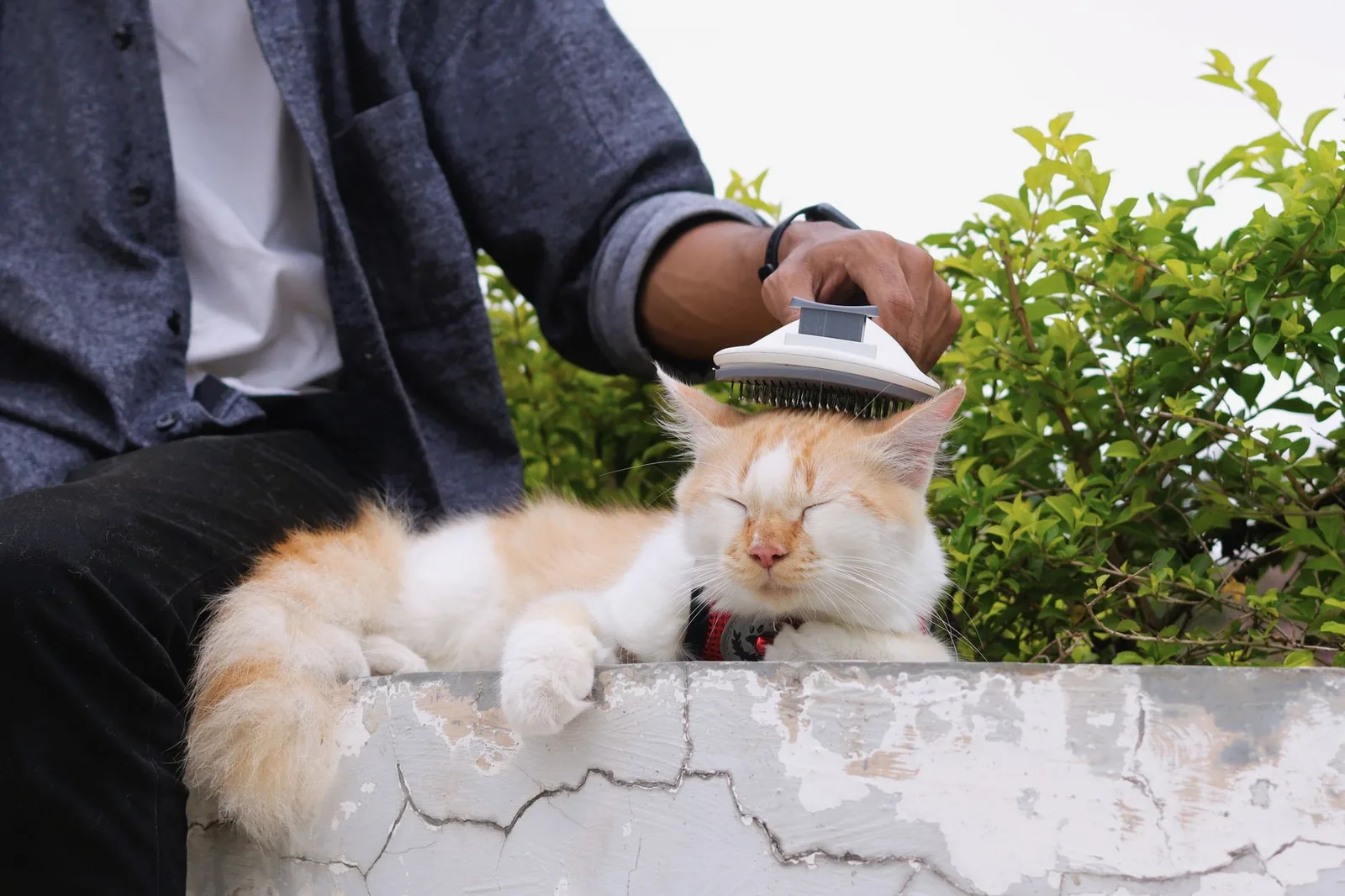
For a long-haired heavy cat, a hygiene trim from a groomer a week or so before the stay saves discomfort later. Do not book it for the day before, because two stressful handling sessions on consecutive days are a poor start to a boarding stay. And when staff do need to lift a heavy cat, one hand goes under the chest and the other under the hindquarters, so the weight never hangs from the front end. Grooming on the floor or a low bench beats lifting the cat onto a table twice a day.
Heat: Why a Warm Cattery Is Harder on a Heavy Cat
Cats barely sweat. PDSA, the UK veterinary charity, explains that they control their temperature by licking themselves and seeking shade, and it names obese cats among the most at risk of heatstroke, alongside long-haired, elderly, very young and flat-faced cats, because they find it harder to cool down. Put the grooming problem next to that and the logic is uncomfortable: the cat that cannot reach its own back is short of one of its two cooling tools. A heavy, long-haired, flat-faced Persian carries three of those risk factors at once.
The English guidance requires some part of the sleeping area to stay between 15°C and 26°C, never dropping below 10°C, and premises meeting the higher standards must keep the sleeping area between 18°C and 26°C. Runs must filter UV light and provide enough shade, and the optional higher standard is managed ventilation (air conditioning or fans) that holds the temperature in all weathers. For a heavy cat, an operator can do more than the minimum:
- Put heavy cats in the coolest units: shaded, out of the afternoon sun, and away from large panes of glass.
- Make sure the cool spot is one the cat can reach. Warm air rises, so the high shelf is often the warmest place in the unit.
- Switch heat pads off in warm weather. The rules say a cat must be able to move away from a heat source, and for a heavy cat that means the pad sits somewhere it can step off, not on a shelf it struggles to climb down from.
- Keep fresh water in more than one place.
PDSA’s list of heatstroke signs starts with panting and fast breathing. A cat panting at rest is not a dog catching its breath. Cool it and call the vet.
Play for a Cat That Tires Fast
Be realistic about what play can do. Cornell’s Feline Health Center, summarising a review of the evidence, notes that exercise programmes for weight loss in cats have not been fully evaluated, and that the authors judged extra activity unlikely to make a significant difference for most indoor cats, largely because owners struggle to keep it up. Either way, the diet does the heavy lifting. Over a two-week stay, play is for joints, muscle and boredom, and the English guidance requires opportunities to exercise unless a vet advises otherwise.
What works for a heavy cat is short and low. Drag a wand toy along the floor for a few minutes at a time, two or three times a day; the pounce is the exercise, not the leap. Stop when the cat lies down, or at the first sign of open-mouth breathing. Skip any game that ends in a high jump and a heavy landing.
Meals can do some of the work. In a University of Illinois study, cats fed the same daily ration as four meals were more active than cats fed it as one, and a follow-up in young female cats found the same. Both groups were lean cats, so treat this as a nudge rather than a plan, but it is a free one: the English guidance already requires at least two meals a day at least eight hours apart, and splitting the same ration into three or four costs nothing.
Puzzle feeders are the obvious next step, with one caution. International Cat Care advises introducing them gradually, keeping part of the daily allowance in a bowl while the cat learns. A cattery is the wrong place to learn. A stressed cat faced with an unfamiliar puzzle holding its whole ration may simply not eat, and in a heavy cat, not eating is the one outcome that matters more than the diet. Use a feeder the cat already knows from home, or save puzzles for after the stay.
Holding a Prescribed Diet Steady
A good weight-loss plan is slow by design. In a University of Liverpool follow-up of 26 obese cats that completed a clinic weight-loss programme, the cats lost weight at a median of 0.6 percent of body weight a week, over a median of 204 days. Cornell suggests aiming for perhaps one or two percent a week. A two-week stay lands somewhere in the middle of that, and there are two ways for it to go wrong.
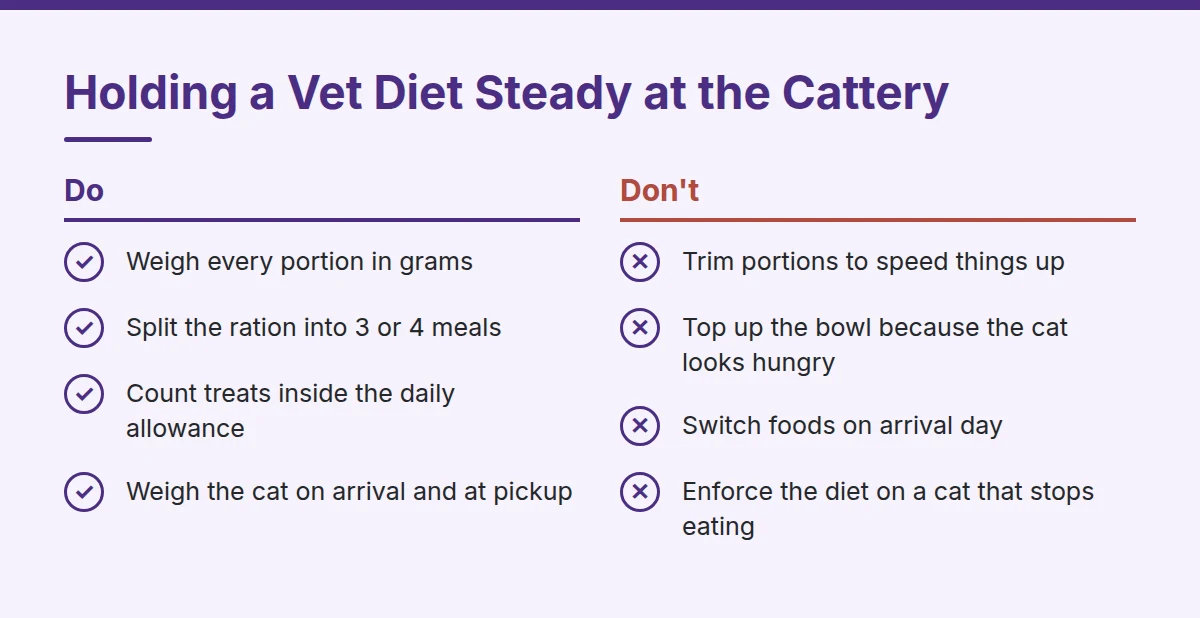
Crash-dieting. Well-meaning staff who see a fat cat and trim the portion are doing harm. Cornell warns that a cat put on a sudden starvation diet is at risk of hepatic lipidosis. The weight-loss plan belongs to the cat’s vet, and nobody else should tighten it.
Quiet abandonment. The opposite failure is more common: a top-up of dry food because the cat looked hungry, treats from staff who have grown fond of the cat, a bowl of kibble left down to keep a stressed cat happy. A fortnight of that can undo weeks of slow progress, and lost weight comes back readily. In the Liverpool follow-up, almost half the cats regained more than 5 percent of their body weight after finishing their programme.
Holding the line comes down to five habits:
- Same food, from home. Do not start a new diet in the week before boarding. England’s guidance requires new food to be introduced gradually, and a new food in a new building is two upheavals at once.
- A written plan. Food, grams per day, number of meals, treat allowance, current weight and the vet’s phone number. In England, agreed dietary requirements must be followed and dietary information goes on the one-page summary kept for every unit, which only works if somebody wrote it down.
- Weigh, never scoop. In another Liverpool study, portions of dry food measured with a cup ranged from 18 percent under to 80 percent over the intended amount. A kitchen scale reading in grams removes the guesswork.
- Treats inside the allowance. If the owner sends treats, they come out of the day’s ration, not on top of it. Staff can show affection with a brush and a wand toy instead.
- Weigh in, weigh out. Same scale on arrival and before going home, and weekly on longer stays. Weight lost at the cattery is not a win, and fast loss is a warning sign. Our long-stay boarding guide sets out trigger thresholds for bookings that run for weeks.
If a Heavy Cat Stops Eating, the Diet Comes Second
Overweight cats are the ones most at risk of hepatic lipidosis, or fatty liver disease, when they stop eating. England’s guidance requires a vet’s advice once a cat has had no appetite for longer than 48 hours, and sooner where there are known health problems. For a heavy cat, agree a tighter trigger with your vet before you leave, and agree what happens next: when a heavy cat refuses food, the weight-loss plan is suspended and getting it eating again comes first, with the vet deciding what to offer. Our guide to cats that won’t eat at the hotel explains how quickly that risk builds and how to coax a stressed cat back to the bowl.
Questions to Ask Before You Book
- Can my cat have the larger unit, with the bed at floor level?
- How big is the litter tray and how high is the entry? Can you provide a lidless tray at least one and a half times my cat’s length?
- Will the cat flap be propped open from the first night?
- How does my cat reach the raised areas: steps, a ramp, or a jump?
- Which units stay coolest in hot weather, and what cooling do you have?
- Will someone brush my cat’s back and check under the tail every day, and is that in the price?
- Will you weigh the food in grams, stick to my treat allowance, and weigh my cat on arrival and departure?
- At what point do you call me and my vet if my cat stops eating?
- Is this a cat-only cattery, or are the cats housed well out of sight and earshot of any dogs?
Then pack for the stay: the cat’s own food with the daily gram weight written on the bag, the written plan from your vet, the brush you use at home, and a blanket that smells of home. If this is your cat’s first stay anywhere, our first-time boarding guide walks through the rest of the process from booking to pickup.
A heavy cat boards well when the suite is built down to its body rather than up to an athletic one, and when everyone treats the vet’s diet as a plan to hold steady, not to improve on and not to abandon for a fortnight. None of it is expensive. A bigger tray, a propped flap, a set of steps, a brush and a kitchen scale cover most of it.
Further reading (sources)
- Catster with a profile of a sanctuary that takes only severely overweight cats
- O’Neill and colleagues on obesity as the second most common disorder recorded in UK cats
- Cornell Feline Health Center for the definition of obesity and the case against a sudden starvation diet
- Scarlett and Donoghue on how body condition tracked with lameness, skin disease and diabetes over four and a half years
- Teng and colleagues with a decade of Sydney clinic records linking high body condition scores to arthritis and breathing problems
- University of Illinois College of Veterinary Medicine on the one and a half times rule for litter tray size
- Defra sets the tray, cat flap and elevated area rules for licensed catteries in England, and in the same guidance the feeding, appetite and weight checks
- International Cat Care for steps, propped flaps, low-sided trays and overgrown claws in stiff cats
- Cornell University on why obese cats in its study had more skin disease
- PDSA with which cats are most at risk of heatstroke and the signs to watch for
- Cornell Feline Health Center also summarises a review that found little benefit from exercise alone in indoor cats
- Deng and colleagues for more meals a day producing more activity on the same ration
- de Godoy and colleagues on the same effect of meal frequency in young female cats
- International Cat Care also explains how to introduce a puzzle feeder without frustrating the cat
- Deagle and colleagues with how slowly obese cats lose weight on a clinic programme and how often it returns
- German and colleagues on how far measuring cups miss when portioning dry food