Long-Stay Cat Boarding: The Complete Guide to Bookings That Run Weeks or Months
Published on September 15, 2026

Almost every piece of boarding advice ever written assumes a holiday. Pack the blanket, drop off on Friday, collect the following weekend, apologise to the cat. But a meaningful share of the bookings catteries actually take look nothing like that. A military deployment. An international relocation stuck waiting on a rental that will accept pets. A house fire, or a renovation that has taken the kitchen down to the joists. A hospital admission that turned into rehab. In those bookings the cat is not visiting. The cat is living there, sometimes for months, and the failure modes are completely different from the ones a one-week guide prepares you for.
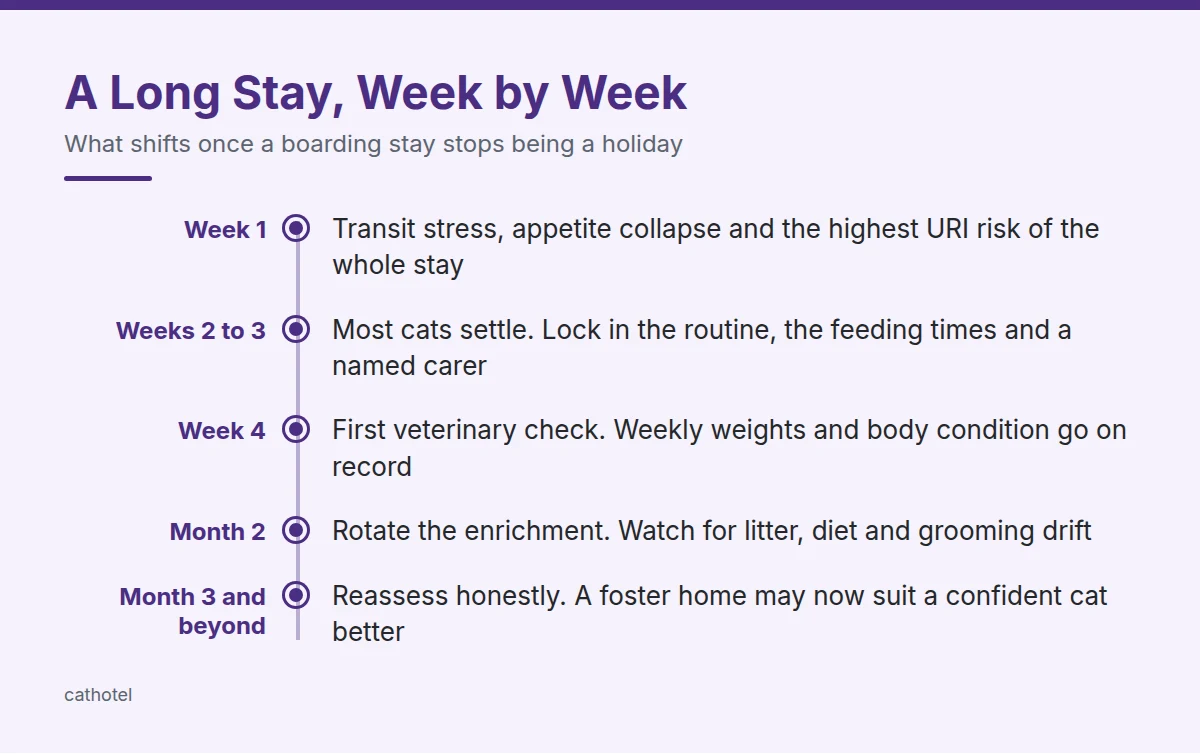
The First Fortnight Is Not the Stay
Nearly all the research owners encounter is about arrival. Stress scores peak in the first days and most cats settle over roughly the first two weeks, which is why intake protocols get so much attention. That early window is real and it matters: in a prospective study of 60 cats, Tanaka and colleagues found that 82 percent lost weight during at least one week of confinement, a quarter lost 10 percent or more of their body weight, and cats with high stress scores in the first week were 5.6 times as likely to develop an upper respiratory infection. Food intake and stress score moved almost perfectly in opposite directions.
That was a shelter, not a private suite, and an owned cat arriving with its own bedding and its own food does considerably better. But the shape of the curve holds, and the important point for a long booking is what happens after the curve flattens. The risks flip. Weeks one and two are about transit stress, URI after drop-off and a cat that will not eat. Week six is about something slower and much easier to miss: boredom, muscle loss, a coat going quietly to pieces, litter and diet substitutions that nobody wrote down, and a facility that has stopped really looking because the cat “is fine, she’s settled in ages ago.”
Length of stay is not a neutral variable. A Czech study that read ten years of shelter records against time in care put the median stay before death or euthanasia at 23 days, with infectious disease dominating the causes. Shelters and catteries are very different populations and the comparison should not be stretched, but the underlying principle transfers: cumulative exposure, cumulative confinement and cumulative inattention all scale with time.
Routine Is the Intervention
Cats run on predictability, and over a long stay predictability is something the facility has to manufacture deliberately rather than something that simply happens. Ask for the daily plan in writing before you book: feeding times, cleaning order, play slot, who does it. Then ask the harder question, which is whether the same one or two people will handle your cat across the whole booking. Rostering makes that difficult, and a facility that says “whoever is on” for a four-month stay is telling you something.
Sustained human contact is not a luxury add-on here. Gourkow and colleagues gave shelter cats four ten-minute sessions of petting, play and grooming a day for ten days and measured the result in their immune system, not just their behaviour: treated cats carried notably higher faecal secretory IgA than controls (1451 versus 846 micrograms per gram) and were far more likely to stay content rather than drift into anxiety or frustration. Four short sessions a day is a real dose of attention, and it is exactly the thing that erodes at week seven when three new arrivals need settling and your cat has become part of the furniture.
Enrichment Has to Rotate, or It Stops Being Enrichment
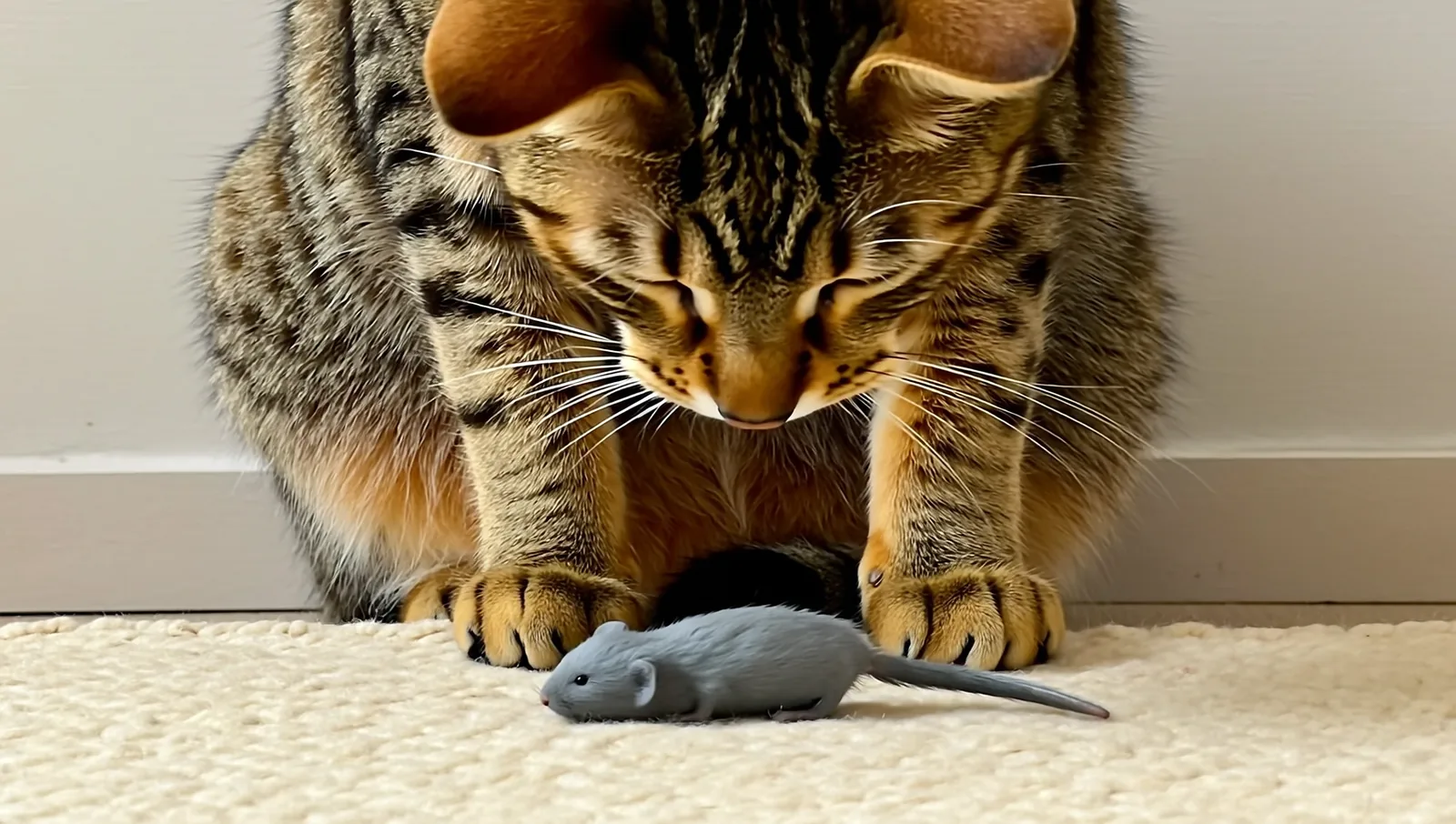
A puzzle feeder is enrichment for about ten days. After that it is a plastic object in the corner. Long stays need a rotation schedule, and a facility that runs them properly will have one: toys cycled in and out of circulation rather than left permanently available, scent variety through catnip, silvervine and dried herbs, fresh cardboard, changing window access, and food delivered in different ways on different days. Ask what the rotation cycle is and ask whether anyone records what your cat actually engages with, because a cat that has stopped playing is giving you information.
The vertical dimension matters more the longer the booking runs. A cat that can only ever occupy one horizontal plane for three months is a cat with no way to make a choice about where it wants to be, and choice is most of what a suite can offer in place of a home.
The Drift Nobody Books For
Long stays fail slowly, through small substitutions that each seem reasonable. Pin these down at booking:
- Litter. Your supply runs out around week three and someone tops it up with whatever is in the store cupboard. Substrate changes are a classic trigger for litter box aversion, which is where house soiling at boarding usually starts. Agree in writing who resupplies and what happens if your brand is discontinued mid-stay.
- Diet. Same problem, higher stakes. Set up a standing order delivered directly to the facility rather than leaving a finite pile of food at drop-off. If a change is genuinely unavoidable, it should be a deliberate transition over a week, not a swap on a Tuesday.
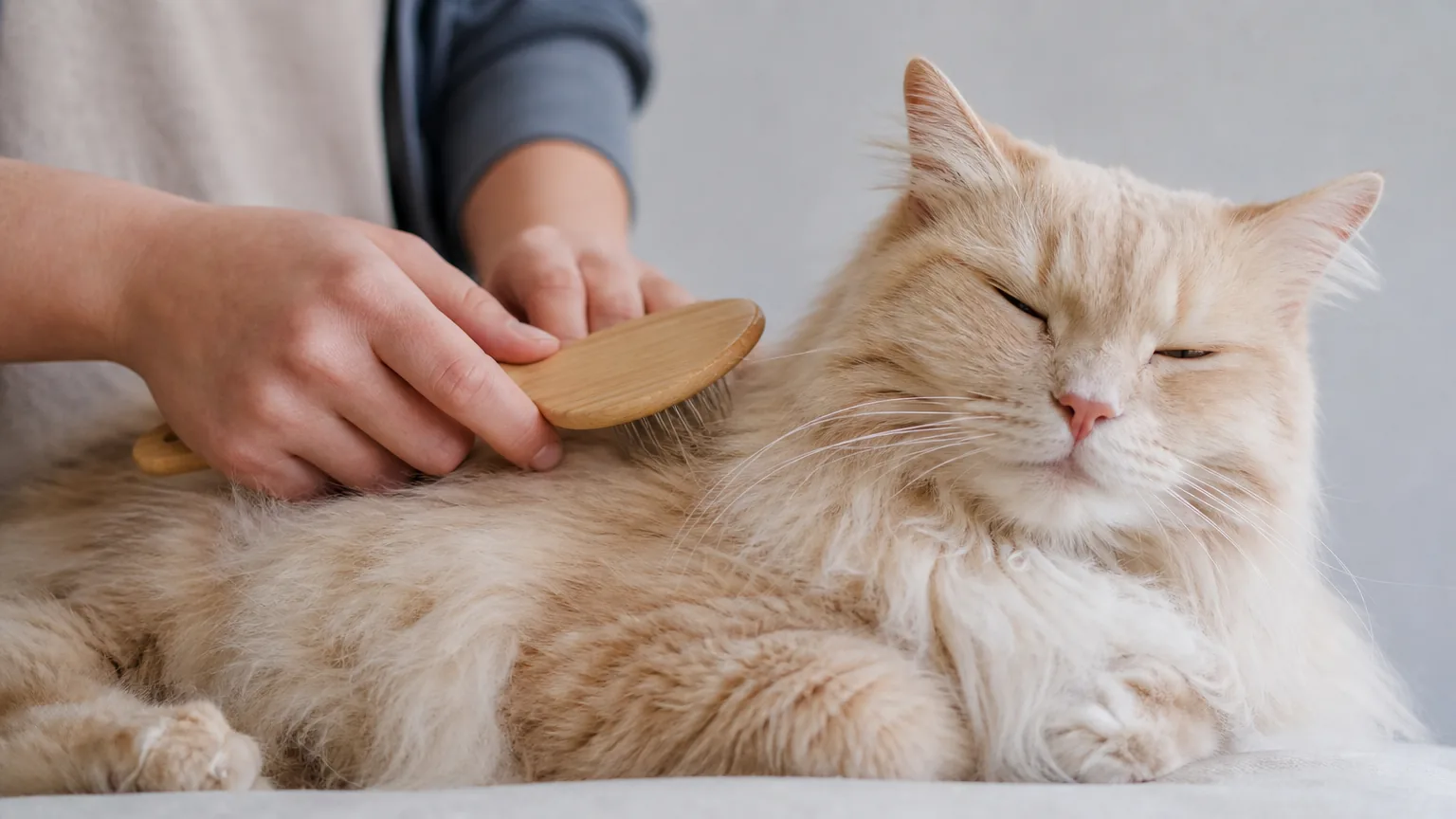
- Coat and grooming. A long-haired cat that would be brushed at home every other day will mat behind the ears, in the armpits and through the britches. At three months that is no longer cosmetic, it is a welfare problem with skin underneath it. Book a grooming cadence into the contract at the start.
- Claws. No stair carpet, no doorframe, no favourite scratching post. Overgrown claws can curl into the pad, and seniors are the ones it happens to.
- Weight, in both directions. The anxious cat loses. The bored cat in a space smaller than home, free-fed on dry food, gains. Both are invisible without a scale.
- Vaccine expiry. A rabies or FVRCP due date can easily land in the middle of a four-month booking. Check the dates against your collection date before you leave and sort the timing out in advance, using our guide to boarding vaccination requirements.
What Monitoring Should Look Like After Week Two
Short-stay monitoring is a daily eyeball and a note. Long-stay monitoring has to produce numbers you can compare month to month.
Weekly weights, same scale, same time of day, recorded as figures rather than adjectives. Agree the trigger points before you go: 5 percent loss starts a conversation, 10 percent is a veterinary visit, not a wait-and-see. Body condition score alongside the weight, because a cat can hold its weight while swapping muscle for fat over three inactive months.
A written report to you at least monthly with the weight log, a photo and a note on appetite, litter output and behaviour. Photographs matter more than owners expect. Matting, weight change and a dull coat are all far easier to see in a picture taken four weeks apart than in a daily glance.

For veterinary cadence, a healthy adult on a long booking is reasonably served by an examination at around four to six weeks and then every couple of months, with your written treatment authority and a spending limit already on file. A senior, or a cat with a chronic condition, needs that tightened and needs current baseline bloodwork before the stay so the facility’s vet is comparing against something. Learning to read the early signals yourself, through the stress and body language cues we cover here, makes those monthly photos far more useful.
How Long-Stay Rates and Deposits Actually Work
Long-stay pricing is structured differently rather than simply discounted, and published figures vary enormously by market, so treat any single number you read as a starting point for questions rather than a quote.
Most facilities work from the nightly rate with a tiered reduction, commonly stepping in around a fortnight and improving again past a month, as covered in our cat boarding cost guide. Some quote a flat weekly or monthly rate instead, which is usually better value and much easier to budget against. Beyond the headline rate, the things worth settling in advance are these: bill monthly in arrears or in advance rather than prepaying half a year, because a prepayment is an unsecured loan to a small business; expect a larger deposit than a holiday booking and check whether it is refundable; ask which services are included in the rate and which are metered, since medication administration, grooming, special diets and vet transport are the usual extras and they compound over months. Ask directly what happens if a scheduled annual price rise falls inside your booking, and what happens if you come home early, because pro rata refunds on a long booking are a policy decision rather than a given. Demand for good cat-only rooms is genuinely tight, with some well-known operators booked out more than a year ahead, so a long stay is a booking to make early and to confirm in writing.
The Contingency Plan Nobody Wants to Write
This is the part that separates a long booking from a holiday, and the part most owners skip.
Name a real emergency contact, not just a phone number: a person who has agreed in advance, who can be reached in your time zone, and who holds written authority to approve veterinary treatment up to a stated limit. Leave a payment method on file and a backup. Then answer the question nobody enjoys: what should happen if you cannot be reached for 30 days? Who pays, who decides on treatment, and who is authorised to collect the cat?
Read the abandonment clause before you sign. Boarding agreements set out a window past the agreed collection date after which the facility may treat an animal as abandoned and rehome it, and the governing statutes vary by state. That clause is not a scare tactic, it is what stands between a facility and an indefinite unpaid occupant, but you need to know the number and make sure your contingency plan comfortably clears it. Our guide to boarding agreements, waivers and insurance walks through what those contracts should and should not contain.
If you are deploying, put the cat into your family care plan the same way you would any other dependent, and give your named person documented authority to collect. Non-profits exist specifically for this: Dogs on Deployment matches service members with volunteer foster homes despite its name, and PACT for Animals arranges fostering for military personnel and for owners facing long hospital admissions.
When a Foster Home Beats a Cattery
Somewhere around the three-month mark the arithmetic changes, and an honest cattery will tell you so.
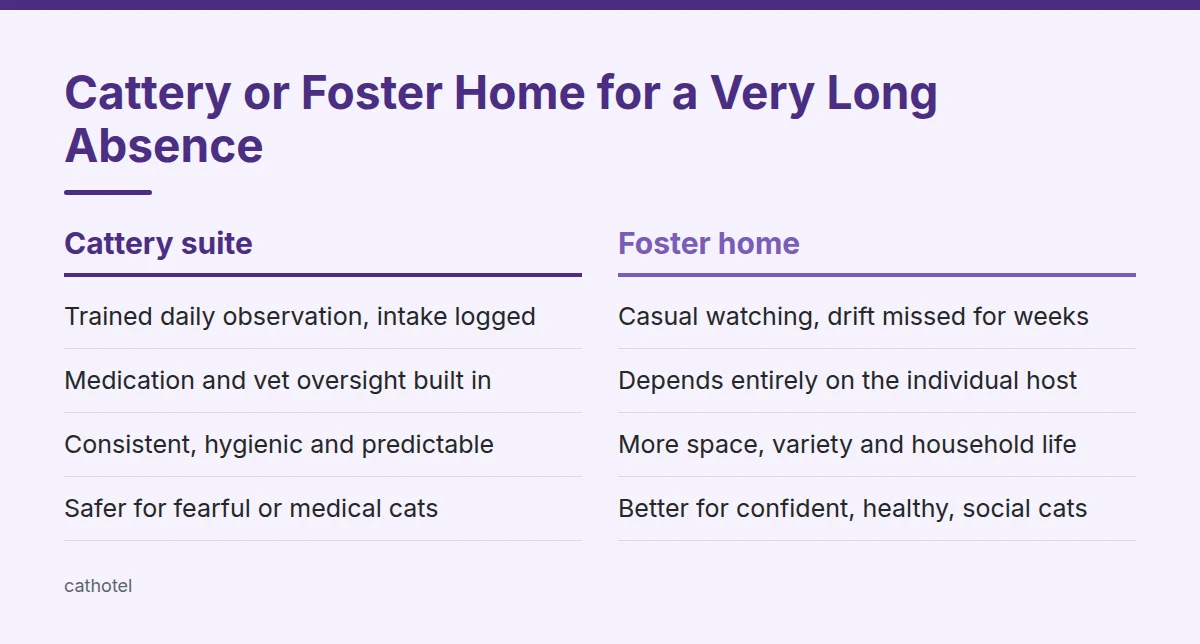
A good cat hotel is excellent at safety, hygiene, medical oversight, consistent feeding and trained observation. What it cannot give a cat over a very long absence is space, variety, and the ordinary boring stimulation of a household with people moving through it. For a confident, social, medically straightforward cat facing six months away, a foster home or a trusted household usually wins past the first couple of months.
The picture reverses for a fearful or territorial cat, and for any cat with real medical needs. In a household, a frightened cat’s hiding place becomes a permanent hiding place, and the weight loss underneath all that fur goes unnoticed for weeks because nobody is weighing anything. A suite with a trained person logging intake every day is genuinely the safer environment for that cat, even at four months. Our comparison of in-home sitters and cat hotels works through the same trade-off at shorter timescales.
The Short Version
Book early and book in writing. Fix the diet and the litter as a standing order, not a pile at drop-off. Get weekly weights with agreed trigger thresholds and a monthly report with photographs. Put grooming and a veterinary check cadence in the contract rather than assuming them. Read the abandonment clause and build a contingency plan that clears it with room to spare. And be honest with yourself about which cat you have, because for some cats the right answer to a six-month absence is not a suite at all.
Further reading (sources)
- Tanaka and colleagues on what weekly weighing and stress scoring caught in confined cats
- Gourkow and colleagues for what daily human contact did to mucosal immunity over ten days
- Veterinary and Animal Science with a decade of records read against length of stay in care
- International Cat Care on housing and management, and what a cat needs from its space
- Dogs on Deployment for the Hero Pet Boarding Network that places pets during deployments
- PACT for Animals with Operation Foster, which places pets during long hospital stays
- Hampshire Chronicle reporting a cat hotel network booked out eighteen months ahead
- FinancialContent describes a boarding operation where the owners live on the property