Cat Hotels and Cat Rescues: Foster Boarding, Adoption Suites, and Where the Biosecurity Line Sits
Published on October 8, 2026
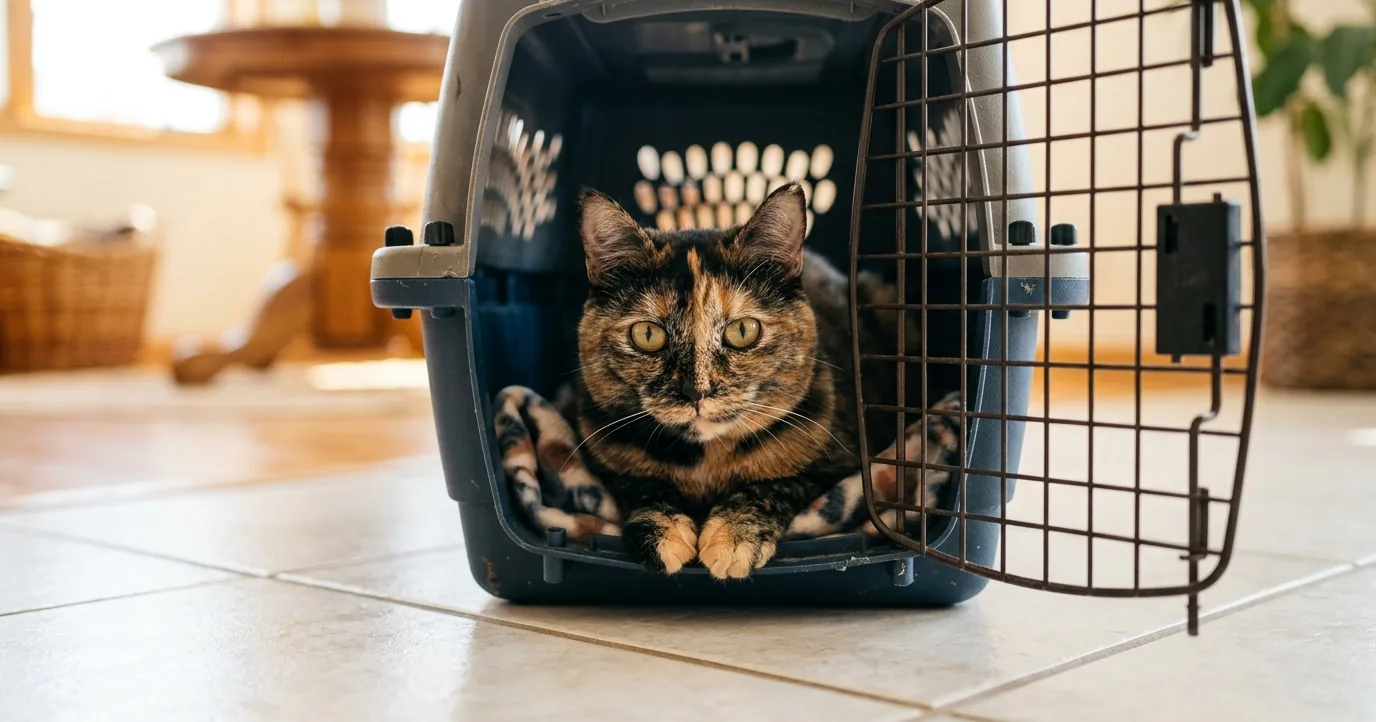
In July 2026, Free Malaysia Today profiled a Kuala Lumpur rescuer who keeps 16 sick and recovering cats in a rented flat across town from her home, and pays for nearly all of it with what she earns from cat boarding and pet sitting. It started with 11 cats in Klang that needed relocating. Vet checks found serious illness in many of them, including feline leukaemia virus (FeLV). Rent, food and treatment now average RM3,500 to RM4,000 a month, she is still paying off RM15,000 in vet bills, and she has taken two days off since she began. Her appeal was for donations, sponsorship, volunteers and adopters.
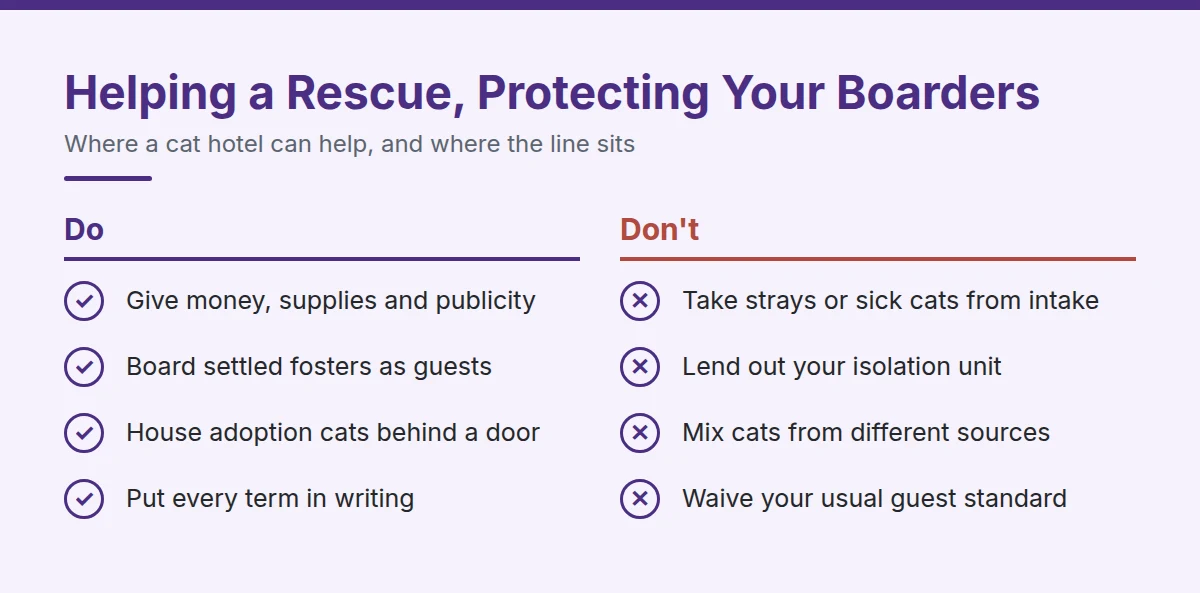
That is boarding income holding up a rescue, and most cat hotel owners will eventually meet a milder version of the same request. A rescue is full, a foster carer needs a holiday, a litter needs somewhere warm, and you have purpose-built suites, trained staff and empty rooms in February. Some of what a rescue asks for carries almost no risk to your guests. Some of it brings cats with unknown histories into the same building, sometimes the same air, as boarders whose owners never agreed to that. This guide sorts one from the other: the case for and against, four ways to partner from safest to riskiest, the intake standard a rescue cat should meet, and the agreement and insurance wording that keeps the arrangement honest.
Why Rescues Ask, and Why Yes Is Tempting
Rescues run on foster homes, and foster homes fill up. A cattery looks like the answer to most of a rescue’s problems at once: secure units, checks through the day, and staff who can pill a cat that has other ideas. The people running small rescues are often exhausted (the Kuala Lumpur rescuer told the paper she wants to quit every day), and a few nights of reliable cover can keep a foster carer going.
There is something in it for the hotel as well. Quiet weeks fill. A partnership earns local goodwill that advertising cannot buy, and rescue volunteers are cat owners who travel, write reviews and recommend. Plenty of cattery staff came into the work for the cats, and a rescue link gives them something to be proud of. None of that is trivial. All of it is small next to an outbreak among paying guests, so it should never be the reason you accept a cat you would otherwise turn away.
The Case Against: A Rescue Cat Arrives With an Unknown History
An owned boarder comes with a vaccination record, a household you can ask about, and a vet who has known it for years. A rescue cat may have a few weeks of any of those, or none. Research on unowned cats shows why that gap matters.
University of Florida researchers swabbed 543 cats across four ways of caring for unowned cats: short-term shelters, long-term sanctuaries, home-based foster care and trap-neuter-return colonies. In every setting, most cats carried at least one respiratory pathogen, whether or not they showed signs of a cold. A companion study of 482 cats found the same in the gut. Most carried at least one enteric pathogen that matters for cats or people, diarrhoea was a poor guide to which ones, and 58 percent of foster cats with perfectly normal stools were shedding feline coronavirus.
Retroviruses follow illness and lifestyle. Of 62,301 cats tested at clinics and shelters in the US and Canada, 3.1 percent were positive for FeLV and 3.6 percent for feline immunodeficiency virus (FIV). Among unhealthy cats, 13.9 percent carried one or both viruses, against 3.6 percent of healthy ones, and adult age, outdoor access, illness and being an intact male all raised the odds. That describes the sick street cat a rescue most needs help with.
Two infections deserve particular respect because of what they do to a building. Panleukopenia virus, the feline parvovirus, stays infectious in the environment for months, tolerates many common disinfectants, and travels on litter trays, bowls, shoes and clothing. The European Advisory Board on Cat Diseases (ABCD) says it has re-emerged as a cause of death in shelters and rescue homes across Europe, the US and Australia, and warns that susceptible cats can still be infected after a seemingly thorough disinfection. Properly vaccinated boarders are well protected. An unvaccinated kitten in a rescue group is not, and a confirmed case still means a deep clean and a phone call to every owner in the building.
Ringworm is the other. It is a fungal skin infection that spreads to people as well as cats, many infected cats carry it without lesions, and ABCD calls it very difficult to eradicate in catteries and shelters, with spores that can stay infective for up to nine months. In 11 cat cafés in and around Bangkok, 16.2 percent of 198 cats grew Microsporum canis on culture, 81 percent of those had no visible lesions, and a staff member at one café developed a ringworm lesion caused by the same fungus. In one large shelter working to clear endemic ringworm, the job dragged on because three kittens returning from foster care carried it back in.
There is a twist worth keeping. In the Bangkok cafés, ringworm was concentrated in cats sourced from breeding catteries (22.8 percent positive), not in adopted strays or cats from friends (1.6 percent). In the retrovirus data, cats tested at shelters were less likely to be positive than cats tested at vet clinics. The risk is not the word “rescue”. It is a crowded or unknown history, which you cannot see in a cat that looks well. That is why the answer is a written screening standard rather than a blanket no.
Four Ways to Partner, From Safest to Riskiest
1. Help That Never Brings a Cat Through the Door
The safest help is also what the Kuala Lumpur rescuer actually asked for: money, sponsorship, volunteers and adopters. None of it needs a suite. Give a share of a quiet week’s takings, sponsor a named cat’s surgery, run a collection point for food and litter at reception, show the rescue’s adoptable cats on a lobby screen and your social feeds, or host an adoption evening with no animals present.
In the US, plan this as a gift or as marketing rather than a write-off. IRS guidance says the value of your time or services is not deductible, and nor is donating the use of property you still own, so ask your accountant about the supplies you hand over instead.
Volunteering needs one rule. Staff who help at the rescue or foster at home should come to work in clean clothes and shoes that have not been in the foster room, because panleukopenia virus travels on both. ABCD’s shelter guideline goes further: care workers should not wear street clothes in a facility at all.
2. Donated Suite Nights for Settled Foster Cats
The most useful thing many catteries can offer is holiday cover for a foster network. A long-term foster or a senior in permanent foster care has lived in one home for weeks or years, and its carer still needs the occasional week away. Once a cat meets the intake standard below, it is a normal guest in a normal suite on a normal round, and a donated or discounted night costs you margin, not safety. Apply your usual vaccination rules, and keep to the rule that cats from different households never share a unit, even when one rescue owns them all.
3. Adoption Suites for Cleared Adults
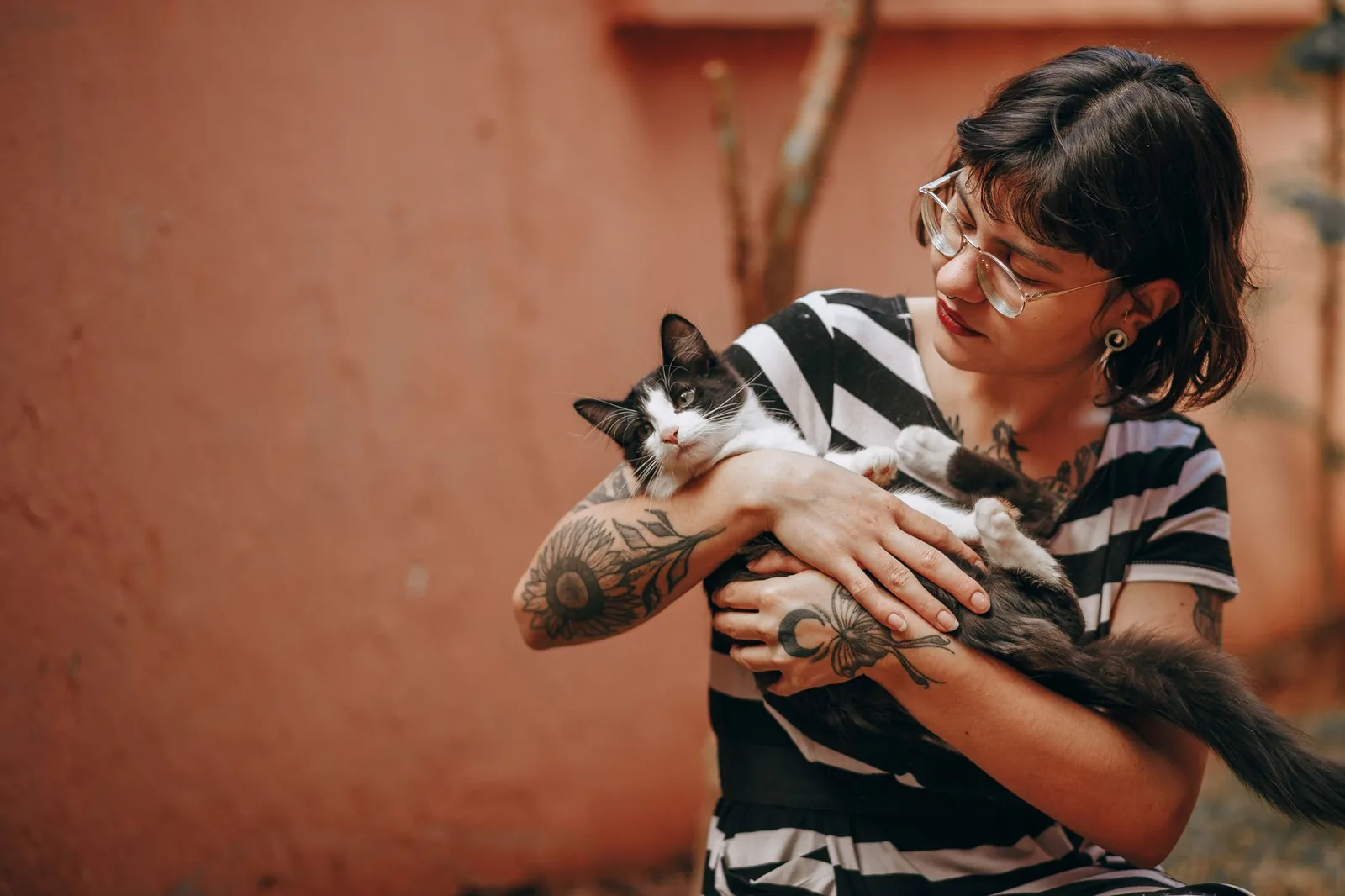
An adoption suite is a unit or two given over to rescue cats waiting for homes, with visitors by appointment. It can work, and it is the option most likely to bring new people through your door. It also changes the risk. Stays run to weeks rather than days, strangers handle the cats, and ringworm can pass to visitors and staff.
The version that does not work is a shared playroom. A room of resident cats on show to the public is a cat café, a different business with its own welfare rules, and our look at what Asian cat hotels do differently explains why it should never share space with boarders. For an adoption suite:
- Adults only, and only after the intake standard below has been met in full.
- One cat per unit, or a bonded pair from one household. ABCD says group housing of untested cats must be avoided.
- Glass or acrylic viewing panels rather than mesh, as ABCD recommends for shelter adoption areas, so visitors can look without touching.
- A hand wash for every visitor on the way in and out, and a route that does not pass through the boarding wing.
- One cat per visit, or a hand wash between cats.
- The rescue runs the adoption: application, home check, contract and fee. You provide the room.
That last point carries legal weight in places. In Scotland, rehoming animals has needed a licence since 2021, triggered by supplying as few as five animals you did not breed within 12 months, and running a rescue centre is licensed separately. Let the rescue be the party that rehomes, and ask your council how it views cats that live on your premises while they wait.
England sets a hard rule for any cattery that houses rescue cats. Its statutory licence conditions say other animal activities must be kept entirely separate from the boarding area, units housing rescue cats must be separated by a door or solid partition, extra precautions must be taken against disease, and a separate member of staff should look after those cats.
4. Foster Overflow and Fresh Intakes: Where the Line Sits
The request to refuse is the one that sounds most urgent: strays straight off the street, cats from a hoarding seizure, sick cats, cats mid-treatment, unvaccinated kittens, pregnant or nursing queens, or a group with FeLV still waiting on retests. That is quarantine work. For shelters that cannot house every cat on its own, ABCD’s guideline sets a minimum quarantine of three weeks for incoming cats, long enough for incubating panleukopenia or calicivirus to show and for vaccination to take effect, and ideally six weeks where they may have met FeLV or FIV. Isolation for sick cats must be strictly separate, preferably in another building, and even pregnant and nursing queens are better off in foster homes than in a shelter.
A cattery cannot do that in a spare suite. Your isolation unit is there for your own guests, and an English licence requires one. The night a rescue cat sleeps in it, the first boarder that starts sneezing has nowhere to go, the chain of events our guide to stocking density and disease risk traces. Turn the request down kindly, and offer what helps instead: pay toward a foster home’s quarantine room, or toward the tests that get a group cleared sooner.
The Intake Standard a Rescue Cat Should Meet
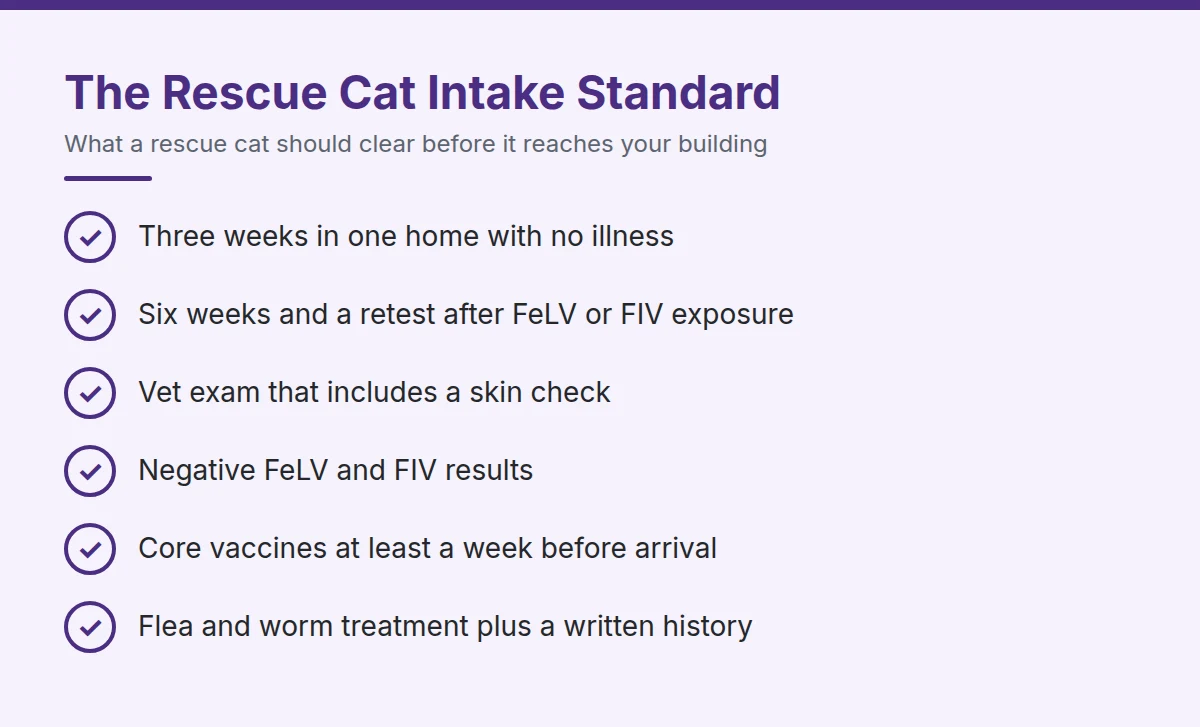
Write the standard down and give it to the rescue before the first booking, so a cat that falls short waits at the rescue rather than at your front desk. This is our suggested minimum, built from the ABCD shelter guideline and the rules you already apply to boarders:
- Three weeks in one place. At least three weeks in a single foster home or the rescue’s own facility, with no signs of illness. That matches ABCD’s minimum quarantine.
- Six weeks and a retest after possible retrovirus exposure. A single negative test is not enough for a cat that may have met an FeLV or FIV positive cat. ABCD notes that FeLV antigen can take three to six weeks to become detectable and FIV antibodies up to six weeks, sometimes longer, so it advises retesting six weeks after a first negative result.
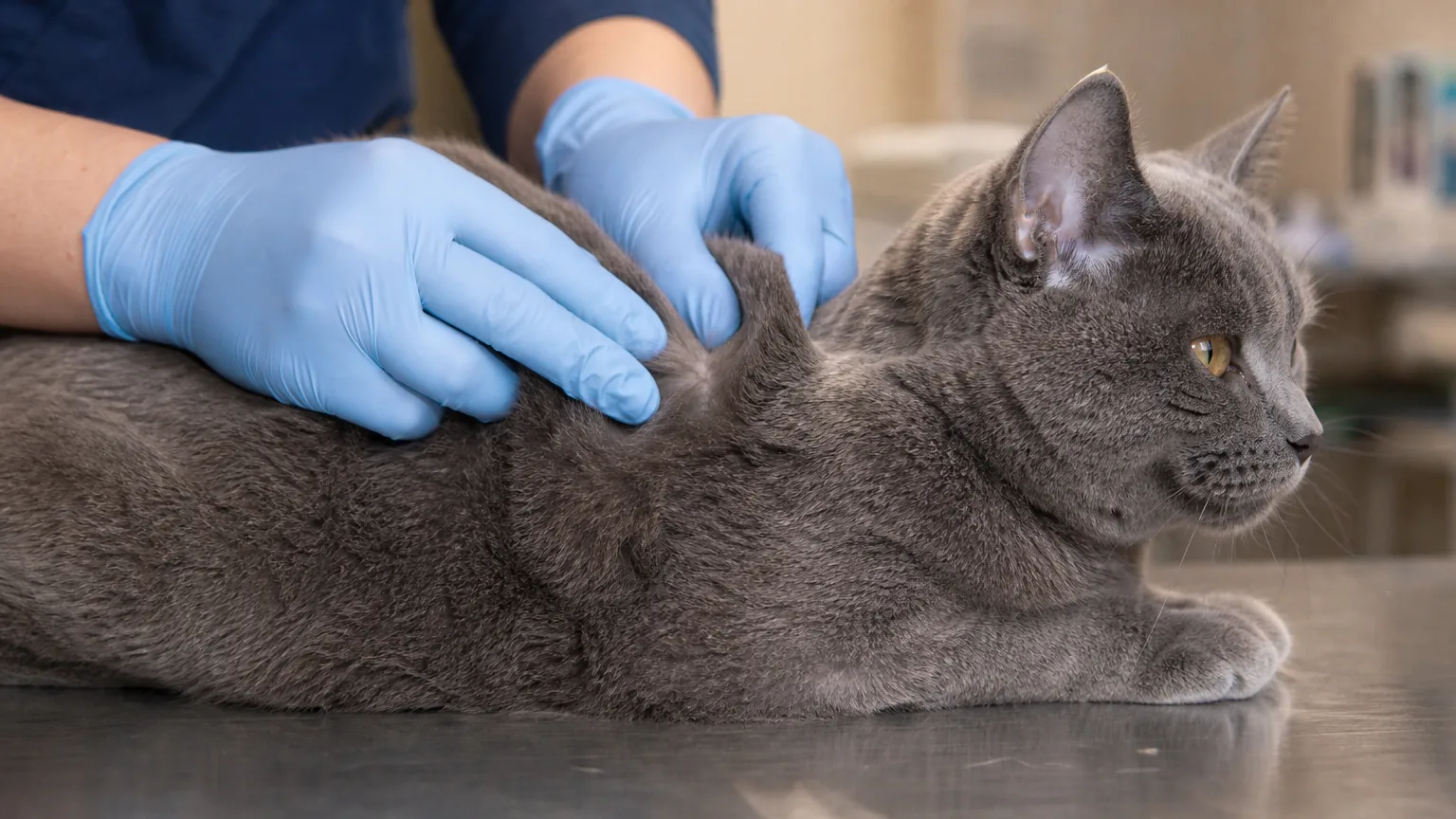
- A vet examination that includes the skin. ABCD wants every incoming cat checked for gut, respiratory and skin problems. Because most ringworm carriers show no lesions, ask for a fungal culture for any cat with a skin change or from a crowded multicat background. The shelter that cleared its outbreak kept admitting cats by adding a careful Wood’s lamp examination at intake to pick out the high-risk ones.
- Negative FeLV and FIV results, from tests taken outside the retest window above.
- Core vaccines in date, with the last dose at least a week before arrival and preferably two, the same timing we recommend for any boarder.
- Parasite treatment and a written history. Flea and worm treatment on record, plus where the cat came from, which cats it has lived with, any medication and any behaviour notes.
Where Rescue Cats Sit in Your Building
England’s rule, a door or solid partition and a separate carer, makes a sound template wherever you operate. The principle is the one our guide to Bordetella in cats applies to cats and dogs: the most reliable protection is never sharing air, hands or equipment. Build on it like this.
Air. Most cat respiratory infection travels on droplets, hands and kit, but ABCD notes that airborne spread of calicivirus has been detected in facilities with shedding cats. If you can, house rescue cats in a room with its own ventilation rather than one that shares a system with the boarding wing.
Care order. ABCD’s barrier nursing order runs from the most susceptible healthy cats, to older vaccinated cats, to cats in quarantine, with the sick last, and the carer does not go back to the healthy cats after the sick ones. In a hotel that means boarders, then rescue cats, then isolation, unless a separate person looks after the rescue cats, as England’s rules expect.
Kit that stays put. Each area keeps its own bowls, trays, bedding and cleaning equipment, ideally in its own colour so nothing wanders.
Surfaces you can scrub. Ringworm decontamination is achievable when the surfaces allow it. A University of Wisconsin researcher reviewed 70 foster homes where infected cats had lived. Debris was removed, rooms were washed with ordinary household detergent and rinsed, and hard surfaces were disinfected with 1:100 household bleach or accelerated hydrogen peroxide. Thirty-eight homes were clear after one cleaning, all but one of the rest after up to three more, and there was no sign of spread to other animals or people. That method depends on surfaces that can be washed, so a rescue suite should have no carpeted towers or fabric hammocks, and only bedding that goes in the machine.
A disinfectant that kills parvovirus. ABCD lists sodium hypochlorite and peracetic acid among the products that inactivate panleukopenia virus, and recommends disinfectants with proven efficacy against non-enveloped viruses. Our guide to chemical hazards in a cattery covers safe choices and contact times.
Clothing and shoes. Protective clothing stays in the rescue area. Disposable overshoes are better than a footbath, since ABCD warns that a poorly maintained footbath can spread pathogens instead of stopping them.
Honesty with clients. Say in your booking information that you host rescue cats in a separate area, and how. Owners who would rather not board near rescue cats can choose, and many owners will think better of you for it.
Put It in Writing: The Agreement, the Insurer and the Licence
A handshake with a rescue you like is how these arrangements go wrong. The agreement should cover at least:
- Ownership and authority. The rescue owns the cat. Name a contact who can approve veterinary treatment at any hour, the vet you will use, and who pays. In England only a vet may euthanise a cat, and not before the owner (here, the rescue) consents unless it is crucial for the cat’s welfare, so agree in advance who gives that consent.
- The intake standard, attached as a schedule, with your right to refuse a cat that arrives without the paperwork.
- Removal. If a rescue cat falls ill or is not coping, the rescue collects it within an agreed time, such as 24 hours.
- An outbreak pause. Either side can suspend the arrangement while the other has an outbreak.
- Adoptions. The rescue handles applications, home checks, contracts and fees, and no money for a cat passes through your till.
- Cover. The rescue’s own liability insurance for its volunteers on your premises, and an indemnity for claims arising from its cats.
Then write to your insurer, because a cattery policy is usually built around paying guests. Ask whether your care, custody and control cover (sometimes sold as animal bailee cover) applies to cats boarded free or at a discount and to cats owned by a charity, whether your liability cover extends to adoption visitors, and whether a contagious disease exclusion applies. Ringworm makes that last question about staff and visitors as well as cats. Our liability and insurance guide explains the lines and the gaps between them.
Last, the licence. In England, the maximum on your licence is meant to account for every cat on the premises, not only paying guests, and for the staff available to care for them. In the US, rules are set state by state, so ask your licensing office before the first rescue cat arrives.
The Short Version
Give a rescue what it most often needs: money, publicity, adopters and holiday cover for cats already settled in a foster home. Host adoptable adults only behind a door, on scrubbable surfaces, after three quiet weeks in one place and the same checks you would demand of a paying guest. Leave fresh intakes, sick cats and kittens to the rescue’s own quarantine, and help pay for it if you can. A cat you would turn away as a paying guest does not become safe because the cause is good. And as with any boarder, ask the rescue to send a familiar blanket or toy with each cat, because a settled cat is a healthier one.
Further reading (sources)
- Free Malaysia Today on a Kuala Lumpur foster home for sick rescue cats kept going by boarding work
- McManus and colleagues for respiratory pathogens in shelter, sanctuary, foster and TNR cats
- Andersen and colleagues with gut pathogens in unowned cats, including foster cats with normal stools
- Burling and colleagues on FeLV and FIV rates in 62,301 cats and what raises the odds
- Sanguansook and colleagues for ringworm and zoonotic worms in Bangkok cat cafés
- Newbury and colleagues on clearing endemic ringworm from a shelter, and the foster kittens who brought it back
- Karen Moriello with decontaminating 70 foster homes after ringworm
- European Advisory Board on Cat Diseases for its guideline on controlling infectious disease in shelters and its panleukopenia guideline
- Defra on England’s cat boarding licence conditions, including the rule for rescue units
- Animal Welfare (Licensing of Activities Involving Animals) (Scotland) Regulations 2021 for the definitions of licensed rehoming and animal welfare establishments
- Internal Revenue Service on why donated services and free use of property are not deductible