How Crowded Is Too Crowded? Stocking Density, Air Volume, and Disease Risk in Cat Boarding
Published on September 17, 2026
Every cattery owner knows the phone call. It is the Wednesday before a bank holiday, every unit is booked, and a regular client has a family emergency. Could you possibly squeeze her in? There is a spare carrier in the office, the isolation unit is sitting empty, and it would only be four nights. Saying yes feels like good service. It is also the decision most likely to turn a full week into a sick one, and the clearest evidence for that comes from places nobody would mistake for a cat hotel.
What Two Thousand Hoarded Cats Reveal About Density
Between November 2009 and March 2012, more than 2,000 cats were removed from four failed cat sanctuaries in Florida and Pennsylvania, between 387 and 697 cats in each case. Hoarding cases, the researchers note, frequently involve people who gather animals with good intentions but lack the capacity to give them minimal care. Polak and colleagues went back through the intake records to document what these cats were carrying.
The picture was grim. More than a quarter of the cats with examination records (27 percent) showed signs of upper respiratory infection at intake. Of 81 cats with respiratory signs that were tested, 78 percent carried calicivirus, 78 percent carried Mycoplasma felis and 55 percent carried Streptococcus equi subspecies zooepidemicus, and most carried more than one pathogen. Of 68 cats with diarrhoea, 88 percent were shedding feline enteric coronavirus, 56 percent Giardia and 39 percent Tritrichomonas foetus. Among 1,940 cats screened for retroviruses, 8 percent tested positive for FeLV and 8 percent for FIV.
A hoarding case is not a boarding cattery, and this study cannot separate crowding from everything else that failed: sanitation, nutrition, veterinary care. But the authors are explicit about where they think the damage came from. They attribute the high Giardia and Cryptosporidium rates to increased population density and constant reinfection from accumulated faeces. The retrovirus rates, higher than those reported in pet or feral cats, they put down to the physical contact, stress and fighting that come with densely populated confinement. The coronavirus finding they link to shared litter trays, the same route our guide to feline coronavirus and FIP at boarding explains.
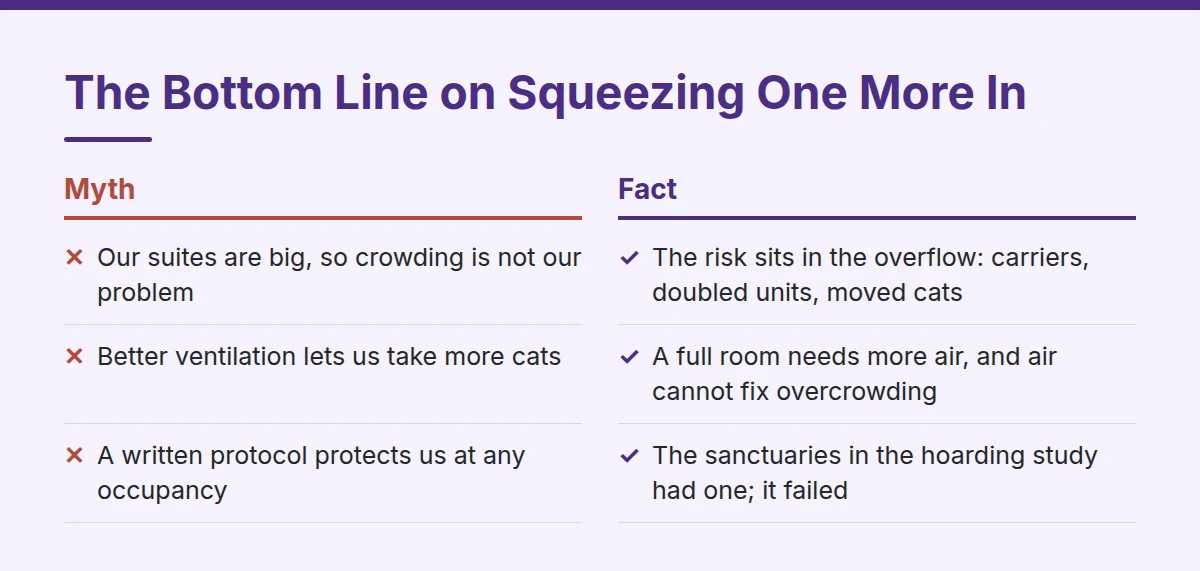
The detail operators should sit with is this. The managers of all four sanctuaries described a policy of testing every cat for FeLV and FIV and keeping positive cats apart. In all four, infected cats were found roaming freely among uninfected ones. The protocol existed. It did not survive the numbers.
Shelters Show the Same Pattern, With Figures You Can Use
Hoarding is the extreme end, but shelter research shows the same relationship at an ordinary scale. Wagner, Kass and Hurley at UC Davis followed 18,373 adult cats through nine North American shelters for a year. Upper respiratory infection (URI) rates varied almost fiftyfold between shelters, and the difference was not explained by how many cats arrived already carrying pathogens. It tracked housing and handling.
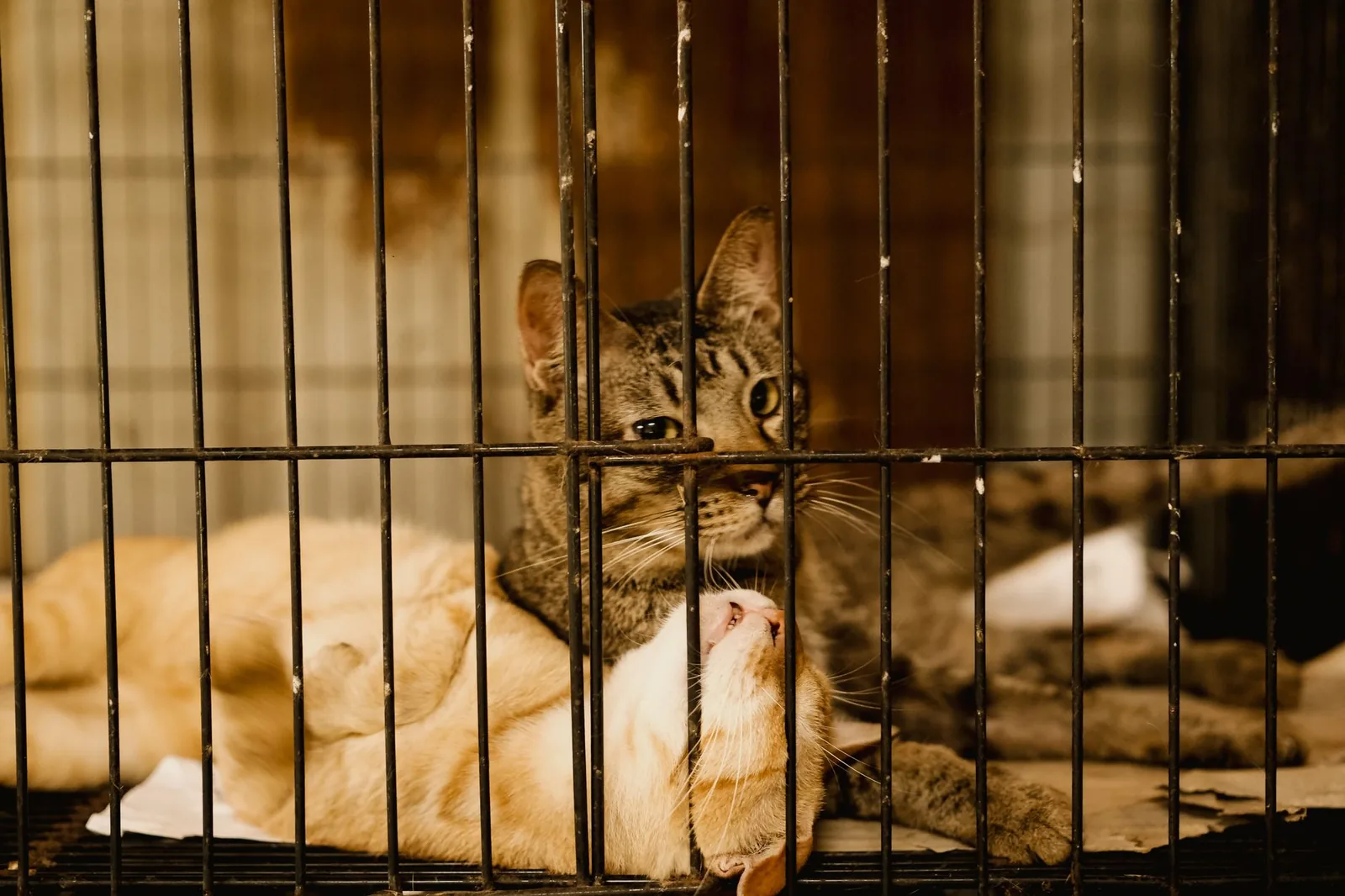
Cats whose intake housing gave them more than 8 square feet of floor (roughly three quarters of a square metre) had a URI rate about 92 percent lower than cats in cages under 6 square feet. Cats moved in and out of their housing no more than twice in their first week had a rate about 81 percent lower than cats moved more often. One result looks backwards until you picture the cage. Shelters that provided hiding structures saw more URI, not less, but five of the six were using cages under 6 square feet, and the authors suggest a solid box alongside the litter tray and bowls may simply have eaten the floor. Enrichment crammed into a unit that is too small can cost more than it gives.
Population targets point the same way. When three shelters adopted the Capacity for Care model, which sets a target for the average daily cat population and pairs it with larger housing units, fewer cats needed isolation for infectious disease and more were adopted. It was an observational before-and-after comparison rather than a trial, but it matches everything above. The Association of Shelter Veterinarians now treats individual adult cat housing under 8 square feet as unacceptable, calls 11 square feet (1.0 m²) ideal, and states plainly that operating beyond capacity for care is an unacceptable practice.
In a Boarding Cattery, the Risk Lives in the Overflow
Boarding catteries start from a much better position. Guests are owned and vaccinated, usually share a unit only with cats from their own household, and most go home within days. In England, new licensed cattery units must be built to at least the two-cat dimensions: a 2.2 m² exercise run plus 1.1 to 1.5 m² of sleeping space depending on the design, four to five times the shelter minimum. Even older one-cat units must give 0.85 m² of sleeping space before the run is counted. Outside England the rules vary widely, and in the US they are set at state or local level, but the English guidance is a useful worked example of how a regulator thinks about space, staff and numbers.
So the suite is rarely the problem. The problem is the cat that does not have one. The extra guest in a carrier behind reception. Two unfamiliar cats doubled into a unit for a night. A cat shuffled between units three times in two days to make a booking fit. Each of those recreates, for one cat, the conditions linked to the highest URI rates in the shelter data: too little space and repeated moves.
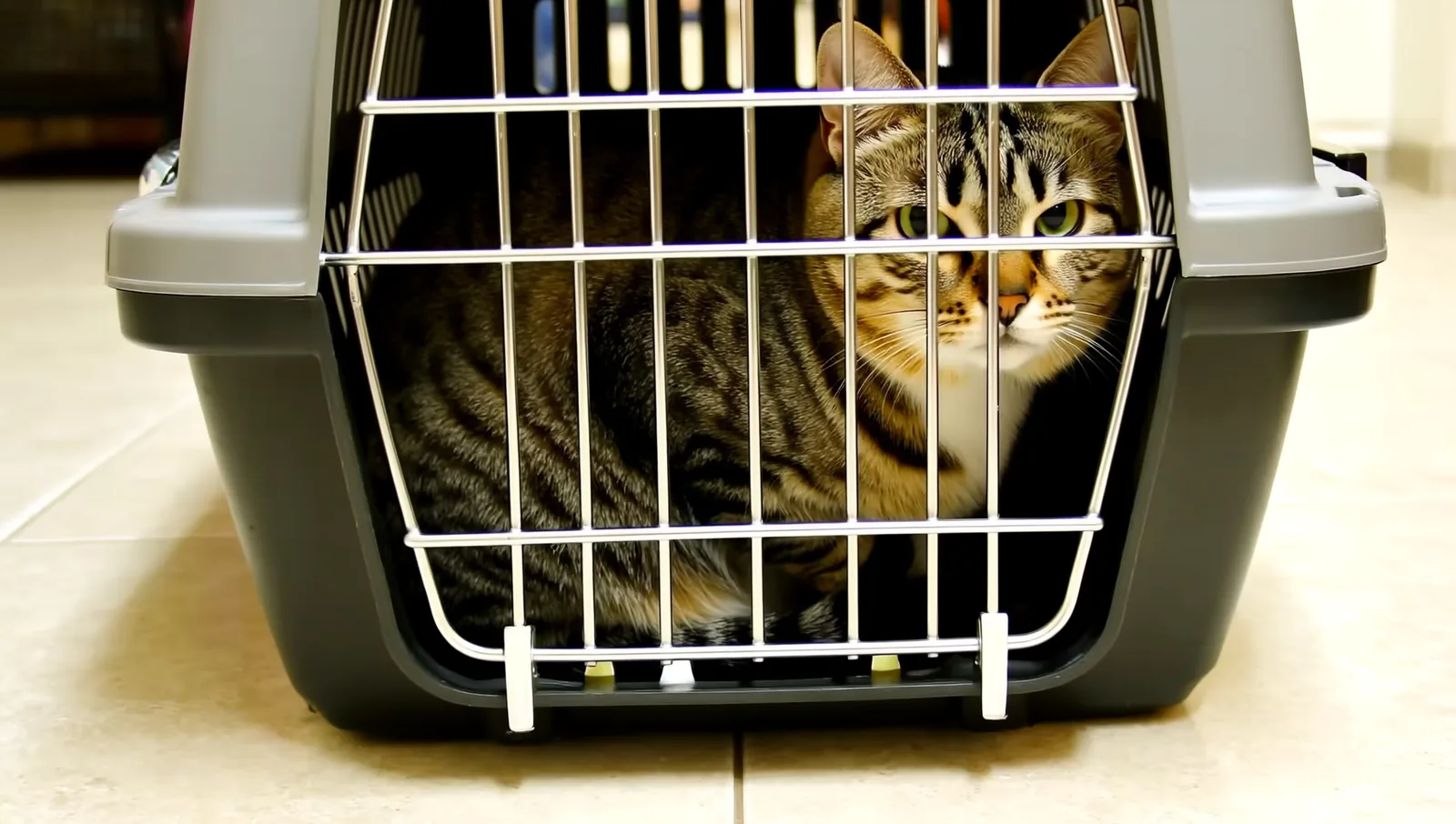
That is not a hypothetical. In July 2023, officers from North Northamptonshire Council, accompanied by the RSPCA, made an unannounced inspection of a licensed cattery and suspended its licence on the spot; it was revoked that September. Cats were being kept in the downstairs toilet and spare bedroom of the adjoining house, in small crates stacked on top of one another in the office with litter trays too close to where they slept, and in the cattery’s storage area and corridor. One pen suitable for a single cat held two, ventilation was poor, and cats were housed with cats they did not know. The cats were examined and found to be in good health, which the council leader called “fortunate, rather than by design.”
Setting a Real Capacity Ceiling
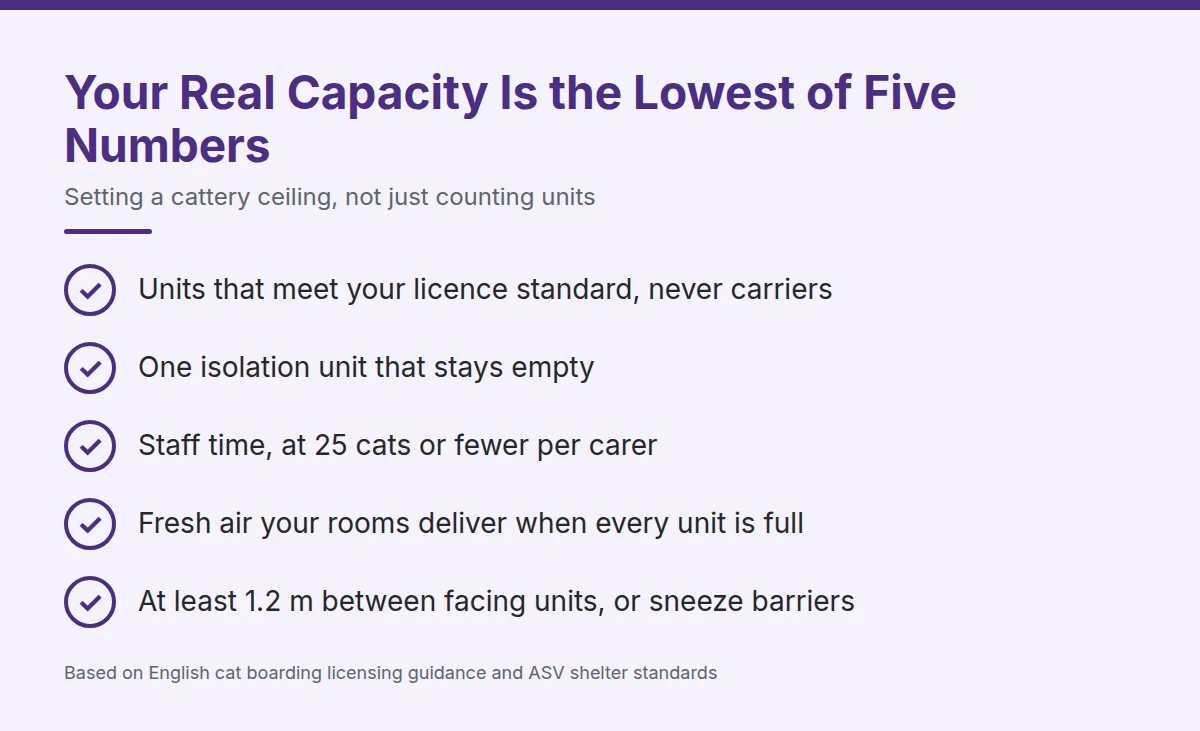
The number of units is not your capacity. The shelter guidelines make the point directly: housing that is too small cannot be counted, and a building can hold more units than its team can properly care for, because staff time and resources set limits too. A workable ceiling is the lowest of five numbers.
- Compliant units only. Count units that meet your licence standard for the cats in them. English rules allow a holding unit only in an emergency and for no more than 12 hours in any 24, and shelter standards rule out travel carriers as housing altogether.
- One isolation unit, kept empty. Isolation is not spare capacity. The night a boarder sleeps in it, the first cat that starts sneezing has nowhere to go.
- Staff time. English licensing guidance says each member of staff should care for 25 cats or fewer. The shelter guidelines cite a minimum of 9 minutes per animal per day for routine enclosure cleaning alone, and use 15 minutes per animal as a rough estimate for cleaning and feeding. At 15 minutes, 40 cats is ten hours of basic care before anyone gives a tablet, settles a new arrival or plays with a long-stay guest. Time the tasks in your own building and staff for peak week, not an average one.
- Air under full load. The ventilation your rooms actually deliver when every unit is occupied, covered in the next section.
- Spacing. English rules require at least 1.2 m of corridor between facing units, or sneeze barriers across the fronts, and any gap between neighbouring units must be at least 0.6 m wide. The shelter guidelines use the same distance, 4 feet, to keep sneeze droplets off the next cat. Temporary crates parked in a corridor break this immediately.
Write the resulting number down and make every member of staff treat it as fixed. In England it is already a licence condition: the licence must state the maximum number of cats, and undeclared numbers are a breach, especially if staffing has not risen to match. Longer bookings deserve a note too. Shelter standards expect animals staying beyond two weeks to get more space and choice, which is one more reason to give your larger units to long-stay guests. Our marketing and occupancy guide is about filling the building; this ceiling is the other half of that plan.
Air Volume: What a Full Block Does to the Room
Air is the part of density nobody can see. Cat respiratory viruses travel mainly in sneeze droplets over short distances and on hands, bowls and bedding, rather than drifting across a building, which is why the shelter guidelines give separate air handling for feline isolation a lower priority than for dogs. But every cat in a room shares its air, and that air gets worse with each one added. Cats give off heat, humidity and carbon dioxide, litter trays give off ammonia, and the guidelines note that a facility at full capacity may need a higher ventilation rate than one that is relatively empty.
Their standard recommendation is 10 to 20 fresh air changes per hour. The catch is that an air change is a room figure, not a per-cat one. Picture a cat room holding 40 cubic metres of air, with a system delivering 10 changes an hour: that is 400 cubic metres of fresh air an hour, or 50 per cat with 8 guests and about 33 per cat with 12. Same room, same fan, and every extra booking dilutes everyone’s share. No standard sets a per-cat figure, but the sum is worth doing for your own rooms.
There is also a hint that air matters more than many assume. A kitten nursery that installed UV germicidal irradiation, one unit in its ventilation system and one on the ceiling, recorded 12.4 URI cases per 100 kitten admissions in 2016 without the systems and 1.6 in 2018 with them, and its authors suggested airborne spread may be more important than previously recognised. That is one facility compared across two different years, so treat it as a signal rather than proof. The shelter guidelines are clear that UV must not be the only safeguard, and that attention to air quality “will not overcome the harmful effects of inadequate housing, poor sanitation, or lax population management.” A simple carbon dioxide monitor in each cat room, read at the end of a full-house day, can show whether your ventilation is keeping up.
Why “We Can Squeeze One More In” Starts Outbreaks
Put the pieces together and the extra booking looks different. The overflow cat has to go somewhere, and in a full cattery the only empty unit is usually isolation. Once that is taken, the cat that starts sneezing on day three stays in the main block, a metre from its neighbours. The rota that fitted 40 cats now covers 41 plus a sick one, so the round runs in corridor order instead of risk order and the extra apron change starts to feel optional. As bookings shuffle to fit, cats get moved, one of the strongest predictors of URI in the shelter study. None of those steps is dramatic. Together they are how a full week becomes a week of calls to owners about runny eyes, the pattern our URI prevention guide is built to stop.
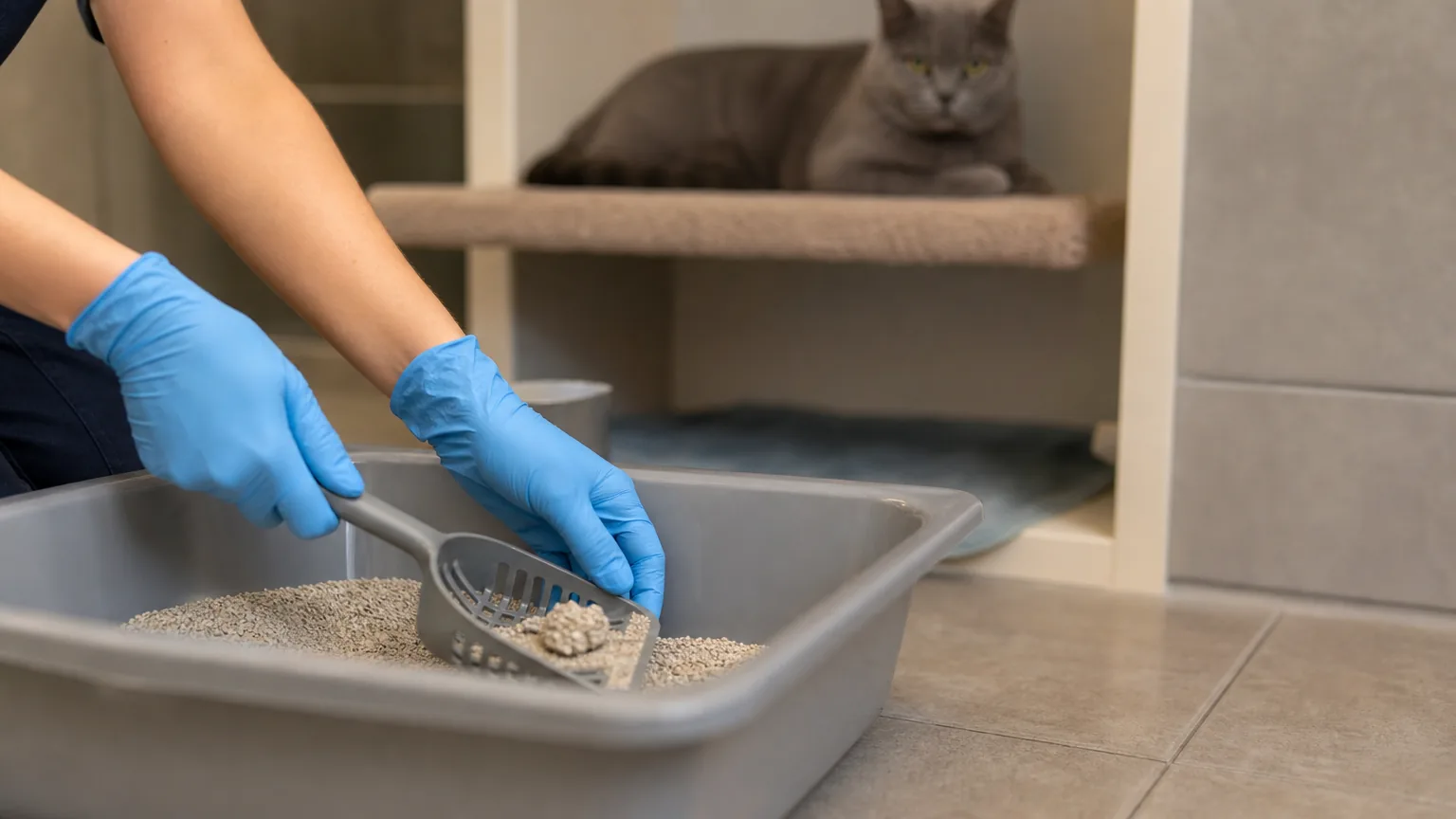
Cleaning order is where density bites hardest. The recommended sequence runs from healthy kittens, to healthy adults, to unwell animals last, and English licensing rules require staff to visit cats in isolation after all the others unless a separate person looks after them. At normal occupancy that line through the building is easy to keep. With a cat in the office and a suspect case still in the main block, it no longer exists. Two habits help hold it together. Spot clean around cats rather than lifting them out of their units, which English rules already expect as routine and which spares stress-sensitive cats extra handling. And slot the day’s new arrivals, whose health is least known, after your settled healthy guests and before any cat under observation.
For Owners: How to Spot a Cattery Running Over Capacity
You cannot measure air changes on a tour, but overcrowding leaves traces. Visit at a busy time if you can, and look past the show suite.
- Cats in places that are not units. Carriers or crates with cats in them in an office, reception, storeroom or corridor. The shelter guidelines call housing animals in hallways and bathrooms unacceptable outside a brief emergency.
- Strangers sharing. In England, cats from different households must never share a unit.
- Stuffy, warm or ammonia-heavy air. Your nose is a crude air-quality meter, but it works.
- Facing units close together with no sneeze screens between them.
Then ask four questions:
- What is your maximum number of cats, and how many are booked for my dates? In England that maximum is written on the licence, which should be displayed along with its star rating, and councils should list licensed businesses and their ratings online.
- Is your isolation unit empty today, and where would a sick cat go right now?
- How many staff are on shift on your busiest days, and for how many cats?
- Do you ever take bookings above your maximum for regular clients?
A confident no to the last question, with a reason attached, is worth more than any amount of décor. Peak weeks are when these answers matter most, which is one more argument for booking holiday dates early enough to choose a cattery rather than take whichever one still has room.
The Short Version
More cats in less space, moved more often, breathing shared air and cared for by stretched staff, get sick more. The evidence from hoarding seizures and shelters is consistent on that, and it does not care about good intentions. A licensed boarding cattery’s suites are usually fine; its overflow is not. Set a ceiling from the lowest of your units, your empty isolation, your staff hours, your air and your spacing, write it down, and treat the extra booking as the outbreak it could become.
Further reading (sources)
- Polak and colleagues on the infections found in cats seized from four failed sanctuaries
- Wagner, Kass and Hurley for how cage floor space and housing moves tracked URI across nine shelters
- Karsten and colleagues with what a population target and larger housing did for shelter cat health
- Jaynes, Thompson and Kennedy on UV air treatment and respiratory infection in a kitten nursery
- Association of Shelter Veterinarians for its standards on capacity for care, cat housing size and ventilation
- Defra with the statutory cat boarding licence conditions, from unit sizes to maximum numbers
- Defra on how licences, star ratings and public lists of licensed businesses work
- Northants Live reporting a cattery licence revoked after cats were found in a toilet, an office and a corridor