How Cats Sleep at a Cat Hotel: Night Restlessness, Hiding to Nap, and When Too Much Sleep Is a Warning Sign
Published on November 1, 2026
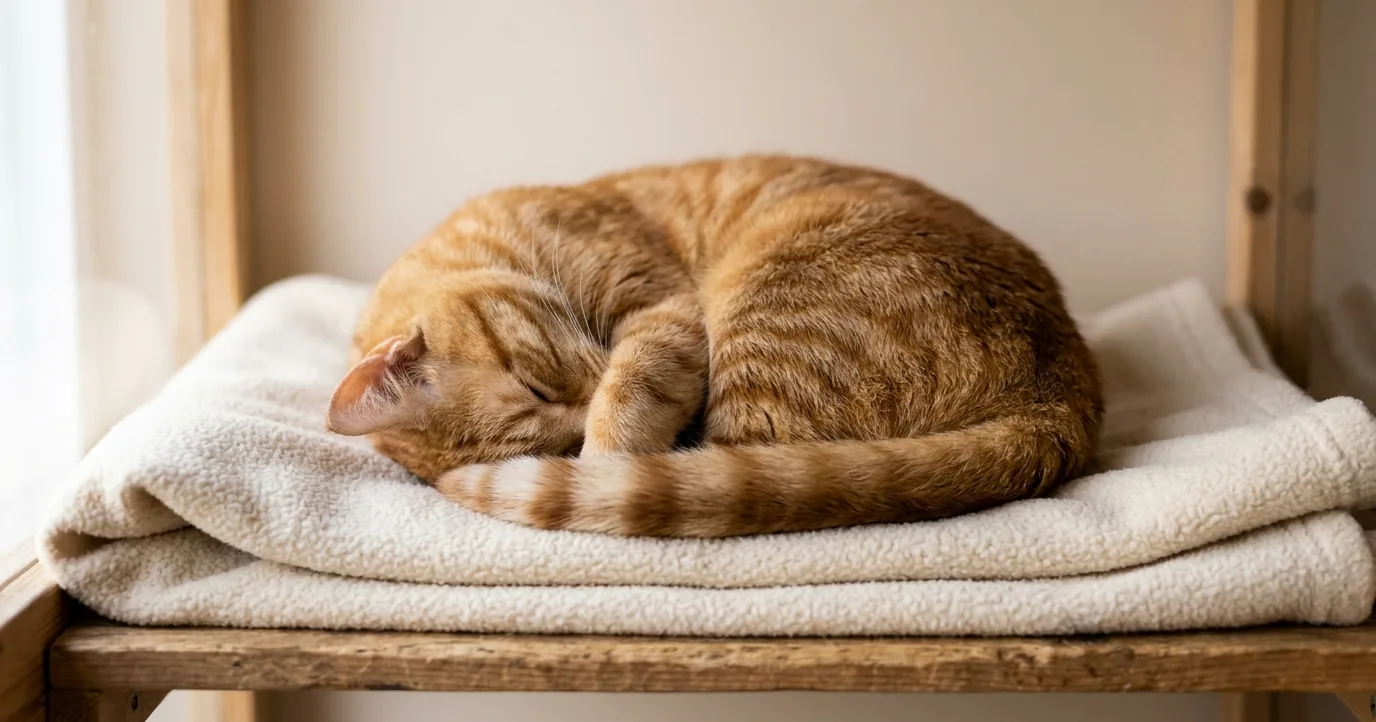
Most of what you will ever see of your cat on a cattery webcam is sleep. Hours of it, often in a box with only an ear showing. Owners who check the feed between meetings tend to worry in one of two directions: the cat has not moved all day, or it was up and pacing at eleven at night. Both are usually normal. Either can also be the first sign of a problem, and the difference lies in details that a camera shows badly and that a stranger cannot judge without knowing your cat.
This guide covers how much sleep is normal, why the first nights in a boarding suite are often restless, what the hiding place, the shelf and the sleeping posture can and cannot tell you, how a good cat hotel protects rest, and when a sleepy cat needs a vet rather than a quiet afternoon.
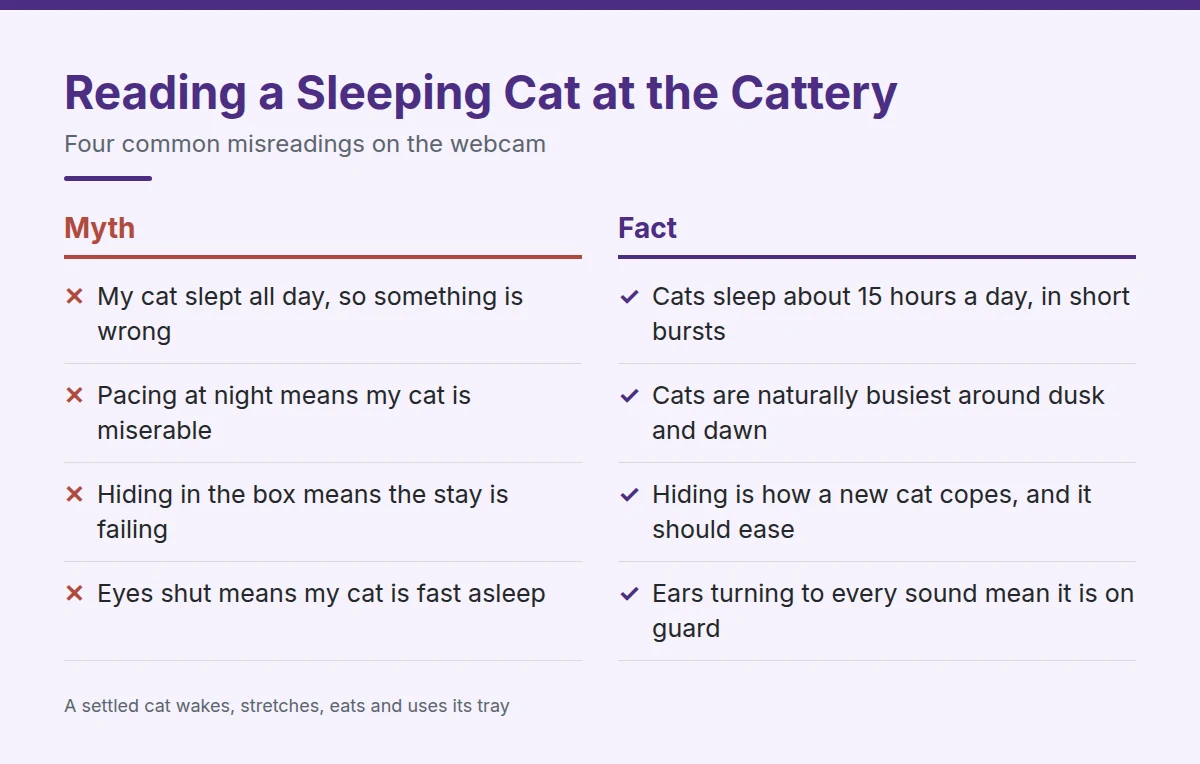
How Much Sleep Is Normal
Cats sleep far more than most people expect, and they do it in pieces. PDSA, the UK veterinary charity, puts the average at about 15 hours a day, with some cats reaching 20, usually in several short bursts rather than one long sleep. Kittens and older cats sit at the top of that range. Two veterinary nurses writing for Cats Protection, the UK cat welfare charity, give a similar figure of 16 hours or more, and add that cats sleep longer on cold, wet or cloudy days and that indoor cats may sleep more out of boredom.
Even awake, cats are mostly still. When researchers at Massey University in New Zealand fitted 28 pet cats with collar sensors, the cats spent 86 percent of their time lying, sitting or standing, and less than 3 percent of it being active. A boarding suite holds less to investigate than a house, so expect plenty of stillness on camera.
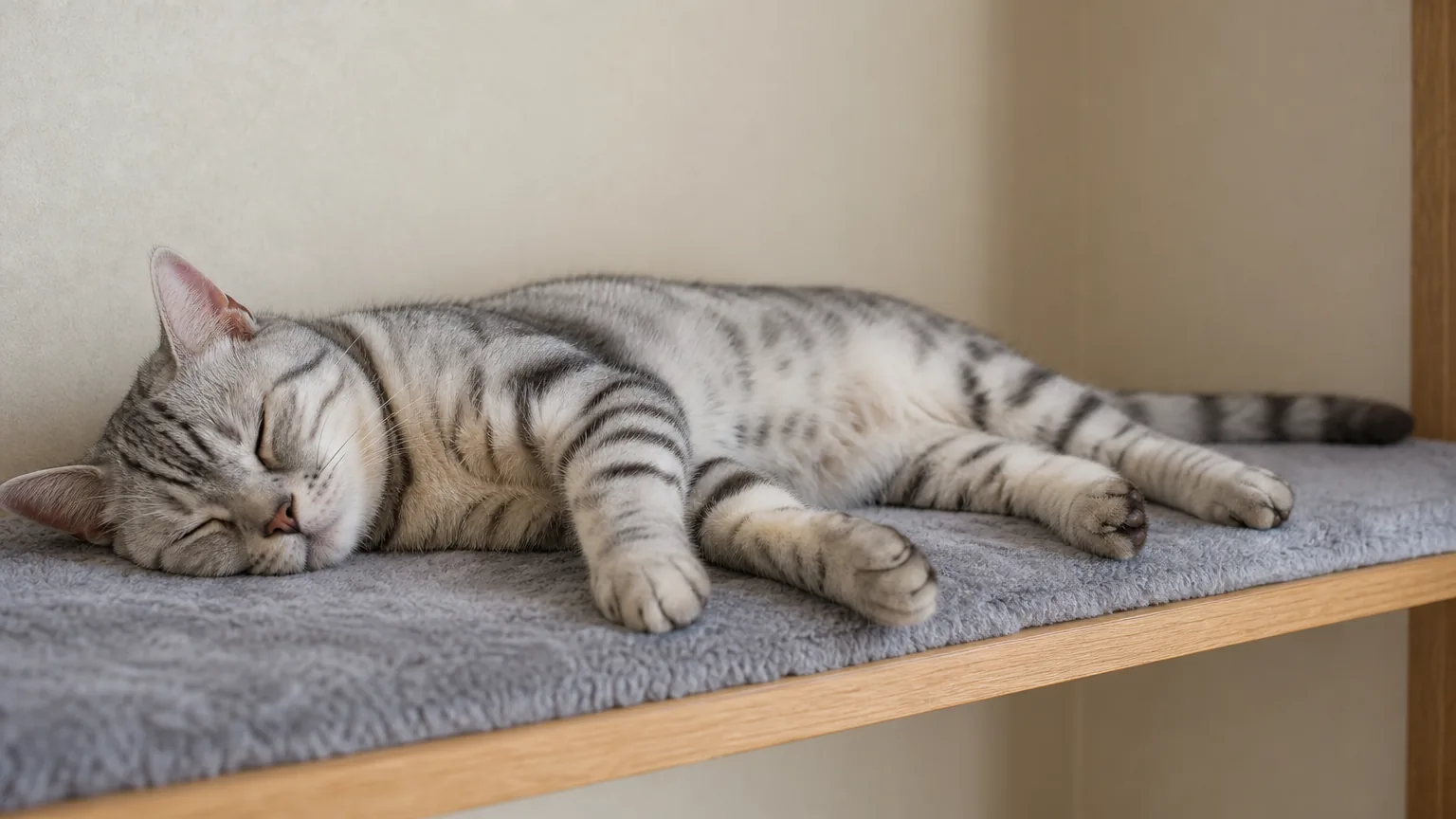
Not all of it is deep sleep. PDSA describes 15 to 30 minutes of light dozing, alert to sounds and sometimes with one eye half open, before a few minutes of deep sleep. Around a quarter of a cat’s sleeping time is deep sleep, when the whiskers, ears and tail may twitch and the breathing change, and when cats are thought to dream.
So a cat that has barely moved all afternoon is, on its own, doing what cats do. What matters is what happens when it wakes.
Why the First Nights Are Restless
Cats are crepuscular, with natural peaks of activity around dawn and dusk. In a French study of cats housed in an indoor room and in a large outdoor enclosure, both groups moved and ate more at twilight and when people were around, and the indoor cats moved much less between 1am and 4am. Staff rounds often end in the early evening, so a boarding cat’s evening peak can arrive after the building has gone quiet. A cat that paces or calls at ten at night, or is up and waiting at five in the morning, is often simply on its own clock.
The new place adds to it. Kessler and Turner followed 140 cats through two-week stays in a boarding cattery and found that stress fell most sharply over the first few days, so the first night or two is when a cat is most on guard. A cat on guard may lie with its eyes shut and still be listening. The Cats Protection nurses call this feigned sleep: the ears keep moving as though following sounds, and the cat stays in a loaf or a crouch instead of settling. They warn that it is hard to spot in cats unsettled by a change of place and routine, which describes every new boarder. In a Tufts study of 120 shelter cats, a widely used behavior-based stress score failed to pick out cats that were feigning sleep while their stress levels were high.
Night has its own noises too: a cat moving next door, the heating clicking on, wind across the runs and, in a mixed facility, dogs. In the Tufts study, cats with heavy exposure to dogs had the highest levels of a stress hormone in their urine. Cats should always be boarded well away from dogs, ideally in a cat-only building. Fireworks season brings its own problems, covered in our guide to noise-fear nights at the cattery.
Some night restlessness is medical. The Cats Protection nurses list painful conditions such as arthritis, an overactive thyroid, high blood pressure and age-related cognitive decline among the causes of increased night activity, sometimes with loud crying. If your older cat roams or yowls at night at home, tell the cattery before the stay. If the habit is new, see your vet first.
Hiding to Nap: What the Sleeping Spot Tells You
A newly boarded cat usually goes to ground, and that is healthy. In a Canadian study, 26 shelter cats given a free choice in a new environment spent a median of 55 percent of their time in a compartment with a hiding place, against 2 percent in one with a toy. Kry and Casey found that cats in an adoption center given a box to hide in grew calmer day by day, while cats given only an open bed were more stressed at day 14 than at day 5. A 2025 review in Veterinary Evidence rated the evidence for hiding boxes in hospitalized cats as moderate. England’s licensing rules make a hiding place compulsory for every boarding cat, and a cardboard box, an igloo bed or the cat’s own carrier all qualify.
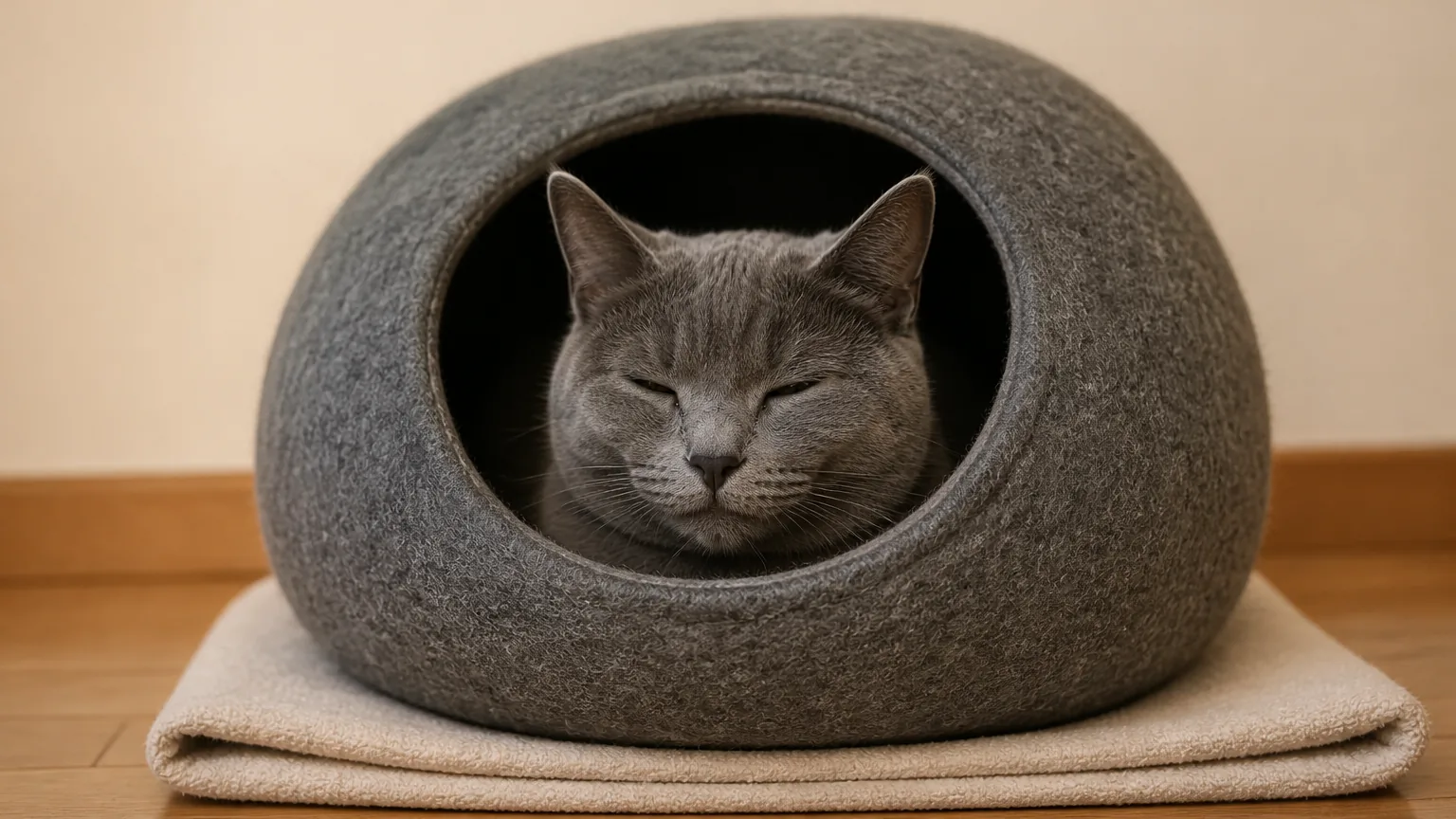
So a cat that sleeps in its box for the first night or two is coping, not failing. Leave it there. International Cat Care says most cats adapt quickly, and once they feel secure they settle into their run to sleep and watch the cattery’s daily routine. On camera, settling often looks like naps moving into the open: onto the shelf, the bed, a patch of sun in the run.
Height matters as much as cover. International Cat Care notes that cats seldom sit on the ground if there is somewhere higher, and that a shelf lets a boarding cat look out over its world and feel more secure. England’s rules require every unit to have an elevated area big enough to lie on, with easy access for elderly, ill, very young or disabled cats. If the sleeping box is a raised “penthouse” reached by a ramp, check that an older, stiff or heavy cat can actually get up there. The Cats Protection nurses add that an older cat that starts sleeping in lower, easier places may be struggling with arthritis.
One place is never a bed. A cat that keeps returning to its litter tray, or squats there for long spells, is not looking for a nap. Repeated squatting with little or nothing to show for it is a classic sign of a urinary problem, and in a male cat possibly a blockage, which is an emergency. Our guide to stress cystitis and urinary blockage at boarding explains what to look for.
What Sleep Postures Can and Cannot Tell You
Owners love to read sleep positions. Cats Protection, in a recent guide, urges caution: a position may hint at a cat’s comfort, temperature or mobility, but most come down to what that cat finds comfortable. What matters more is what is normal for your cat, and any sudden or lasting change. With that in mind:
- Curled into a ball. The most familiar shape, and it may help hold in heat in cold weather. On its own it cannot tell you whether the cat feels safe or anxious.
- Stretched out on its side. Usually a comfortable cat, and often a warm one, since stretching out may help shed heat. England’s rules require every unit to be big enough for a cat to lie fully stretched out without touching the walls.
- The loaf. A loose loaf with the head resting comfortably is a relaxed cat. Cats Protection draws a useful line: legs tucked underneath suggest more relaxation than a cat resting with all four paws on the ground, ready to move. A tense loaf with the head held low, in a cat that never seems to settle, deserves a closer look.
- Belly up. Looks blissful and may well be, but many relaxed cats still dislike a belly rub.
- Eyes shut, ears working. The one that fools people. Veterinary researchers who drew up a catalog of acute pain behaviors in cats included feigned sleep: eyes partly closed, ears pulled apart and muzzle drawn back, in a cat that looks still but is easily disturbed. They add that a shy or fearful cat may use it to cope with a stressful place.
Real sleep looks loose. The same researchers describe normal sleeping cats as relaxed and curled up, in what has been called a “bagel” or “croissant” position. It also ends in a recognizable way. A healthy cat usually wakes with a long forward stretch, which the researchers note is often missing or altered in a cat in pain. A cat that wakes, stretches, has a quick groom and wanders over to its food has slept well, however long the nap lasted.
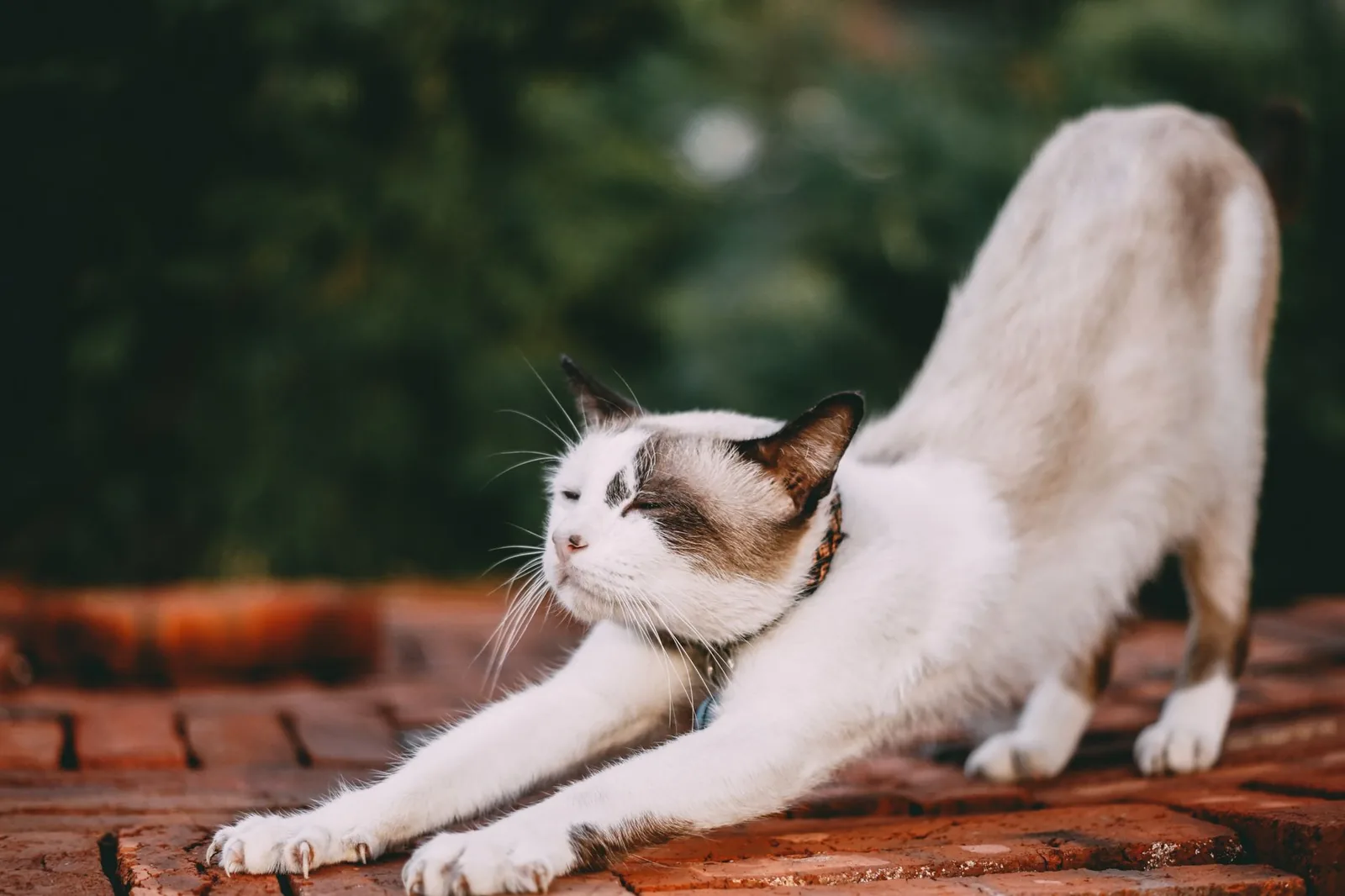
The awake versions of these signals (ears, tail, pupils, appetite) are covered in our guide to reading feline stress signals at boarding.
How a Good Cat Hotel Protects Sleep
Sleep in a cattery is shaped by the building and the timetable as much as by the cat. A well-run cat hotel gets these right:
- A proper night. England’s rules say artificial lighting must fall within a range of 10 to 12 hours a day, and that lights must be turned off overnight to give a period of darkness. Rules elsewhere vary, but the principle travels.
- A predictable day. International Cat Care puts it simply: routine makes cats feel secure, because they need to know when they will be fed and to see when people come and go. The opposite has been tested. In a 2013 Ohio State experiment, five days of unfamiliar caretakers, an irregular care schedule and no play time raised sickness behaviors, a list that includes lethargy, sleepiness, eating less and grooming less, in healthy cats and in cats with a bladder pain condition alike.
- Quiet. England’s guidance says cats must not be exposed to excessive or continuous noise, and gives dogs barking as its example.
- A bed that smells of home. Under England’s rules a boarding cat must have constant access to its sleeping area and must never be left without bedding unless the owner says otherwise. International Cat Care notes that many catteries let owners bring bedding or toys because the familiar smell helps cats feel secure. Send a blanket or a worn T-shirt unwashed, and ask staff to wash it only if it gets dirty, which is the Cats Protection nurses’ advice for beds at home too.
- Warmth and layout. England requires part of the sleeping area to stay between 15 and 26°C and never drop below 10°C (between 18 and 26°C at the higher standard), and at least 60 centimeters between the litter tray, the resting place and the food, so no cat has to sleep beside its toilet.
- Something to do by day. For cats that wake their owners at dawn, PDSA suggests vigorous play in the evening. A few minutes with a wand toy at the evening round can help a boarder too, if it wants to play. A cat that prefers its box should be left in it.
- Night checks that look, not wake. England’s minimum standard sets regular checks from 8am to 6pm. The higher standard adds at least one check between 6pm and 8am, in person or by camera. A good night round is quiet and low-lit, and leaves sleeping cats asleep.
Watching on the Webcam
Some cat hotels, especially at the premium end, offer a camera that owners can log into. It can reassure, or it can feed worry. A few rules of thumb:
- Stillness is normal. Hours without movement are what cats do. Judge by what happens when the cat wakes: does it stretch, groom, eat, use the tray, look around?
- The box on night one is a good sign. A cat that hides is using the tool it was given. Look for its naps to drift into the open over the following days.
- Watch the ears, not the eyes. Eyes shut but ears swiveling at every sound, night after night, means a cat on guard rather than resting. Mention it to the staff.
- Night footage is often grey and grainy. Judge posture and position. Do not try to read an expression from an infrared picture.
- The camera cannot see the bowl or the tray. Whether a boarding cat is eating and passing urine rarely shows on a webcam, yet those are the two most important facts about its stay. England’s rules require every cat to be checked at least once a day for signs of pain, injury, disease or abnormal behavior, and each cat’s urine and feces to be monitored daily. Ask the staff rather than guessing from video.
- The same hunched shape, hours apart. If your cat is crouched in the same spot at the back of the unit in views taken hours apart, call the cattery. It may be nothing. It may be the first sign of the problems below.
When Too Much Sleep Is a Warning Sign
Sleep becomes a problem when it stops looking like sleep. PDSA notes that a cat that is ill or injured may sleep more than usual, and advises seeing a vet if a cat is constantly lethargic and loses interest in things it normally enjoys, such as food, attention or play. A sudden change in sleep pattern, or excessive napping, can signal an underlying health problem.
The distinction that matters is between a cat that is asleep and a cat that has shut down. A sleeping cat lies loose, wakes to a voice or the sound of the door, stretches and gets on with its day. A shut-down cat stays put. The pain researchers’ catalog describes it well: positioned at the back of the cage, paying no attention to its surroundings, crouched or hunched with the head held below the line of the shoulders, eyes squinting, unresponsive and still. That cat may be in pain, unwell, or so stressed that it has stopped coping, and from the door of a suite you cannot always tell which. All three need action.
Stress alone can produce this picture. In the Ohio State experiment, disruption by itself raised sickness behaviors in healthy cats. That is not a reason to wait and see. It is a reason to call.
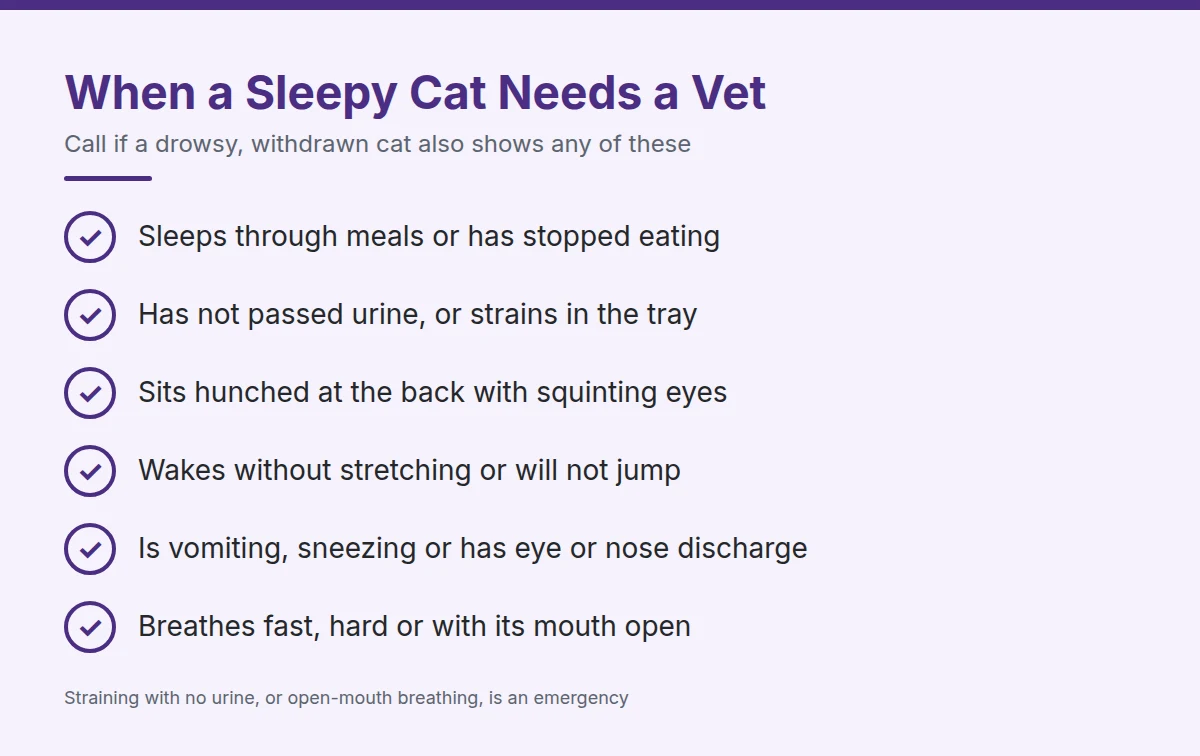
Call a vet, not just the owner, if a sleepy, withdrawn cat also:
- Has stopped eating. A cat that sleeps through its meals is in danger, because cats that go without food can develop serious liver disease. Our guide to cats that won’t eat at boarding explains the thresholds.
- Has not passed urine, or is straining. Straining with nothing coming out is an emergency.
- Has had recent surgery or dental work. After an operation, a cat with squinting eyes and its head lower than its body is often taken for a sleeping cat when it is in pain, as the pain researchers point out. Our guide to boarding a cat after surgery covers the red flags.
- Cannot get comfortable or will not jump. Stiffness, reluctance to climb to its usual shelf, or an inability to stay still.
- Shows other signs of illness. Vomiting, diarrhea, sneezing, or discharge from the eyes or nose.
- Is breathing fast, hard or with its mouth open. In a resting cat, that needs a vet urgently.
England’s rules spell out what should follow: behavior monitored daily, changes recorded and acted on, and a vet contacted for advice immediately when staff suspect a cat is ill, with the instructions recorded and the owner told. A cat sleeping more than it should is exactly the change those rules exist to catch.
Give the Cattery Your Cat’s Sleep Profile
Everything above depends on knowing what is normal for this particular cat. You know; the cattery does not. In England each unit must carry a one-page summary of the cat inside, including any relevant medical, behavioral or dietary information, which makes a natural home for a few lines on sleep. Tell the cattery, in writing:
- Where your cat sleeps at home: up high, hidden away, under the duvet, on your bed.
- How it usually sleeps, and roughly how much. A cat that always naps in a loaf looks different on camera from one that always sprawls.
- Its night habits. Does it call at 5am, roam at night or yowl? Is that new?
- Its health and mobility. Can it manage a raised sleeping box or a high shelf? Does it have arthritis, or a thyroid, kidney or heart condition? For a cat with a chronic illness or a behavior problem, see your vet before booking, and agree what change in sleep or appetite should trigger a call.
- What it is bringing: an unwashed blanket or T-shirt, a favorite toy, and its own carrier, which can double as its hiding place.
Then ask the cattery four questions. What time do the lights go out, and is anyone on site or watching overnight? Are dogs boarded on the same site, and how far away? How do you record whether each cat is eating and using its tray? And if my cat seems to be sleeping too much, at what point do you call a vet?
A cat that sleeps in its box the first night, on the shelf by the third and stretched across its bed by the end of the week is having a good stay. A cat that sleeps all day but never stretches, eats or looks around is telling you something. Between your knowledge of your cat and the staff’s eye on the bowl and the tray, you should be able to tell which one you are watching.
Further reading (sources)
- PDSA on how long cats sleep and when sleepiness needs a vet
- Placzek and Smith, for Cats Protection with a veterinary nurses’ guide to sleep, feigned sleep and night activity
- Cats Protection for what sleeping positions can and cannot tell you
- Smit and colleagues on collar sensor data from 28 pet cats
- Parker and colleagues with twilight activity peaks in indoor and outdoor cats
- Kessler and Turner for how stress changes over a two-week stay in a boarding cattery
- McCobb and colleagues on stress scores, feigned sleep and dog exposure in shelter cats
- Marangoni, Beatty and Steagall with an expert catalog of acute pain behaviors, including feigned sleep
- Ellis and colleagues for the enrichment shelter cats choose in a new place
- Kry and Casey on hiding boxes and stress in shelter cats
- Foster, in Veterinary Evidence with a review of hiding boxes for hospitalized cats
- Stella, Croney and Buffington for sickness behaviors after five days of disrupted care
- International Cat Care on choosing a boarding cattery, from shelves and hiding places to bedding from home
- Defra for England’s cattery rules on lighting, bedding, hiding places and checks