Entrapment and Strangulation Hazards in a Cat Suite: Collars, Cords, Hammocks, and Gaps
Published on September 18, 2026
In 2018 a Waikato woman went to collect her cat from a New Zealand cattery and found the animal hanging. She spent the years afterward pushing for the boarding sector to be regulated, because at the time there was almost nothing to push against. Cases like hers rarely involve anything exotic. They trace back to ordinary suite furniture: a collar that did not release, a hammock strap, a cord left dangling near a shelf, the finger-width gap behind a fixture where a paw fits going in and does not come out going back.
Two things make a boarding suite different from a living room. A cat is alone in it for long stretches, and it is a novel environment the cat will test by climbing, squeezing, and pulling. This article is the physical-hazard half of the safety picture. The chemical and toxic hazards guide covers what can poison a cat in a cattery, and the fire safety guide covers the building. Neither covers the thing most likely to hurt a cat on a quiet Tuesday night, which is the furniture it is sleeping on.
The Collar Is the Single Biggest One
Start at intake, because most of the risk walks through the door on the cat’s neck.
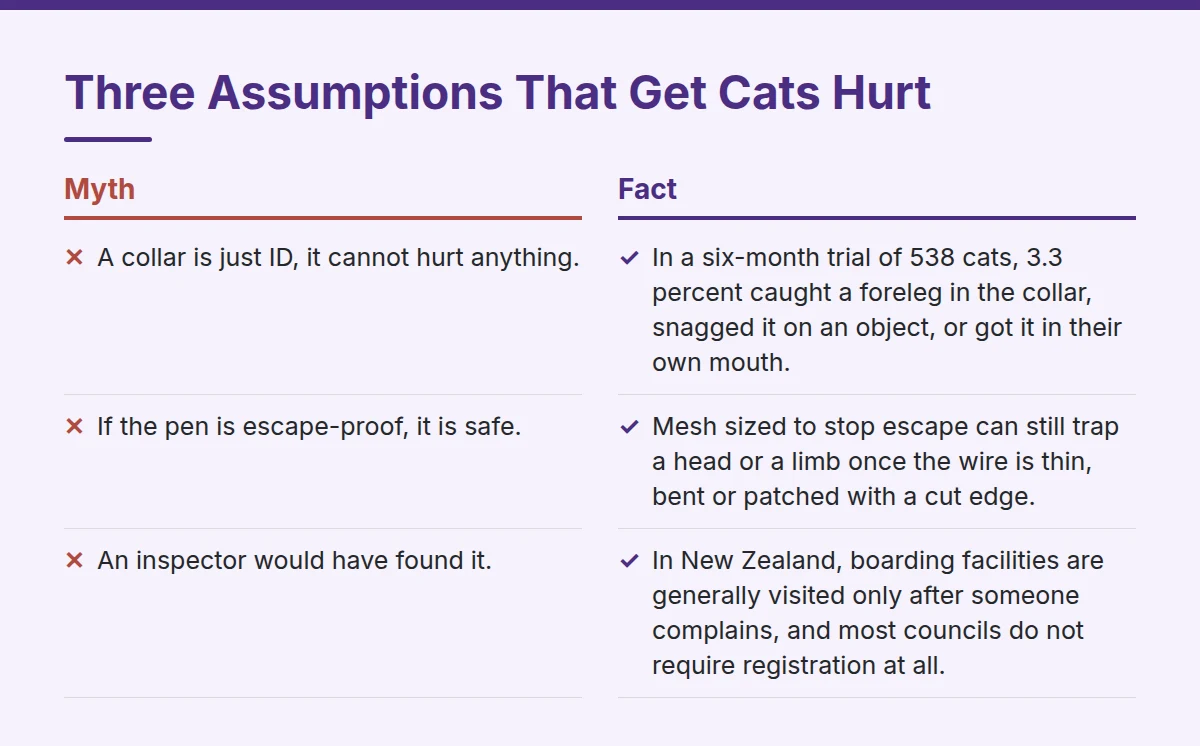
A randomized trial by Lord and colleagues put collars on 538 client-owned cats for six months and tracked what happened. Most cats tolerated them fine, but 18 cats, 3.3 percent of the group, caught a forelimb in the collar or caught the collar on an object or in their own mouth. Over six months, in ordinary homes. Compress that risk into an unfamiliar pen with wire mesh, shelf brackets, and a cat that is agitated enough to climb the walls, and the rate goes nowhere but up.
The consequences are not theoretical. Veterinary surgical literature has a whole small genre on the injury: Lascelles and White reported on ten cats needing reconstruction of chronic non-healing armpit wounds caused by a forelimb trapped inside a collar, cats that had already been through a median of three failed repair attempts before referral. Brinkley described five more of the same wounds, three of them confirmed collar entrapment. These are cats that did not die. They just spent months with an open wound that would not close.
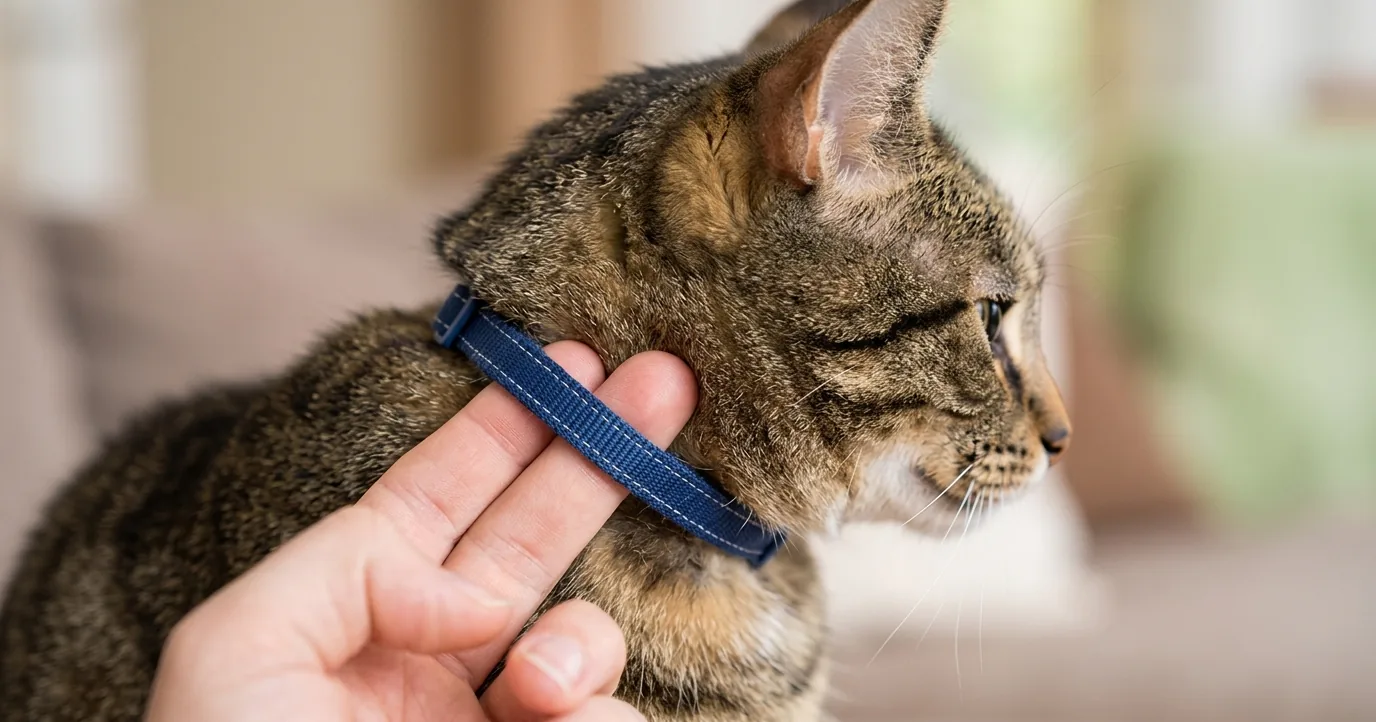
The policy that follows is simple and should be non-negotiable. Any collar that stays on during a stay must have a breakaway or snap-open buckle, the kind that comes apart under load and leaves the collar behind rather than the cat. Buckle collars, flea collars without a safety clasp, and decorative collars with a fixed fastening come off at check-in and go in the cat’s belongings bag. Fit gets checked too: the standard is one large or two small fingers between the collar and the coat, which is what stops a foreleg fitting through the gap in the first place.
Two honest caveats. A breakaway buckle is a mitigation, not a guarantee, and both International Cat Care and the RSPCA are careful to say so. And magnetic or electronic cat-flap tags hanging off a collar add a snag point of their own, which is one reason microchip-operated flaps have largely replaced them.
Mesh Gauge and Gap Tolerance
England’s statutory guidance for licensed cat boarding establishments is the most specific published standard on suite construction, and it is worth knowing the actual numbers whether or not you operate in England.
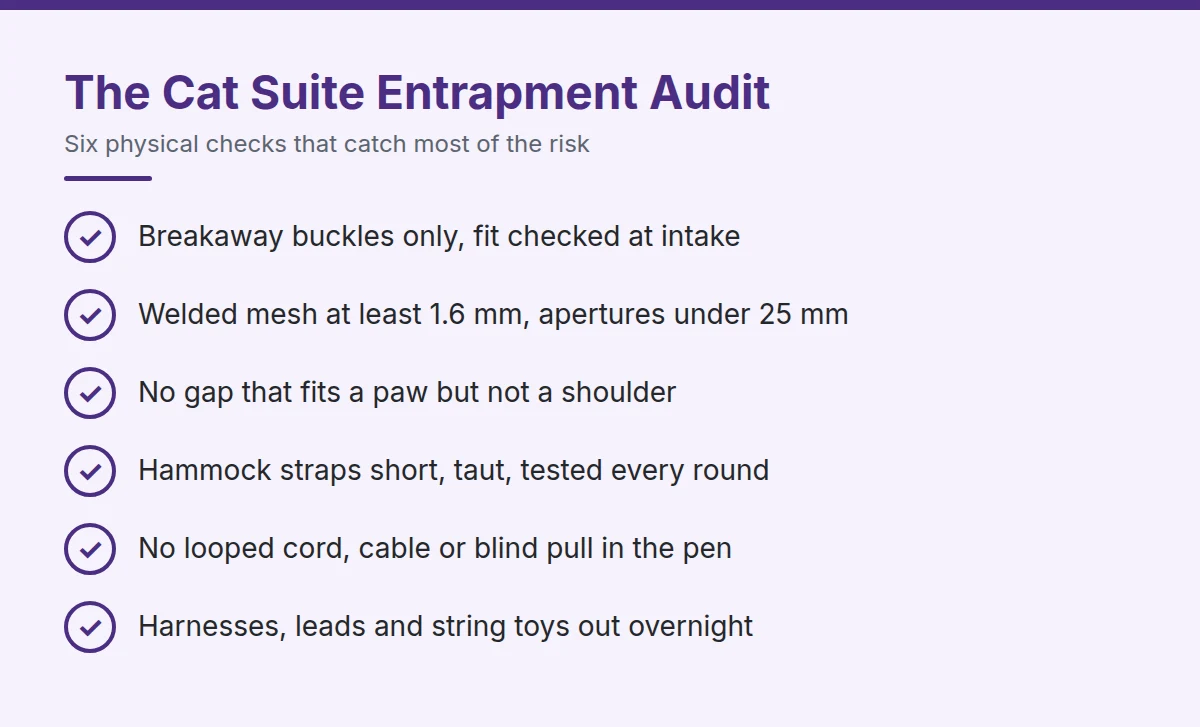
Wire must be at least 1.6 mm in diameter, which is 16 gauge welded mesh, and mesh aperture must not exceed 25 mm in one direction. That combination matters for entrapment as much as for escape. Thin wire bends into a snagging hook; a large aperture lets a head or a limb through. The guidance also requires that there be no sharp edges, projections, or rough edges that could injure a cat, and states the general rule plainly: gaps or openings must be small enough to prevent a cat’s head passing through, or trapping any limb or body parts.
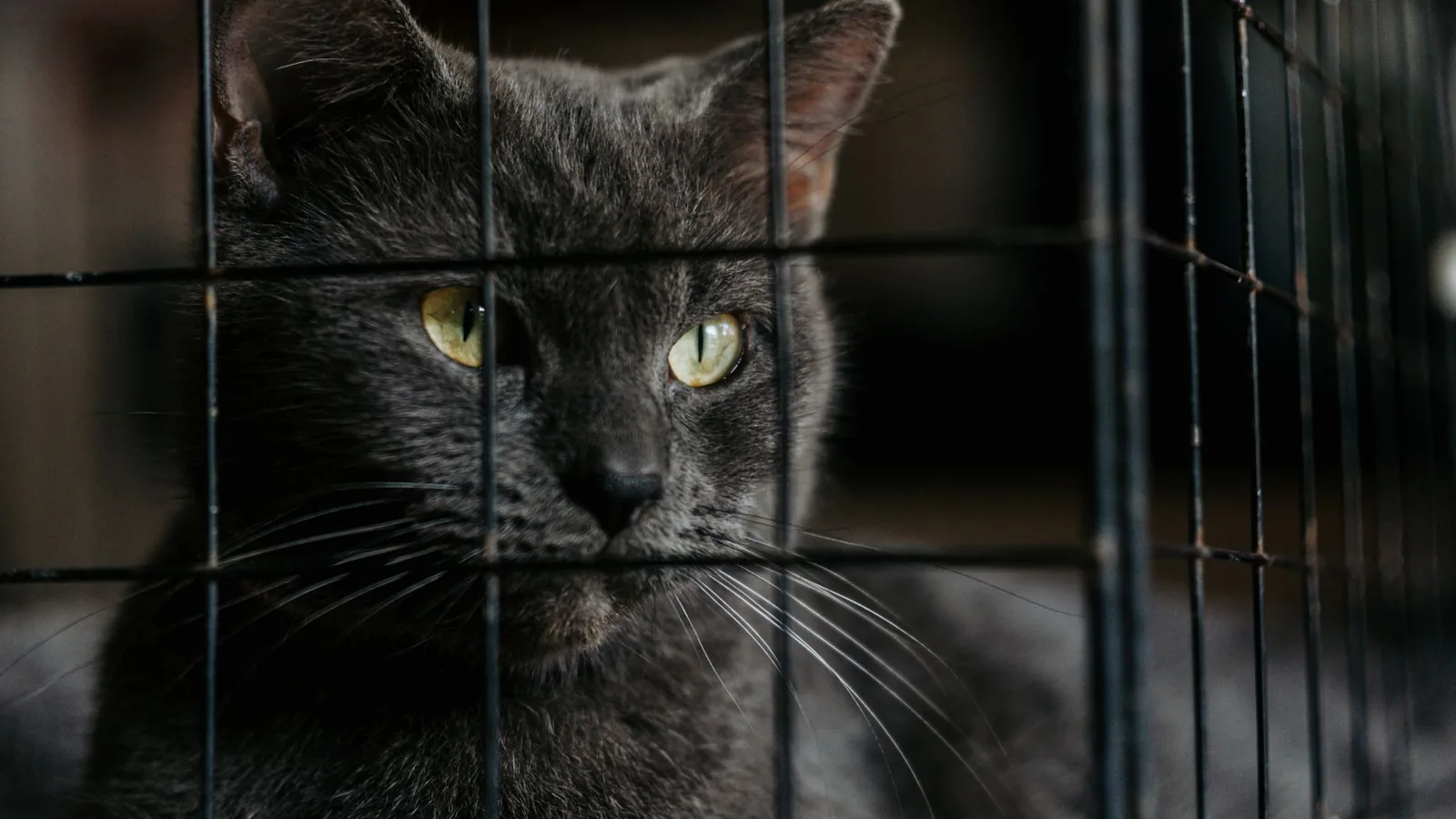
Chicken wire fails both tests and has no place in a cat suite. Neither does a mesh panel that has been repaired with a cut and folded edge, which is exactly the kind of quiet degradation an annual inspection catches and a daily glance does not.
The other gap that matters is the one between units. The same guidance sets a minimum 0.6 m gap between cat units, or a full-height solid sneeze barrier where units adjoin. That spacing is primarily an infection-control measure, and the stocking density guide covers why squeezing units closer together is the decision that starts an outbreak. It has a physical-safety payoff too: units pushed tight against each other create pinch points where a paw pushed through mesh meets the neighbouring frame.
Hanging Furniture: Hammocks, Ropes, and Cords
Every soft hanging thing in a suite is a loop waiting to be made.
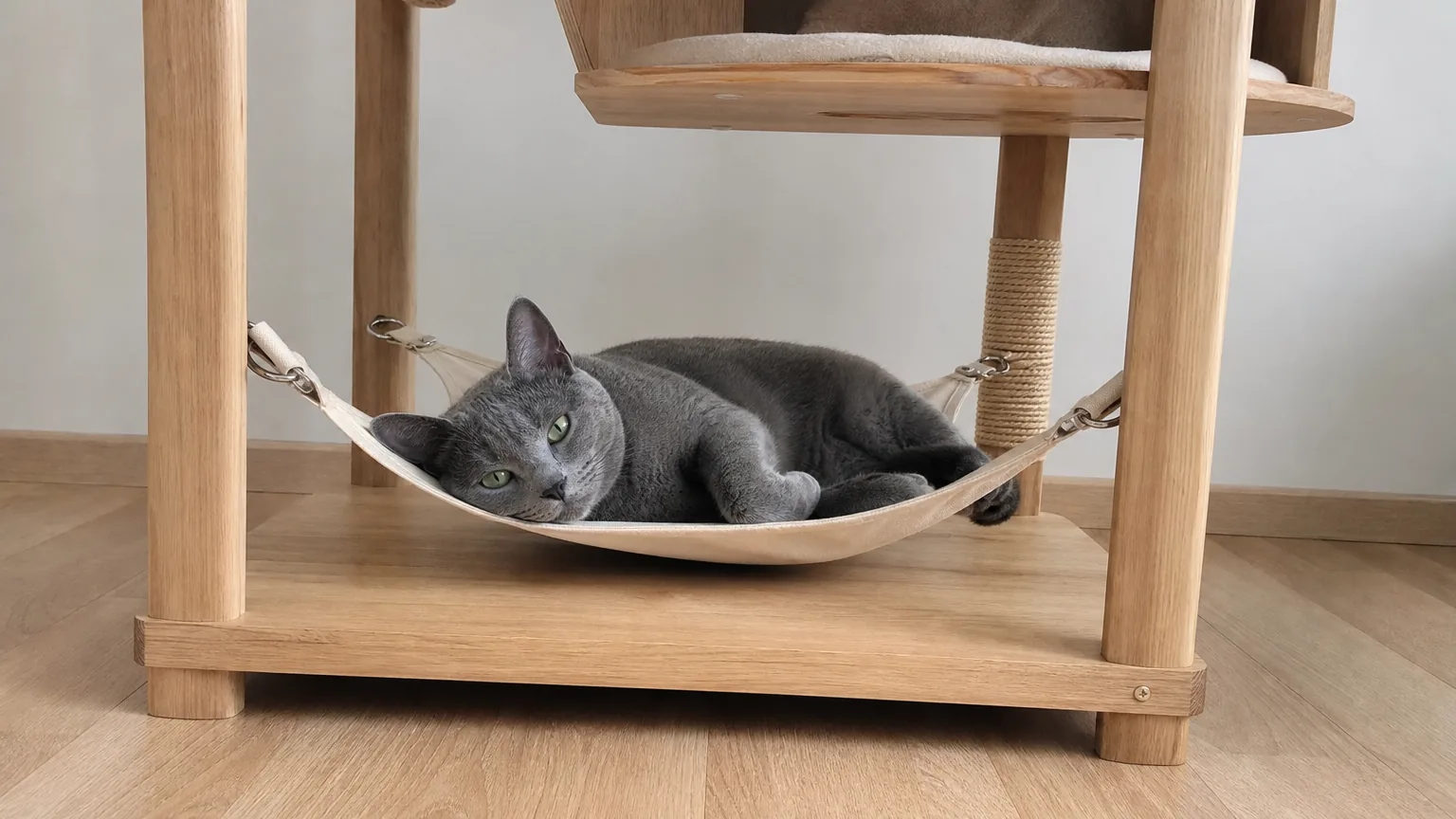
Hammocks are the common one. A hammock slung on four straps with clips is safe when the straps are short and taut and the hammock is loaded. It becomes a hazard when a strap is long enough to form a loop under the weight of a cat that has jumped onto the edge rather than the centre, or when a clip releases on one corner and leaves a single strap dangling. Rig hammocks so straps are as short as the fixing allows, check tension on every round, and prefer hammocks that bolt or velcro flush to a shelf frame over ones suspended on cord.
Cords are worse and easier to fix. Looped blind and curtain cords are a recognised strangulation hazard for small children, which is why modern window-covering safety standards exist at all, and a cat that plays with a dangling cord is doing the same thing a toddler does. There is no version of a cat suite that needs a free-hanging looped cord. Use cordless blinds, or cleat the cord at height outside the suite. The same applies to charging cables for a webcam, thermostat leads, and the pull cord on an extractor.
Climbing furniture should be freestanding and stable or fixed to the wall, with no gap behind it wider than a paw and narrower than a shoulder. The gap behind a shelf is the classic trap: a cat reaches down after a toy, the leg goes in past the elbow, and the shoulder will not follow it back out. Close those gaps with a filler strip rather than trusting the cat not to try.
What Owners Send In
Owners bring things, and most of them are good. Familiar-smelling bedding genuinely reduces stress and should be encouraged. A few categories need a policy.
Harnesses and leads should never stay on an unattended cat, full stop. A harness is designed not to release under load, which is the exact opposite of what you want in a pen. Take it off at intake, bag it, label it, and use it only for supervised handling if the owner has asked for that.
Toys with string, ribbon, feathers on elastic, or tinsel are supervised-play items, not suite furniture. The risk here is swallowing rather than strangling, and it is a serious one: in a twelve-year case series of 56 cats operated on for gastrointestinal foreign bodies, 18 had linear foreign bodies, and those cats had significantly longer surgeries and a higher rate of surgical site infection than cats with a solid object. String saws through intestine in a way a swallowed bottle cap does not.
Beds with drawstrings, zip pulls, or loose trim get inspected, not assumed. So do the cat’s own blankets, which arrive with loose threads and chewed corners the owner stopped noticing years ago.
What a Night Round Should Actually Check
Most catteries run a last round. The difference between a good one and a box-ticking one is whether anyone looks at the hardware instead of the cat.
A round that covers entrapment risk includes: every cat physically sighted, not just assumed present in a hide; collar checked for fit and buckle type if one is on; hammock and shelf fixings pressed for movement; mesh scanned at cat height for a bent, cut, or sprung wire; nothing hanging in a loop anywhere in the suite; no toy with string left in; litter tray, bowls, and furniture back in their positions rather than wedged into a corner; and the cat flap or pop-hole, if the unit has one, checked that it swings freely and has not jammed part-open.
Staff should also know what a struggling cat sounds like versus a vocalising one, which is covered in the feline stress signals guide. A cat caught by the collar does not usually make a lot of noise for very long.
What Owners Should Look At On a Tour
You will not get to inspect mesh gauge with a micrometer, but four things are visible from a corridor.
- Is there a safety corridor? International Cat Care’s guidance is that each unit should open into a safety corridor or safety area, with the outer door shut whenever the inner one is open. It prevents escapes, and it is a reliable proxy for whether the facility was designed by someone who thought about failure.
- Look up. Any cord, strap, or cable hanging in a loop inside a pen is a finding, and it is the easiest one to spot.
- Look at the mesh where it meets the frame. Rust, patched sections, and cut ends are the places wire snags a collar.
- Ask the collar question directly. “What do you do with a cat that arrives in a buckle collar?” A facility with a policy will answer in one sentence. Fold that into the wider tour checklist in the guide to choosing the right cat hotel.
The Regulatory Gap Is Real
The reason this falls to operators and owners is that inspection will not reliably catch it. In New Zealand, where the Waikato case happened, a code of welfare sets minimum standards under the Animal Welfare Act, but Consumer NZ found there is no requirement for routine auditing of pet care facilities; they are generally visited only after a complaint. Of twelve city councils it contacted, only one required catteries to register at all. The SPCA had received 56 complaints about pet care facilities over two years, roughly one a fortnight, including complaints about inadequate security.
England’s licensing regime is stricter and does put a trained inspector inside the building. Even there, an annual visit is a snapshot of a hammock strap that will be a year older by the next one.
So write the physical-hazard audit into your own operating routine, document it, and keep the record. If something does go wrong, a dated inspection log is the difference between an accident and negligence, which is the ground covered in the boarding agreement and liability guide. None of this is expensive. A collar bin at intake, a tape measure, and a round that looks at the fixtures will remove most of it.
Further reading (sources)
- Lord and colleagues on how often collars catch a forelimb, an object, or a cat’s own mouth over six months
- Lascelles and White for reconstruction of chronic armpit wounds caused by forelimb entrapment in a collar
- Brinkley with five more collar-entrapment axillary wounds and how the elbow skin fold is damaged
- Gollnick and colleagues on why linear foreign bodies mean longer surgery and more infection than solid ones
- Defra sets the mesh gauge, aperture and gap conditions for licensed cat boarding in England
- International Cat Care explains what a safety corridor is and why units must have no squeeze-through gaps
- International Cat Care also lists the three ways a collar injures a cat and what a snap-open buckle does
- RSPCA Australia for the breakaway clip recommendation and the one-or-two-finger fit test
- Consumer NZ on why catteries are only inspected after someone complains
- Stuff reported the Waikato owner’s campaign for cattery regulation