Holiday and Peak-Season Cat Boarding: How Far Ahead to Book and What It Costs
Published on August 30, 2026

Every cat hotel has a version of the same phone call. It comes in the second week of December, the caller is polite and slightly frantic, and the answer is no. Not because the facility is unhelpful, but because the rooms were sold in September and there is no elastic in a building with a fixed number of suites.
Peak season is the one part of boarding where the cat’s needs and the market’s mechanics pull in opposite directions. Your cat wants the quietest room in the calmest week with the most experienced staff. The calendar has handed you the loudest week of the year, at the highest price, with the thinnest availability. This guide covers how the peak windows actually work, how far ahead to book each one, what the surcharges and deposits really mean, and what to do when your first choice is already full.
When Peak Season Actually Starts
The first thing to understand is that peak season, from the facility’s side, begins the day bookings open rather than the day the holiday arrives. By the time the holiday is visible on your calendar, the inventory decision has already been made by other people.
The major windows in most Western markets are predictable. Thanksgiving in the US runs from the Wednesday before through the Sunday after, and it is the single most compressed window of the year because almost everybody travels on the same four days. Christmas and New Year form one long block from roughly December 20 to January 2, and it is the highest-revenue stretch most catteries have. Spring break is messier, spreading across February and March depending on school district, which means facilities in university towns and family suburbs see a rolling four to six weeks rather than one spike. Summer, mid-July through the end of August, is not a spike at all but a plateau, sustained high occupancy that quietly eats the rooms you assumed would always be there.
Then there are windows that a lot of guides skip. China’s Spring Festival is arguably the most intense pet-boarding crunch on earth. Reporting on the 2023 holiday found nationwide boarding demand surging as people finally traveled home for family reunions, with Beijing boarding fees rising by as much as 40 percent and premium daily care advertised at 599 yuan. A Beijing operator running five cat-only venues told China Daily that its accommodation was fully booked three months before Spring Festival, and that all five sites filled. In the UK the school half-terms matter more than most owners expect, and in the Gulf the picture inverts, with the summer exodus from cities like Dubai creating a long high season while the winter months stay comparatively easy.
How Far Ahead to Book
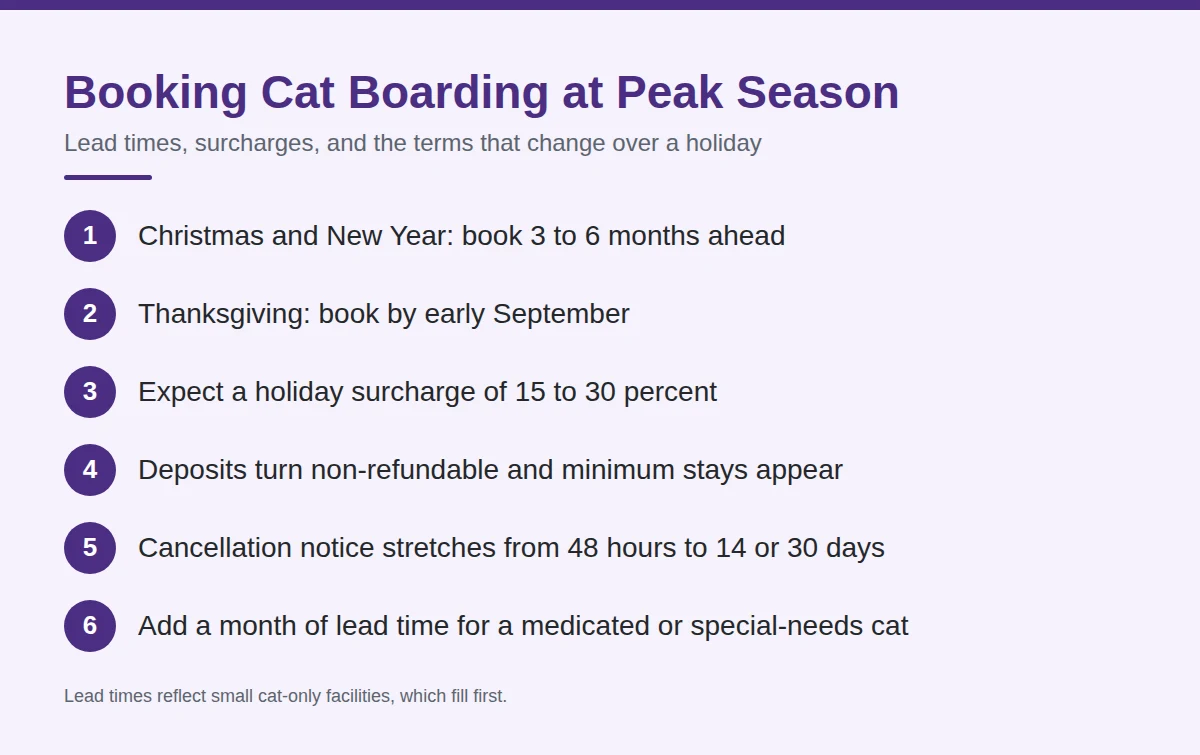
The honest answer varies by facility size, but these lead times reflect what actually happens at cat-only boutiques, which are small and fill first.
- Christmas and New Year: three to six months. Book by September. Popular cat-only facilities in dense cities are effectively gone by October.
- Thanksgiving: two to three months. Book by early September.
- Spring Festival and other major cultural travel holidays: three months at minimum, and the Beijing example above shows why.
- Spring break: six to eight weeks, earlier if you are in a school-district cluster where everyone breaks the same week.
- Summer: two to three months for July and August, especially if your dates are flexible only within a narrow band.
- Ordinary weekends: one to two weeks, and this is the baseline that lulls people into missing the holiday deadlines.
Two adjustments. If your cat needs medication, a special diet, or a ground-floor suite, add a month to everything, because the subset of rooms that suit them is smaller than the total. And if you are a returning client, ask whether the facility opens holiday booking to existing customers first. Many do, quietly, and the difference between the internal list and the public one is often the whole difference between getting a room and not.
Why the Price Goes Up, and What Is Negotiable
Holiday surcharges are close to universal. They usually take one of three shapes: a flat holiday fee per stay, a per-night premium of a few dollars per cat, or a percentage uplift of roughly 15 to 30 percent on the nightly rate. Our complete cat boarding pricing guide maps the underlying rates across facility tiers, and the holiday uplift sits on top of whichever tier you have chosen.
The surcharge is not pure opportunism, though some of it is simple demand pricing. Holiday staffing genuinely costs more, because someone has to be scooping litter at seven in the morning on Christmas Day and is being paid a premium to do it. Occupancy at 100 percent also means every suite turns over on the same two days, which is when cleaning and disinfection between guests gets rushed at weaker facilities. That is worth knowing when you are comparing quotes: a cheap holiday rate at a full house can be a signal about corners, not a bargain.
What is actually negotiable is narrower than most people hope. The nightly rate and the holiday surcharge itself almost never move. What sometimes moves is everything around them. Add-on services get bundled if you ask, so the daily play session or the webcam fee that would normally be billed separately can be folded into a long peak booking. Multi-cat rates are real: two cats who genuinely get along and can share one suite usually cost far less than two rooms, and our guide to boarding bonded pairs in a shared suite covers how to judge whether yours qualify, because a peak week is the worst possible time to discover they do not. Shoulder dates are the biggest lever of all. Dropping off on the Monday before Thanksgiving instead of the Wednesday, or collecting on January 3 instead of January 1, can move you out of the surcharge band entirely at some facilities and is easier on the cat besides.

Deposits, Minimum Stays, and the Clause That Bites
Peak-season terms are stricter than the terms you agreed to in April, and they are usually the same document with different clauses activated. Read them before you pay.
Deposits go non-refundable. Off-season, a deposit is often just a hold. Over a holiday it commonly becomes a non-refundable payment of one or two nights, or in some cases the full stay charged up front. The logic is straightforward, since a cancellation on December 22 leaves a room that cannot be resold.
Minimum stays appear. Many facilities impose a three-, five-, or seven-night minimum across the peak block. If you need four nights over Christmas at a facility with a five-night minimum, you pay for five. Budget for the minimum, not for your actual trip.
Cancellation windows lengthen sharply. A 48-hour notice period off-season routinely becomes 14 or even 30 days over a holiday. Cancel inside the window and you are typically liable for the full stay, not the deposit.
Late pickup penalties get real. A delayed flight home on January 2 can trigger an extra night at the holiday rate, sometimes plus a fee, because your suite has already been promised to the next guest. Ask what happens if you are stuck, and get the answer in writing.
When Your First Choice Is Full
Being late is common, and it is recoverable. Work down the ladder in this order rather than panicking at the bottom of it.
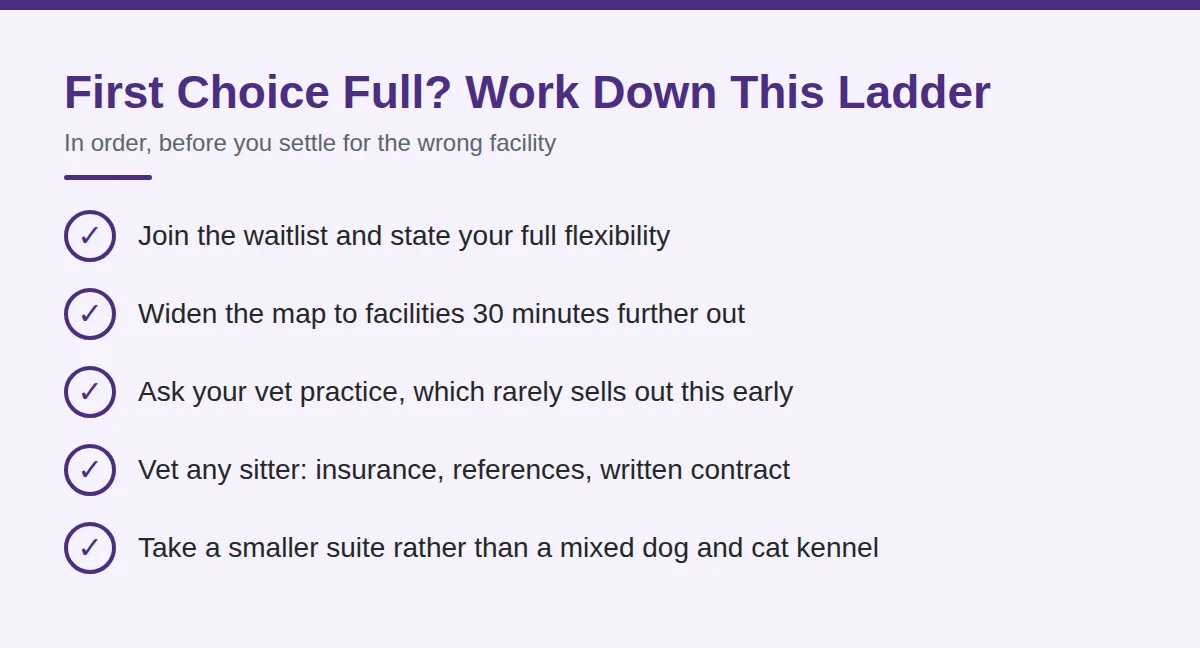
Start with the waitlist, and be specific about your flexibility, because “any suite, either drop-off day” gets called before “the garden room, Wednesday only.” Holiday cancellations do happen, and lists move in the final fortnight. Next, widen the geography: a facility 30 minutes farther out is frequently wide open when the ones in town are not, and one longer car journey at each end is a small price for a suite in a quiet building. Then ask your veterinary practice, since many clinics board a handful of cats and rarely sell out as early as boutiques do. Vet boarding is plainer, but for a healthy cat over a short stay it is perfectly sound, and for a medically complex cat it can be the better option anyway.
Below that come the alternatives that need more care. In-home pet sitting expands to absorb holiday overflow, which is exactly why it needs vetting: reporting on China’s Spring Festival rush described owners who could not get a boarding place turning to online sitters in a market with very little standardization and often no written contract. Insist on insurance, references, a written agreement, and a meet-and-greet before you leave. Finally, if the facility offers it, a shared suite with a friend’s cat or a smaller room than you wanted is usually better than a scramble. What is not on the ladder is a mixed dog and cat kennel with no separation, at any point. A full house of barking dogs over the loudest week of the year is the one substitution genuinely worth refusing.
Prepping a Cat for the Busiest Week of the Year
A peak-week stay asks more of a cat than a quiet March weekend does, so front-load the preparation.
Sort vaccinations early. Most facilities require FVRCP and rabies to be current, and many require them to have been given 7 to 14 days before arrival, so a booster on the morning of drop-off can get you turned away. Our guide to boarding vaccination requirements covers timing and accepted proof formats. Book the vet appointment a month out, because vet clinics are busy in December too. One Beijing cat hotel makes the standard explicit, requiring vaccination certificates, good health, and recent deworming before a cat is accepted at all.
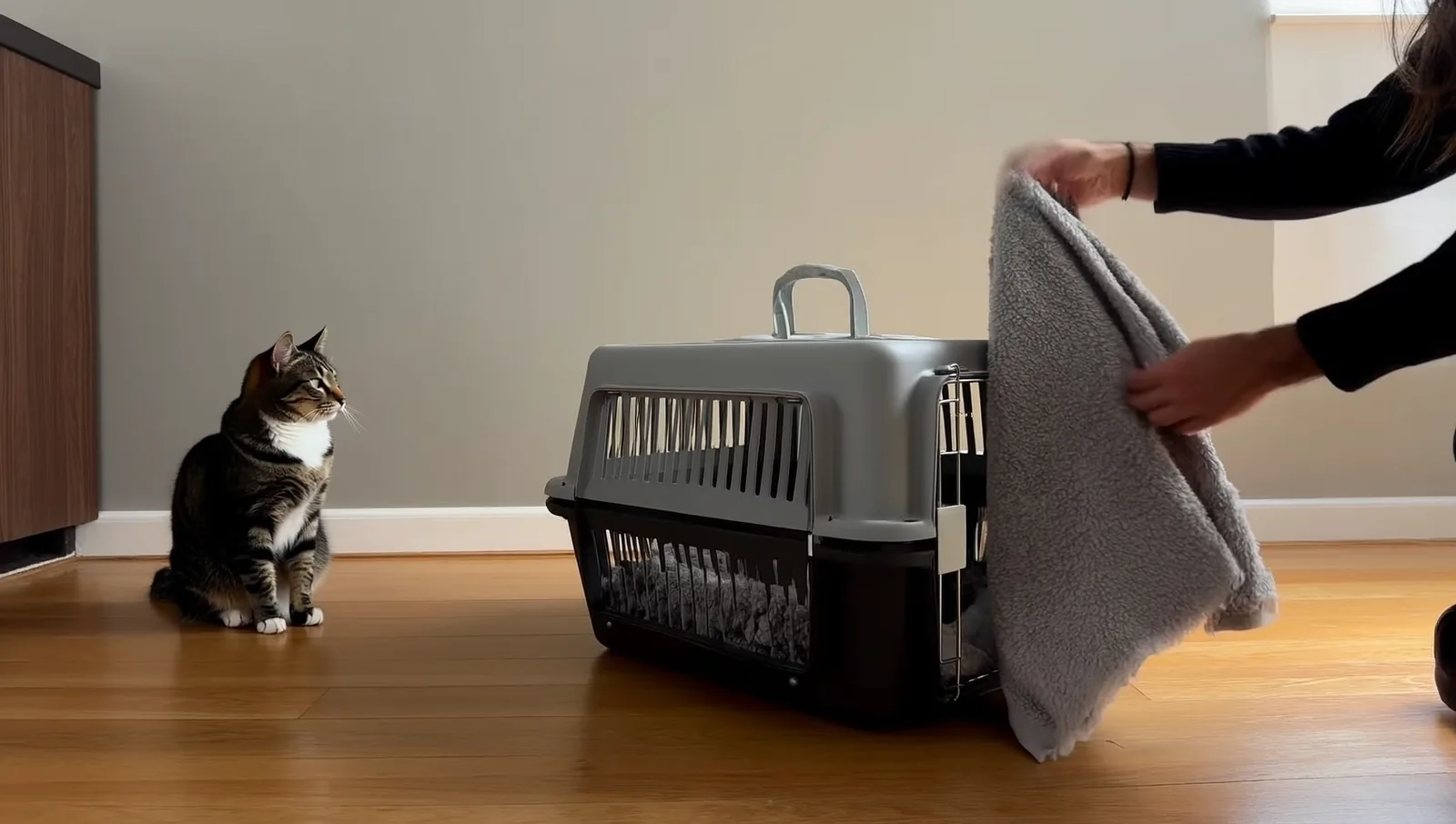
Then manage the house. Peak stays sit inside your own busiest weeks, and cats read the signs early. Suitcases out, deliveries arriving, visitors in the living room and a schedule that has stopped resembling normal all register days before you leave, which is the anticipatory stress described in our piece on whether cats know you are leaving town. Leave the carrier out for two weeks rather than producing it on the morning. Keep feeding and play times anchored even when everything else slips.
Pack for a full house. Send an unwashed blanket or a worn T-shirt, because scent is the strongest piece of home a cat can carry, and it matters more when the building is at capacity and smells of thirty other cats. Send the exact food, in enough quantity for the full booked stay plus two days. Label medication clearly with written instructions rather than relying on a verbal handover at a chaotic reception desk.
Finally, ask the health question directly, because occupancy and infection risk move together. A facility at 100 percent has less isolation space, more turnover, and more cats sharing an air-handling system, all of which is why our URI prevention guide puts ventilation zoning and isolation capacity ahead of almost everything else. Ask what happens if a cat develops a cold during your dates and whether the isolation room is currently occupied. During a peak week, the answer tells you more about the facility than the tour did.
The Short Version
Book Christmas in September, Thanksgiving in early September, spring break six to eight weeks out, and add a month if your cat has any special requirement. Expect a surcharge of 15 to 30 percent, a minimum stay, a non-refundable deposit, and a cancellation window measured in weeks rather than days. Read those clauses before you pay, negotiate the shoulder dates rather than the rate, and if you have left it late, work the waitlist and widen the map before you settle for a facility that boards cats alongside dogs. The rooms are finite, the calendar is not a surprise, and the owners who get the quiet suite in the good building are simply the ones who called first.
Further reading (sources)
- China Daily on pet hotels booked solid three months before Spring Festival
- Dao Insights for how holiday demand pushed Beijing boarding fees up by 40 percent
- Norwich Evening News with a look at how a boutique six-suite cat hotel is set up
- Yahoo Style Singapore covering the pet hotels that fill first in a dense city market
- WOW-RAK surveying luxury cat boarding options across Dubai