Boarding a Kitten: Minimum Age, Fear Periods, and Why Young Cats Need a Different Suite
Published on September 11, 2026
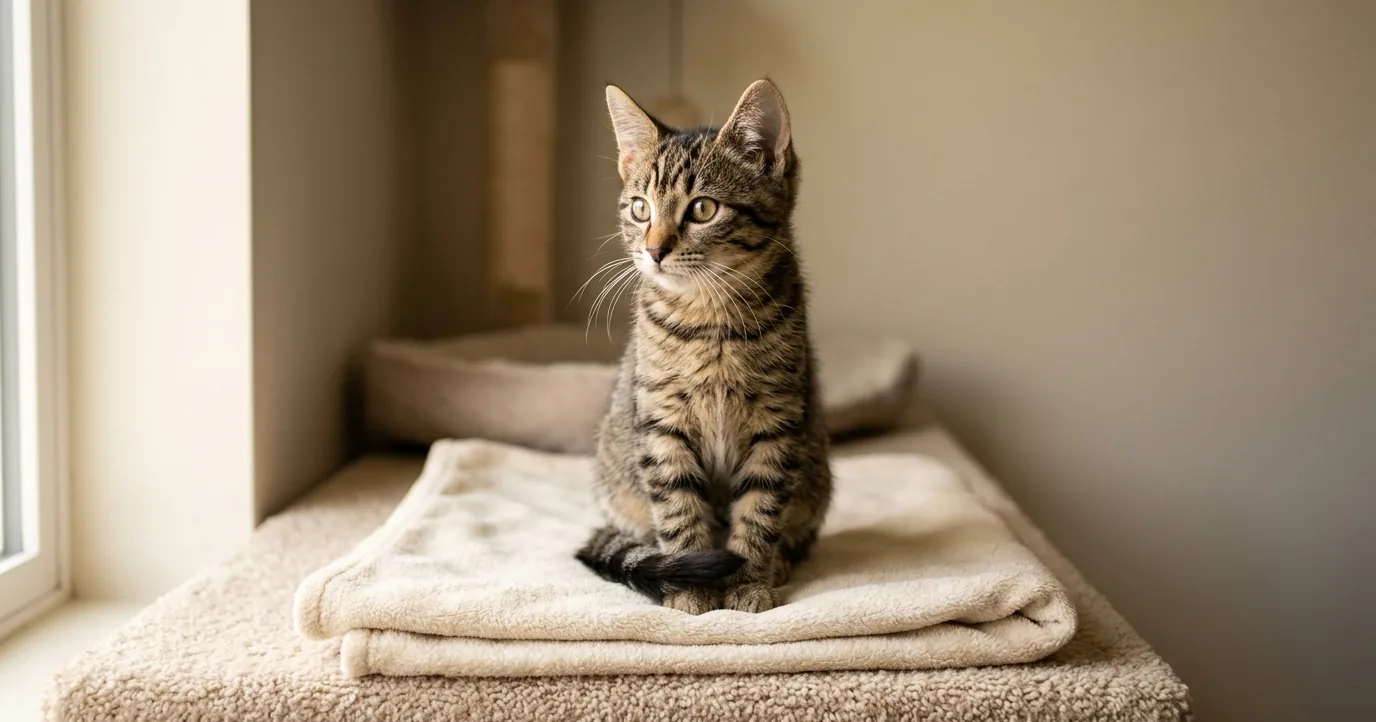
A kitten is not a small adult guest. Our guide to boarding a senior cat deals with a body that is running out of reserve, and the answer there is to design everything downward: ground-level litter, soft bedding, no jumping. A kitten has reserve to spare. What it does not yet have is a finished immune system or a settled opinion about the world, and both of those facts change how a stay should be built.
The second one is the part owners underestimate. A few days at a cattery at five months old is not just a few days of care. It is a set of first impressions about carriers, strangers, handling, and confinement, laid down at an age when impressions stick hard. Get it right and you have a cat that travels well for the next fifteen years. Get it wrong and you can spend those fifteen years wrestling a carrier out of a wardrobe. This guide is for owners of cats under a year, and for operators writing a kitten policy that a staff member can actually follow.
Why Most Catteries Set a Minimum Age
Ask five facilities and you will hear four different numbers. Some take kittens from 12 or 16 weeks, many set four months, and a fair number will not board a cat under six months at all. The variation looks arbitrary from the outside, but the reasoning behind it is consistent, and it comes down to four things.
The vaccine series is not finished before 16 weeks at the earliest. That alone rules out most younger kittens, and it is the reason a minimum age and a vaccine rule are two separate gates rather than one.
Very young kittens are physiologically fragile. They regulate their own temperature poorly, carry small energy reserves, and go downhill faster than an adult when they stop eating. Overnight care at that age is closer to nursing than to hospitality.
Licensing and insurance often set a floor. Local animal boarding regulations and the facility’s insurer may specify a minimum age or require proof of a completed primary course, and no amount of owner persuasion moves that line.
Staffing is the quiet constraint. A kitten needs three or four meals a day, more litter changes, more supervised play, and more frequent eyes on it. A facility that has honestly costed a kitten stay knows it is not the same labor as an adult in the next suite.
A well written policy states both gates plainly: a minimum age in weeks, and a requirement that the final dose of the primary vaccine course was given at least seven to fourteen days before drop-off. Facilities that state only one of the two end up taking a 20-week kitten that had its last shot yesterday, which is the exact cat they were trying to avoid.
The Immunity Gap: Why a Half-Finished Series Is Not Half Protection
The kitten vaccine course is a series for a reason that has nothing to do with topping up a dose. Kittens absorb antibodies from their mother’s first milk, and those maternally derived antibodies protect the kitten for a while. They also block vaccines. The same antibody that neutralizes a field virus will neutralize the modified virus in a vaccine, so a dose given while maternal antibody is still high does very little.
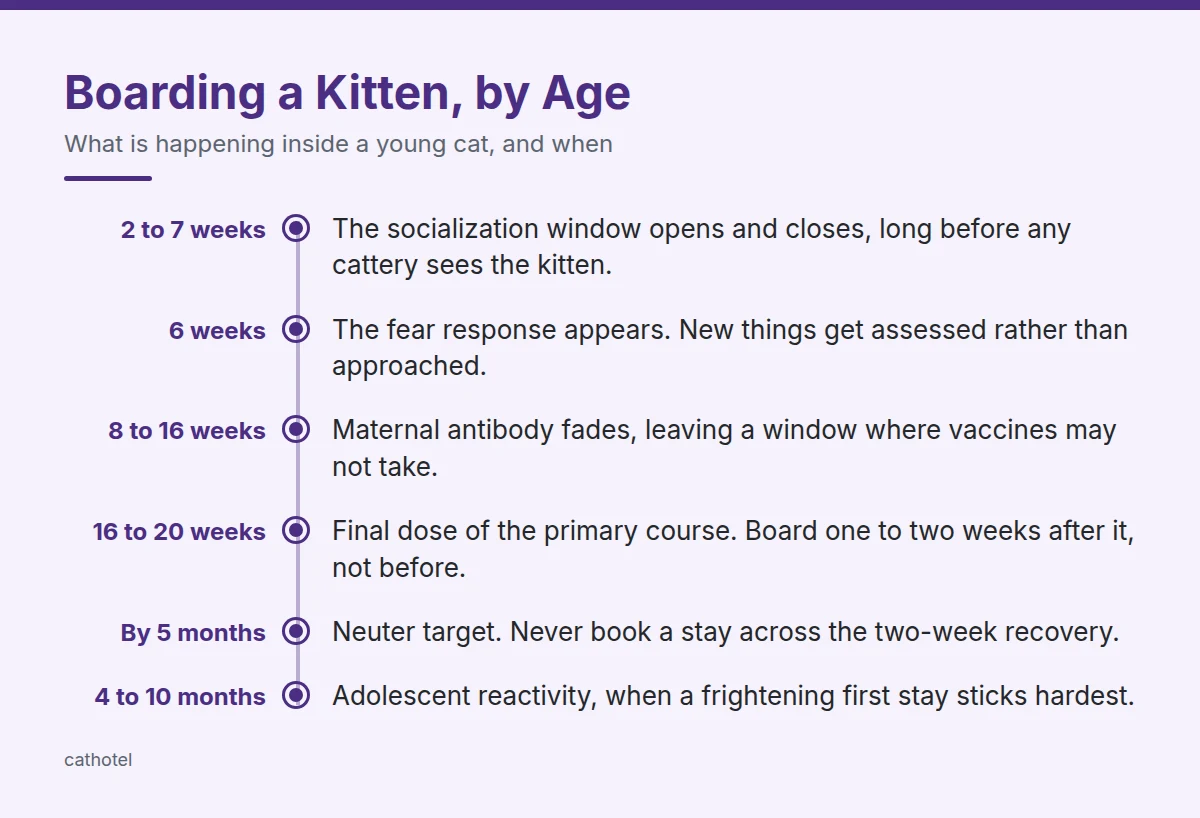
The problem is that maternal antibody fades at a different rate in every kitten, somewhere between about 8 and 16 weeks, and occasionally later. That creates a window of susceptibility: a stretch of days or weeks where the borrowed antibody is too low to protect but still high enough to spoil the vaccine. Nobody can tell from the outside which week a given kitten is in, which is why guidelines call for repeat doses every three to four weeks until the kitten is at least 16 weeks old, with many recommending a final dose at 16 to 20 weeks (AAHA/AAFP, 2020; WSAVA).
So a kitten with two of three FVRCP doses is not “mostly vaccinated”. It may be fully protected, or it may be sitting in the gap. Our complete guide to cat boarding vaccinations covers each vaccine and the proof formats facilities accept, but two points matter more for a young cat than for any adult. Rabies is normally a single dose from 12 weeks of age, with a booster a year later, so the timing rarely lines up neatly with the end of the FVRCP course. And feline leukemia virus vaccination is recommended for all kittens, not just outdoor ones, because susceptibility to persistent FeLV infection after exposure is highest in young cats and falls off with age.
The practical rule for owners is simple. Book the stay for at least one to two weeks after the final dose of the primary course, so the immune response has time to mature. And accept that a young cat is still the guest most likely to come home sneezing, for reasons we unpack in why URI risk spikes right after drop-off.
Fear Periods, and Why a First Stay Is Formative
Cats socialize early and fast. The sensitive period during which a kitten readily accepts new people, animals, sounds, and handling runs from roughly two to seven weeks of age, far earlier and far shorter than a puppy’s. By the time a kitten arrives at a cattery at four or five months, that window has closed. What remains is a long, more gradual period in which experience still shapes the adult cat, but good experiences accumulate slowly and frightening ones land in a single hit.
The fear response itself emerges around six weeks, which is when a kitten’s default behaviour toward something unfamiliar shifts from approach to assessment. Adolescence brings a second wobble. The evidence for a discrete second fear period in cats is thinner than the equivalent literature in dogs, but the pattern is familiar to anyone who has run a ward: somewhere between four and ten months, cats that were confident as small kittens become noticeably more reactive to novelty, and a bad experience in that stretch is unusually durable.
This is the case for treating a kitten’s first stay as training rather than storage:
- Let the cat come out of the carrier itself. Open the door, stand back, wait. A kitten tipped or pulled out learns that carriers end badly, and that lesson generalizes to every vet visit afterward.
- Handle on the cat’s terms. Short, gentle, choice-based contact beats a long cuddle that the kitten cannot leave. Scruffing has no place here.
- Pair people with food and play. A kitten that gets a wand toy and a treat every time a human appears forms an association worth years of easy handling.
- Do not force socializing. A kitten pressed nose to mesh with a hissing adult next door is learning something, and it is not what you wanted it to learn.
- Keep cats away from dogs entirely. That is true for every cat, and non negotiable for a young one forming lifelong impressions.
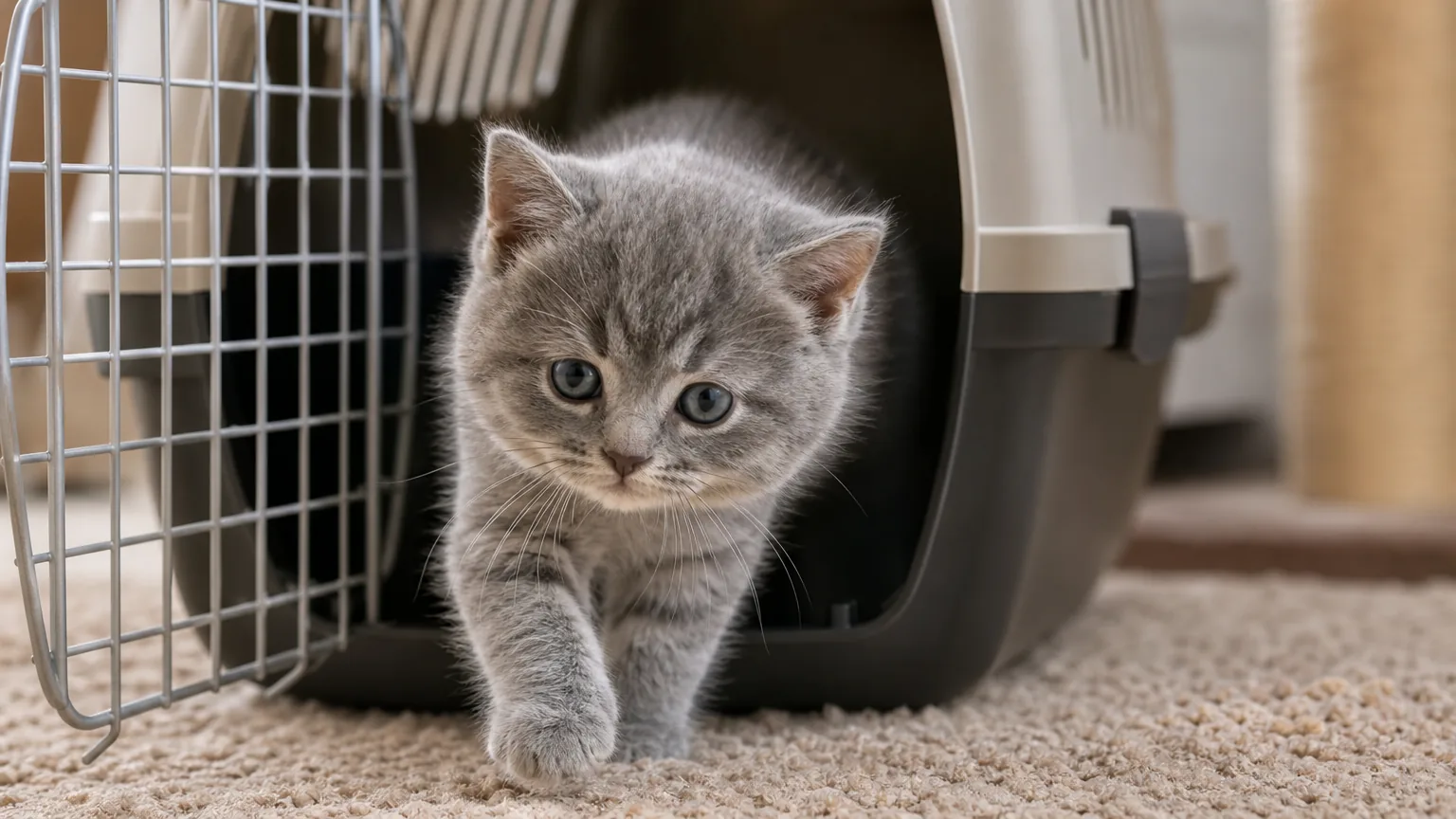
Kitten stress also looks different. An adult under pressure goes still and small, while a kitten may bounce off the walls, play frantically, or eat and then hide. Frenetic activity is easy to read as a cat having fun. Our guide to reading feline stress signals at boarding covers the quieter tells that matter more than the noisy ones.
Neuter Timing, and the Window You Should Not Book Across
Most kittens are now neutered earlier than their owners expect. Shelters routinely neuter from eight weeks, and the veterinary consensus behind the Feline Fix by Five campaign is that private practice should aim for five months, before a female’s first heat.
Two rules follow for boarding. First, never book a stay across the post-operative window. Practices typically ask for 10 to 14 days of restricted activity and daily incision checks after a spay, and a four-month-old kitten will not respect restriction no matter who is watching. Finish the surgery at least two weeks before the stay, or schedule it after you get back.
Second, tell the facility whether the cat is entire. A queen can come into heat from around four months, and an in-heat queen calling for three days is miserable for herself and unsettling for the whole wing. Intact young males may spray in an unfamiliar space. Neither is a reason to refuse a booking, but both change which suite the cat should go in.
If your kitten has a chronic condition, a known heart murmur, or a behavioral issue that worries you, talk to your veterinarian before you book rather than after.
Feeding: Frequency Is the Thing That Changes
A growing kitten eats a diet formulated for growth, two to three times the calories per kilogram of an adult, and it eats often. Under six months that generally means three or four meals a day; from six to twelve months, two or three. A facility that feeds twice daily as standard needs to say plainly whether it can manage four, and to price it honestly.

The stakes are higher than with an adult. A kitten’s energy reserves are small, and a very young one that refuses food can become hypoglycemic within a day rather than a week. Weigh a kitten guest daily on a gram scale and record it. A growing cat should hold its weight or gain, and a flat line over two days is a reason to act, not a sign the cat is settling in. Do not change the food. Send the kitten’s own diet, portioned and labeled, with extra in case the stay runs long.
A Suite Built for Energy, Not for Rest
Where a senior suite is designed down, a kitten suite is designed up, and then audited for gaps.
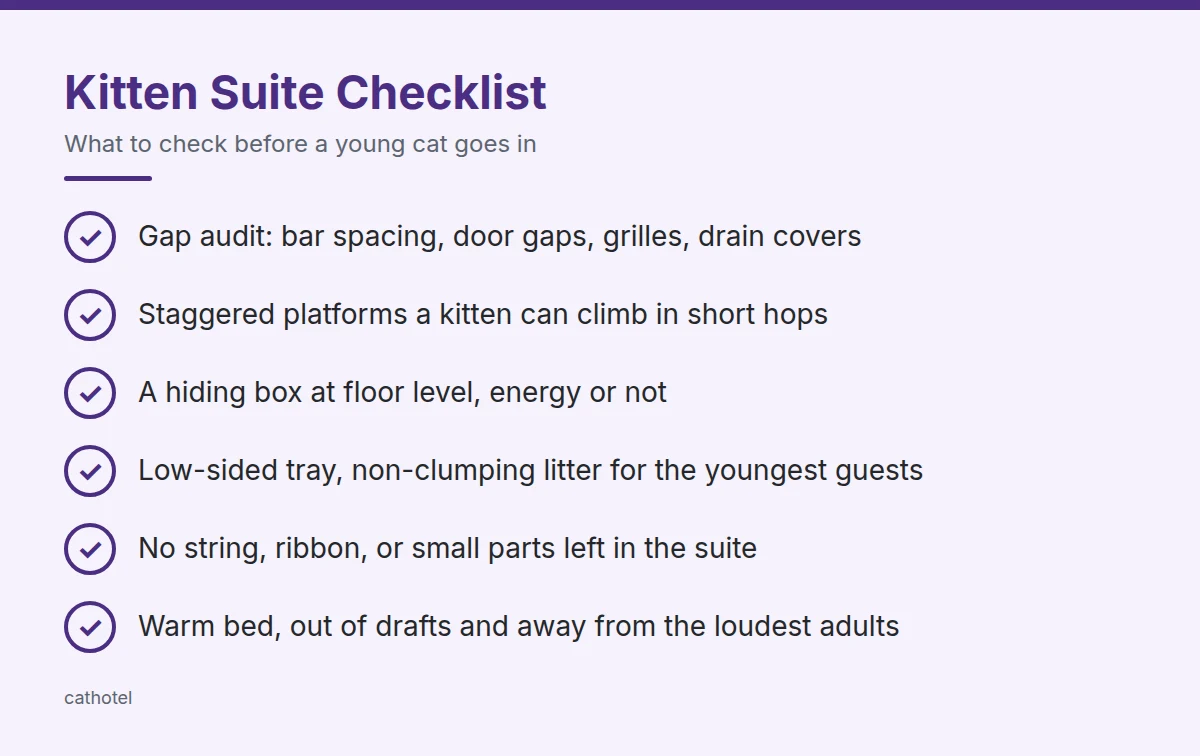
Climbable in stages. Staggered platforms a kitten can reach in two or three short hops, on stable freestanding furniture that cannot tip when something small launches off it. One big leap to a single high shelf is how young cats fall.
Gap-proof. A kitten fits through a gap barely wider than its own skull. Before a young cat goes in, someone should physically check bar spacing, the gap under the door, ventilation grilles, drain covers, and the space behind fixed cabinets. This is the single most common way a kitten stay goes wrong.
A hiding box anyway. Energy does not cancel the need for cover. A simple box with one entrance, at floor level, gives a kitten somewhere to reset.
Safe litter and safe toys. A low-sided tray it can climb into, and non-clumping litter for the youngest guests, who taste things. No string, ribbon, tinsel, or small detachable parts left in the suite. Linear foreign bodies are a classic kitten emergency, and wand toys should be supervised and then put away.
Cleaned with a kitten in mind. Young cats lick and chew every surface they meet, so disinfectant choice, contact time, and rinsing matter more here than anywhere else in the building. Our guide to chemical and toxic hazards in a cat boarding facility sets out what belongs in the cupboard and what does not.
Warm, and well placed. Kittens lose heat faster than adults, so a warm bed out of any draft. Site the suite away from the loudest, boldest adult guests.

Then add the things that make any stay easier: something from home that smells of you, a worn t-shirt or an unwashed blanket, a trial overnight before a long trip, and a few weeks of carrier training with the door left open in the living room. A kitten that has eaten dinner in its carrier twenty times does not fear it.
What to Ask Before You Book a Kitten In
- What is your minimum age, and how long after the final vaccine dose do you require?
- How many meals a day can you feed, and is there a charge for extra feeds?
- Do you weigh kittens daily and record it, and at what point do you call me or a vet?
- Has this suite been checked for gaps a kitten could get through?
- What does the play schedule look like, and who does it?
- How far is the kitten’s suite from the loudest adults, and from any dogs on the site?
- What is your handling policy, and does anyone scruff?
- Can I do a single trial night first?
A facility that boards kittens regularly answers all eight without pausing. Vagueness on the gap audit or the feeding schedule is the answer, whatever words come with it.
Boarding a kitten well is not harder than boarding a senior, it is just a different set of constraints: an immune system that is still catching up, a temperament still being written, and a body that eats often and fits through small spaces. Plan around those three and the first stay becomes exactly what you want it to be, which is unremarkable.
Further reading (sources)
- AAHA and AAFP on the 2020 joint feline vaccination guidelines and the kitten series schedule
- WSAVA for why maternal antibody dictates the timing of the final kitten dose
- International Cat Care with what the early socialization window does and does not cover
- International Cat Care on the developmental stages a kitten moves through in its first year
- Feline Fix by Five on the veterinary case for neutering before five months
- Cornell Feline Health Center for feeding frequency and growth diets in young cats
- AAFP and ISFM set out handling technique for a cat that is frightened rather than difficult