Travel Stress and Sick Cats: Why URI Risk Spikes Right After Drop-Off
Published on September 2, 2026
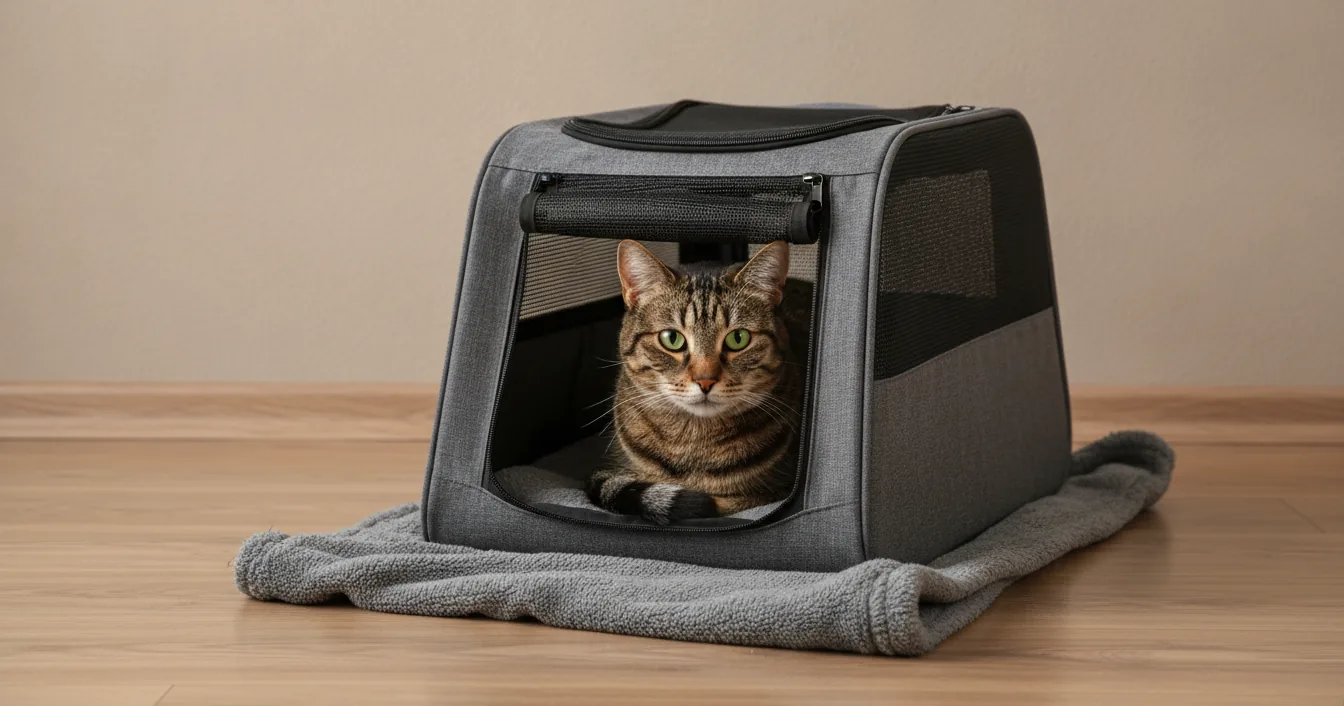
The call comes on day three or day four, and it always sounds the same. The cat went in perfectly healthy. She had a vet check the week before. Now she is sneezing, one eye is weeping, and the owner wants to know what happened at the facility.
Something did happen at the facility, but not usually the thing owners imagine. The most common answer is not a dirty suite or a sick cat two doors down. It is that the car ride, the carrier, the strange smells, and the handover all landed on the same nervous system inside a couple of hours, and the virus that cat has been carrying quietly since kittenhood woke up. The clock on that process starts at pickup, not at check-in, and the highest-risk window closes long before most owners think to worry.
What the Relocation Research Shows
The cleanest data on this comes from a place you would not immediately think to look: animal welfare transport programs, which move large numbers of cats long distances and then track what happens to them. A 2018 study by Aziz and colleagues followed 430 cats relocated through an established program over seven months and recorded infectious disease at the destination agency. Upper respiratory infection had a period prevalence of 25.8%. Roughly one cat in four came down with a cold.
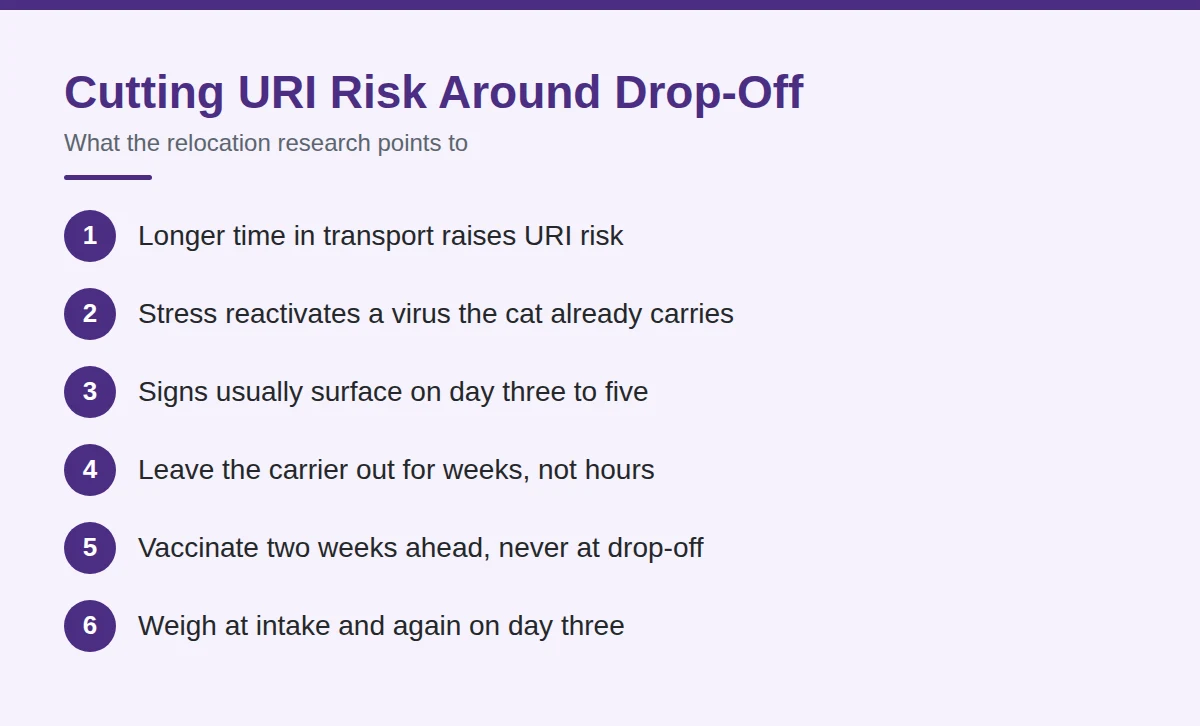
What matters more than the headline number is the list of things that predicted it. Three factors were associated with higher URI prevalence: younger age, longer length of stay at the destination, and increased time in transport. Transport time was not a proxy for crowding or for a bad facility. It was its own independent risk factor. The longer a cat spent moving, the likelier it was to get sick afterwards.
The other two diseases the study looked for were reassuringly rare: feline panleukopenia in 1.6% of cats and ringworm in 0.9%. A well-run program keeps the environmentally persistent, terrifying pathogens under control. Respiratory disease slips through anyway, because it is not really an environmental hygiene problem. It is a stress problem wearing a hygiene problem’s clothes.
The Virus Was Already There
Here is the part that reframes the whole conversation for most owners. Feline herpesvirus-1 (FHV-1) is the main driver of boarding-related colds, and the large majority of adult cats have already met it. After the initial infection, usually in kittenhood, the virus does not clear. It retreats into the trigeminal ganglia, the nerve bundle behind the face, and sits there in a latent state indefinitely.
Cortisol is what wakes it up. A surge of stress hormone suppresses mucosal immunity, secretory IgA antibody production drops in the nose and gut, and the latent virus starts replicating and shedding again. This is why a cat who has had no contact with another cat in six years can develop a textbook upper respiratory infection three days into a boarding stay. Nobody gave it to her. She brought it with her, in a nerve, and the trip is what let it out. We cover the immunology of that chain in more detail in our guide to how stress drives cat colds at boarding.
The timing explains the pattern owners find so suspicious. Reactivation is not instant, and neither is the incubation of anything genuinely picked up on site. Shedding restarts within a few days of the stress event, with clinical signs trailing behind it, so the sneezing surfaces on day three, four, or five. That feels like the facility’s fault and is very often the drive there. A cat can also go home apparently fine and start sneezing 48 hours later, because the trip back is a second stress event stacked on a nervous system that never fully recovered from the first.
The practical implication is not comforting but it is useful: by the time you can see the illness, the causal window has already shut. Everything that reduces risk happens before it.
The Week Before Drop-Off
Owner-side preparation is not a nice-to-have here. It is the part of the risk you have most control over.
Get the carrier out early. A carrier that appears once a year, means the vet, and gets used as a trap is a stress amplifier. Leave it out permanently with the door off or tied open, put a blanket and treats inside, and let the cat use it as furniture for two or three weeks before the trip. A cat that walks into the carrier voluntarily arrives at the facility with a meaningfully lower cortisol load than one who was chased under a bed and pushed in backwards. This is the single highest-yield thing most owners never do. Our piece on anticipatory stress before a trip covers the wider at-home preparation window.
Book the vet check with room to spare. Two to three weeks out, not the day before. You want time to treat anything the exam turns up, and you do not want a vet visit sitting immediately in front of the boarding trip as a second transit event.
Time vaccines properly. FVRCP should be given at least two weeks ahead, so immunity has developed and the mild post-vaccination malaise is long past. A dose administered at drop-off is worse than useless: it adds a stressor without delivering protection in time. Worth knowing too that FVRCP reduces the severity of herpesvirus disease but does not prevent latency or reactivation, so a fully vaccinated cat can still get sneezy. The timing rules are in our boarding vaccination guide.
Do not switch food. Whatever the cat is eating, keep it identical and send enough of it. A diet change layered on top of transit stress is how a mild appetite dip becomes a real one.
Talk to your vet about medication if your cat is a hard traveler. Pre-visit gabapentin has decent evidence behind it for transport specifically, and for a cat with a history of chronic herpes flares, an antiviral course timed around the stay is a real conversation to have. Both need a prescription and lead time. Neither should be improvised the morning of.
Drop-Off Day
The goal on the day is boring: make the transit as short, as quiet, and as uneventful as possible.
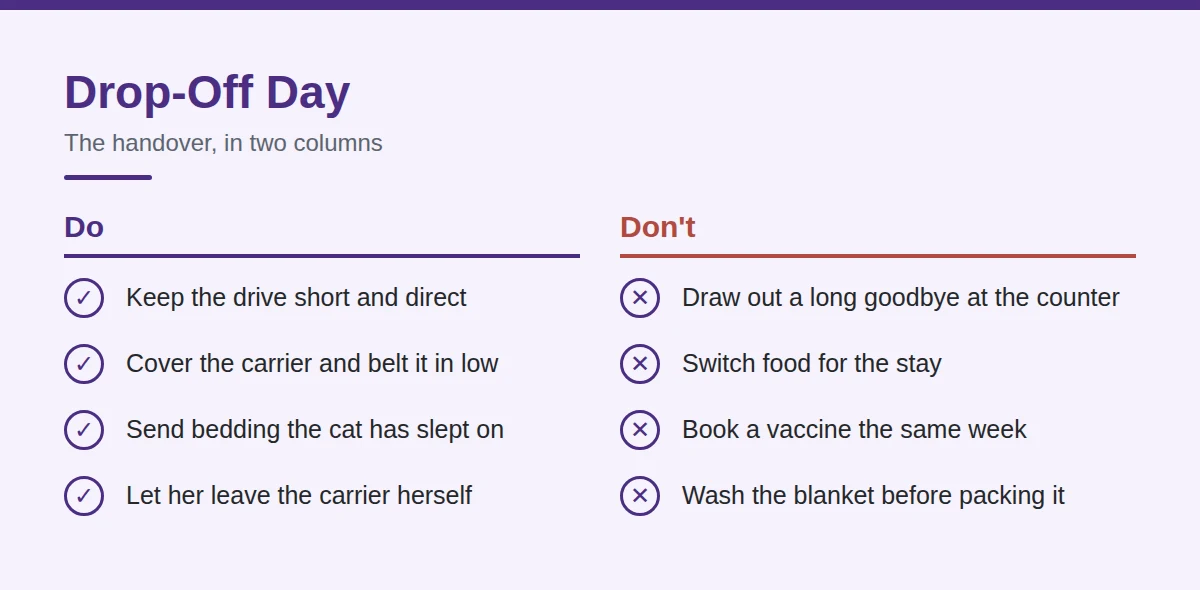
- Keep the drive direct. Transport time is a measured risk factor, so a facility twenty minutes away has a genuine advantage over one an hour out.
- Cover the carrier with a towel and secure it with a seatbelt on the floor or footwell. Visual isolation plus stability beats a view every time.
- Put a blanket the cat has slept on inside the carrier, and send the same blanket into the suite unwashed. Familiar scent is one of the few things that carries across the threshold intact.
- Keep the handover short and calm. Prolonged goodbyes at the counter add several minutes of high-arousal noise and handling for no benefit. Hand over the paperwork, hand over the carrier, go.
- Ask that the cat be allowed to leave the carrier on her own terms. Tipping a cat out into a strange room is the last avoidable stress spike in the sequence.
If all of this makes the trip itself sound like the problem, that is a fair reading, and for some cats it genuinely is. A comparison of in-home sitters and cat hotels is worth reading if your cat is elderly, medically fragile, or a spectacularly bad traveler, because removing the transit removes this whole risk pathway.
What Good Facilities Do in the First 72 Hours
Operators should treat the first three days as a distinct clinical phase, not just the start of the stay.
Ask about transport on the booking form. Journey time and whether the cat is carrier-trained are two cheap questions that identify your highest-risk arrivals before they walk in.
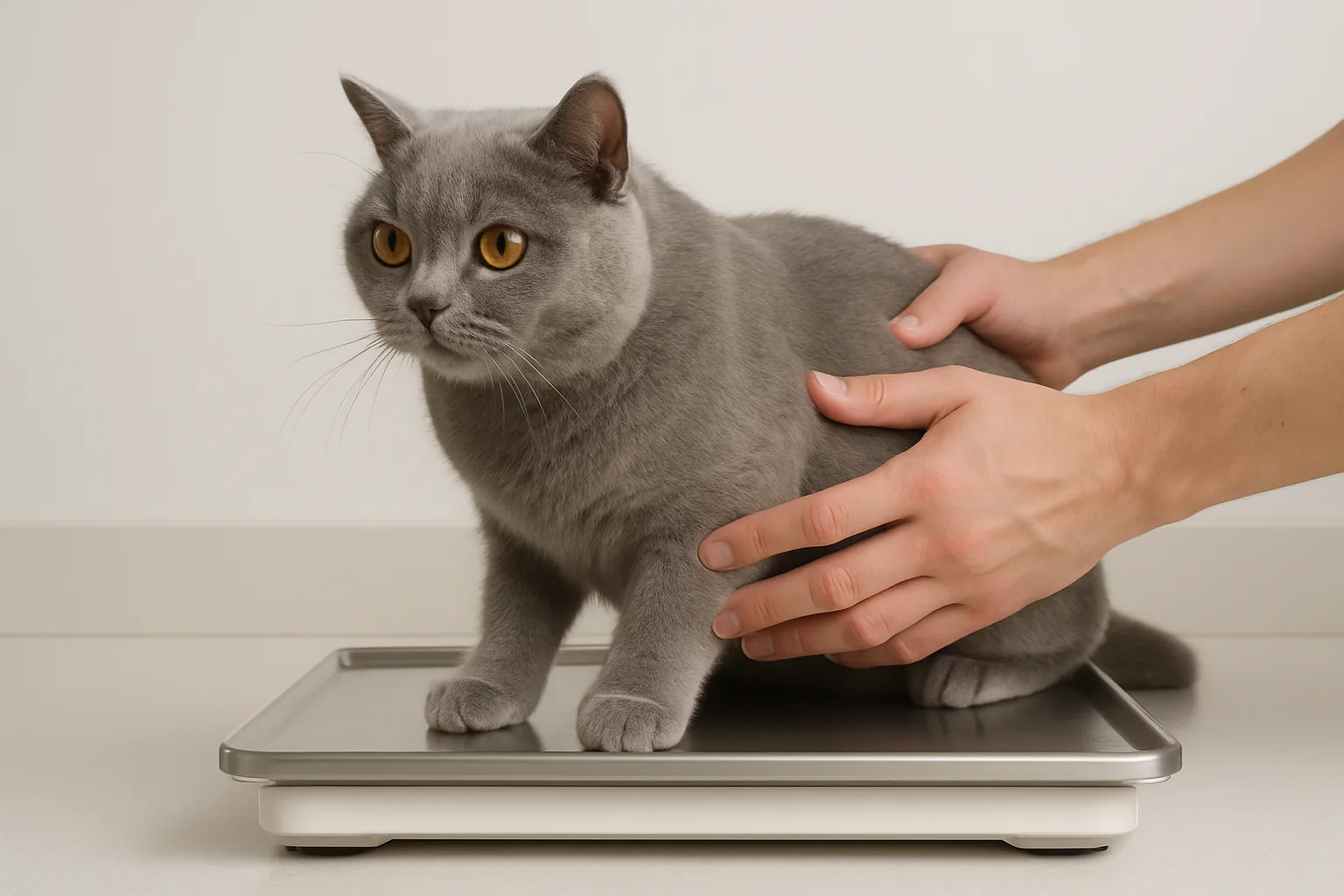
Weigh at intake, then again on day three. Weight is the best early-warning instrument in the building. Tanaka’s shelter cohort found cats with high behavioral stress scores in week one were 5.6 times likelier to develop URI, and food intake tracked stress almost perfectly. A 5% loss by day three is an escalation trigger, not a feeding note.
Place new arrivals low-traffic and out of sight lines. Not the suite by the door, not opposite the prep area. New cats need somewhere to decompress, and a covered hiding box in the suite from the first minute.
Minimize handling on day one. Resist the instinct to comfort a hiding cat by pulling her out. Structured gentle contact has real evidence behind it once a cat is receptive, but on arrival day the useful intervention is quiet presence, fresh food, and leaving her alone.
Stagger intakes and separate new arrivals from long-stay residents where the layout allows. Cats in the shedding window are the ones most likely to seed a room, and a Canadian shelter study found 28% of cats were already positive for at least one respiratory agent on admission. The population you are protecting against is arriving through your own front door.
Log appetite, litter use, and demeanor daily from day one. Guessing retrospectively about when a cat stopped eating is worthless. Our complete URI prevention guide covers the ventilation and isolation infrastructure sitting underneath all of this.
When It Warrants a Vet
Most post-transit colds are mild and self-limiting, running seven to ten days with clear discharge and a bit of sneezing. Call the vet when you see thick yellow or green discharge, an eye held closed or with visible corneal cloudiness, labored breathing or open-mouth breathing, a cat not eating for more than 24 hours, or lethargy that goes beyond the usual boarding sulk. Cats under a year old and cats over about twelve should get a lower threshold on all of these, and any cat with a known chronic herpes history is worth a call sooner rather than later.
The reassuring thing here is how much of it is upstream and cheap. A carrier left out for three weeks, a vaccine given on time rather than on the way, a twenty-minute drive instead of an hour, a blanket that smells like home, and a facility that weighs the cat on day three. None of it costs much, and collectively it moves the odds a long way.
Further reading (sources)
- Aziz and colleagues on transport time as a risk factor for URI in 430 relocated cats
- Tanaka and colleagues for the link between behavioral stress, weight loss, and respiratory infection
- Gourkow and colleagues with shelter data on how many cats are already shedding at admission
- Gourkow and colleagues on gentle handling, mucosal antibody, and lower URI rates
- Cooper and colleagues and famciclovir given in the first week after shelter intake