Boarding an FIV-Positive or FeLV-Positive Cat: Will a Cat Hotel Take Them, and Is the Risk to Other Boarders Real?
Published on October 26, 2026
The call tends to go the same way. An owner rings a cattery, mentions near the end that their cat is FIV positive, and the voice on the other end turns careful: sorry, we can’t take cats with that. The second cattery says the same. The third asks for a negative test this cat will never produce.
Some of those refusals are sound. Many are not. Feline immunodeficiency virus (FIV) and feline leukemia virus (FeLV) spread in specific ways, and a cattery that keeps every household in its own unit already blocks most of them. This guide sets out what the retrovirus guidelines from the American Association of Feline Practitioners (now the Feline Veterinary Medical Association) and the European Advisory Board on Cat Diseases (ABCD) actually say about transmission, what a fair acceptance policy looks like, why the positive cat is the guest most at risk in the building, and how owners should disclose. It expands the short section on FeLV in our cat boarding vaccinations guide and adds FIV, which that guide leaves out.
These are not rare cats, either. In a large study of more than 62,000 cats tested at clinics and shelters in the US and Canada, 3.1 percent were positive for FeLV and 3.6 percent for FIV. Any busy cattery will be asked, so it pays to have an answer ready.
Two Viruses, Two Different Routes
FIV and FeLV are both retroviruses, both stay with a cat for life once established, and both share a line on most intake forms. They do not spread the same way, and that difference drives everything else in this article.
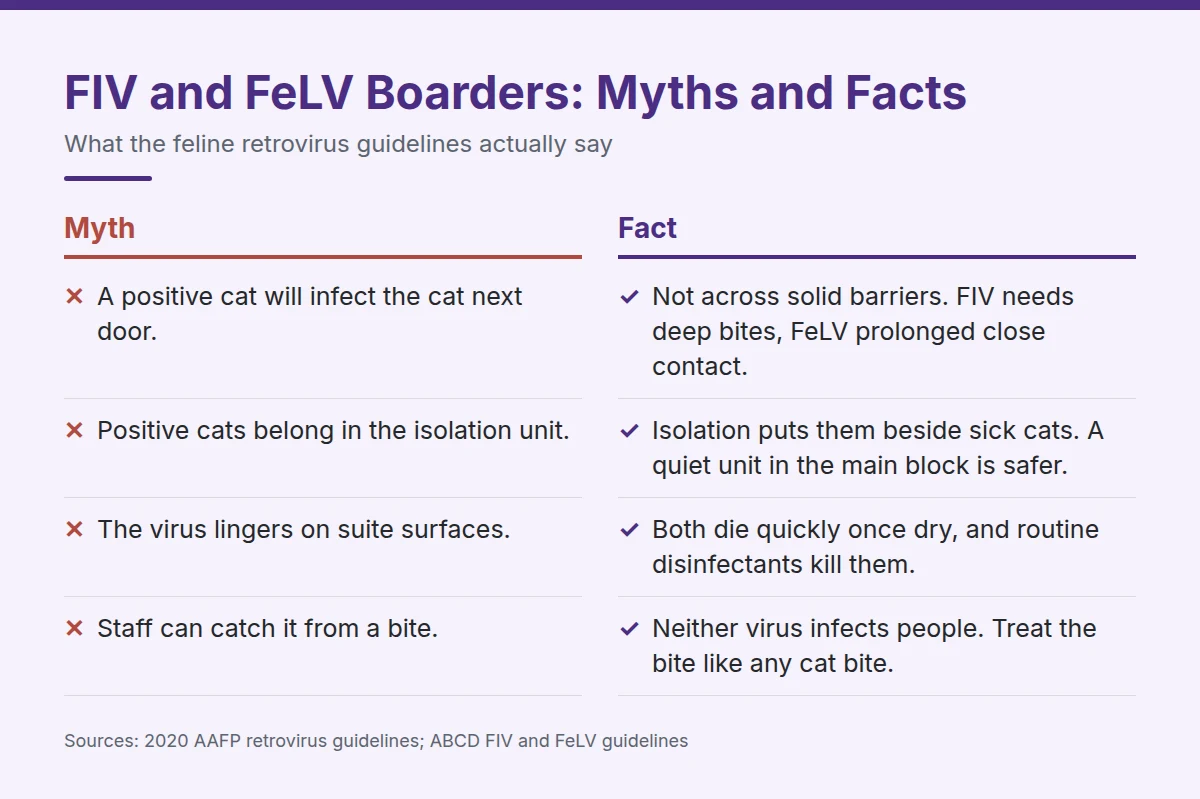
FIV spreads mainly through deep bites. The 2020 AAFP guidelines name bite wounds as “the major mode of FIV transmission”, because a bite drives infected saliva and white blood cells under the skin. Cornell’s Feline Health Center adds that casual contact, such as sharing water bowls or grooming each other, “does not appear to be an efficient route of spreading the virus.” The classic FIV positive cat is an unneutered tom with a history of fights, not the cat who shared a sofa with one.
The evidence from peaceful homes is reassuring, though not absolute. At a rescue where 8 FIV positive cats lived among 130 negative ones, a Purdue study retested 45 of the negative cats a median of 28 months later and found no new infections. On the other side, a Glasgow team that followed a closed household of 26 cats for ten years saw FIV spread from the original 9 positive cats to 6 more, without evidence of bites, in a house where FeLV was also circulating. Weighing both, the guidelines conclude that cats in stable households where housemates do not fight are at negligible risk.
FeLV spreads through prolonged close contact. Progressively infected cats shed the virus mainly in saliva, with smaller amounts in nasal secretions, milk, urine and feces. ABCD’s FeLV guideline, updated in 2025, lists the routes as friendly grooming, biting and shared food and water bowls, with litter trays a less common route. FeLV needs cats to live like housemates: licking each other and eating from the same dish, day after day.
Not every FeLV positive cat is a shedder. In a progressive infection the virus keeps replicating and the cat sheds it. In a regressive infection the immune system holds the virus in check, and the guidelines state plainly that regressively infected cats do not shed infectious virus, although their blood can still infect a cat that receives it in a transfusion. Which kind your cat has is a question for your vet, and the answer matters at the booking desk.
Neither virus lasts long outside a cat. The AAFP guidelines describe both as inactivated “within a very short time on dry surfaces” and killed quickly by detergents and common disinfectants. ABCD says FIV survives only minutes outside the host and is susceptible to all disinfectants, including ordinary soap. The one caveat comes from the FeLV guideline: in a moist environment FeLV can stay infectious for up to 48 hours, which is why a food bowl wet with an infected cat’s saliva is a real route and a dry unit wall is not.
Neither virus infects people. Cornell calls FIV “a highly species-specific virus that infects only felines”, and the ABCD guideline says FeLV poses no risk to human health. A staff member bitten by a positive cat needs the same prompt care as after any cat bite, and nothing extra.
So How Big Is the Risk to the Cat Next Door?
Set those routes against the way a well-run cattery operates and the answer follows.
England’s statutory guidance for licensed catteries already requires the conditions that block them. Cats from different households must never share a unit, communal exercise areas are not permitted, and adjoining units need solid barriers covering the full height and width of the shared wall. International Cat Care gives owners the same principle: cats from different households should never be able to touch each other. In a building run that way, a positive cat never bites, grooms or shares a bowl with anybody else’s cat.
Veterinary hospitals already work on this basis. The AAFP guidelines say hospitalized cats should have no direct contact with one another, that retrovirus-infected cats do not need an infectious disease ward, and that they “can be kept in the general hospital wards” in their own cages. They reach the same view about cat shows, which they say are not significant sources of retrovirus infection because exhibited cats are housed separately and both viruses are susceptible to common disinfectants. A cattery with individual units is the same arrangement over a longer stay.
So for the cat in the next unit, the risk from a positive neighbor is negligible, provided the basics hold. The guidelines are just as clear that both viruses pass very efficiently in contaminated body fluids, especially blood, and that food and oral dosing syringes should never be shared between patients. In a cattery the realistic routes are human ones: a food bowl moved between units without washing, an oral syringe used for two cats’ medicine, a brush carried down the row, or a cat that slips past a door and picks a fight in the corridor. Each is a lapse no cattery should make for any cat.
The risk turns real where cats mix. Communal play rooms, shared catios and “social” suites that put cats from different households together recreate the conditions these viruses need. The guidelines describe two Australian rescue sanctuaries that housed FeLV infected and uninfected cats together without separating sick cats from healthy ones. FeLV prevalence there was more than 20 times higher than in the general pet cat population. A playroom used by one household at a time, cleaned and left to dry between turns, is a different thing entirely.
Why Catteries Say No
Most refusals trace back to one of four things.
- Habit. Intake forms written years ago often list FIV and FeLV as automatic exclusions, and nobody has revisited them.
- Fear of the phone call. Nobody wants to tell another owner that their cat caught something. The evidence above answers that worry, and it is a strong answer.
- Licensing wording. England’s guidance never mentions FIV or FeLV. Its isolation rule covers any cat that is injured, sick, infectious or “carrying a serious infectious disease”, and an operator could read that as a reason to put a positive cat in the isolation unit. That gets the veterinary advice backwards, as the next section explains. If you are licensed and unsure, ask your licensing officer and your vet how they read the rule for a healthy positive cat, and keep their answer on file.
- A facility built for mixing. If cats from different households share space, declining a positive cat is the honest answer. Ending the mixing would protect every guest.
One kind of refusal deserves a challenge: a ban based on a single positive screening test in a healthy indoor cat. The guidelines recommend further testing in exactly that case, because a positive screen is more likely to be false in a low-risk cat. Our guide to lab tests in cat boarding explains the confirmation step.
The Positive Cat Is the Vulnerable One
Turn the question around and the picture changes. In a building full of cats, the retrovirus-positive guest is the one at greatest risk.
FIV slowly wears down parts of the immune system, and the guidelines describe infected cats as “predisposed to chronic and recurrent infections”. Progressive FeLV can suppress both the immune system and the bone marrow, and it shortens life: in a large study cited in the guidelines, median survival after diagnosis was 2.4 years for progressively infected cats against 6.3 years for matched negative cats. FIV is usually gentler, and Cornell notes that FIV positive cats commonly live average lifespans if they are not also infected with FeLV.
The guidelines also warn that retrovirus-infected cats can develop more severe disease from panleukopenia and upper respiratory infections than uninfected cats, which is why vaccination should not be skipped in them. Cat flu is the illness most often picked up at boarding, so it is the main hazard for a positive guest, and our URI prevention guide covers how it moves through a building.
That is why the isolation unit is the wrong place for a healthy positive cat. Both sets of guidelines say these cats should not be housed in isolation alongside cats with contagious disease. ABCD’s FIV guideline puts it bluntly: “Under no circumstances” should an FIV positive cat go into a contagious ward with cats suffering from viral respiratory disease. The AAFP adds dogs carrying canine parvovirus or Bordetella bronchiseptica to the list of neighbors to avoid, one more argument for a facility that boards only cats.
Stress belongs in the same calculation. Researchers from Glasgow and Purdue followed FIV positive cats for 22 months. Most cats living in homes with one or two cats showed no signs of immunodeficiency, while 17 of 27 cats from a crowded indoor household of more than 60 lost about half their body weight and died during the study, most often of lymphoma. That study was about where cats live, not about boarding, but the guidelines draw the general lesson: positive cats do best in low-density housing, with fewer stressors and caregivers who can watch them closely. A short stay in a quiet unit fits that description far better than a long one in a busy block. If your cat has any chronic illness, talk to your vet before you book.
A Fair Acceptance Policy, Written Down
For cat hotels, a policy for retrovirus-positive guests does not need special buildings. It needs the standards a good cattery already keeps, written down and followed every time.
- Their own unit, behind solid barriers. Never shared with a cat from another household, and no communal time. Cats from the same home can share if they already live together and the owner consents in writing. Ask whether negative housemates are vaccinated against FeLV, as the guidelines advise for cats living with an FeLV positive cat.
- A quiet unit away from isolation. Not beside the isolation facility, not next to a sneezing cat, and not by the door where every new arrival passes.
- Their own bowls, tray, scoop, brush and toys. Kept with the unit for the whole stay and washed separately. Never share oral syringes or pill dispensers between cats.
- Routine cleaning and disinfection. Ordinary detergents and disinfectants inactivate both viruses. Clean the unit thoroughly between guests, as you would for any cat, and let surfaces dry.
- Hand washing after every unit. The guidelines ask hospital staff to wash their hands after handling animals and cleaning cages, and a cattery round is no different. Staff with colds should follow a sick policy like the one in our guide to what cats can catch from people.
- A sensible round order. Healthy guests first, a progressively FeLV infected cat at the end of the healthy round, and the isolation unit last, which England’s guidance already requires.
- Closer monitoring. Log appetite, litter output and any sneezing or eye discharge every day, with a lower threshold for calling the owner’s vet.
- No raw food. The guidelines advise against raw meat and raw dairy for these cats because of the risk of food-borne infection. If the owner feeds raw, settle the boarding diet with them and their vet before arrival.

Should a positive cat cost more? Charge for extra work, such as medication, exactly as you would for any cat. The guidelines do not call for an isolation suite, so an isolation surcharge for a healthy positive cat is hard to justify on the evidence.
What to Put on Paper at Intake
Owner or operator, the booking should capture the same facts:
- Which virus, and when it was diagnosed.
- How it was confirmed. The date and type of the screening test, plus any confirmatory test of a different kind, such as PCR. For FeLV, whether the vet considers the infection progressive or regressive.
- FIV vaccination history, for cats that have had the FIV vaccine, which is still used in some countries. Vaccinated cats can test antibody positive without being infected.
- A recent vet check. The guidelines recommend checkups at least every six months for infected cats, so most owners will have a recent one. A short note from the vet saying the cat is fit to board settles most conversations.
- Current vaccinations, for the reasons above.
- Medication, diet and the vet’s contact details, with written authority to treat.
Operators should keep the status on the unit card so every member of staff knows it, and treat it as confidential, like any other medical history.
How Owners Should Disclose
Tell the cattery at the first enquiry, not at the front desk on the morning you fly. Raised early, it is a planning conversation. Raised at drop-off, it is a refusal with your suitcase in the car.
Lead with the facts: which virus, how it was confirmed, that your cat is well, and when your vet last saw it. Offer the vet’s note. Then ask the questions that show whether this cattery suits your cat:
- Will my cat have its own unit behind solid barriers, and never share space with another household’s cats?
- Where is that unit, relative to isolation and the entrance?
- Do bowls, trays and grooming tools stay with each unit?
- What happens if my cat starts sneezing, and how fast will you call my vet?
A cattery with clear answers is a good sign. One that says “it should be fine” and stops there is not.
Do not leave the status off the form. Hiding it does not protect your cat. It removes the extra watching a positive cat needs, and if the truth comes out mid-stay, the cattery is entitled to wonder what else it was not told.
If your cat is unwell, the answer may not be a cattery at all. A positive cat that is losing weight, has sore gums or keeps picking up infections needs a vet’s view before any stay, and a sitter at home may be kinder. Our comparison of an in-home sitter and a cat hotel walks through that choice. Whatever you decide, pack a blanket or toy that smells of home.
The Bottom Line
An FIV or FeLV positive cat is not a danger to the cat in the next unit of a properly run cattery. FIV spreads mainly through deep bites and FeLV through prolonged close contact, and individual units, solid barriers, equipment that stays with each unit, hand washing and routine disinfection block both. The positive cat is the vulnerable one, so keep it away from isolation and sneezing cats, keep its vaccines current, and watch it closely. Owners should disclose early with paperwork in hand. Operators should write a policy rather than a blanket ban.
Further reading (sources)
- Little and colleagues on the 2020 AAFP retrovirus testing and management guidelines
- European Advisory Board on Cat Diseases with its FIV guideline, including hospital ward housing and its 2025 FeLV guideline on routes of infection
- Cornell Feline Health Center for how FIV spreads and why it infects only cats and how briefly FeLV survives outside the body
- Litster on years of cohabitation without FIV spread in a rescue shelter
- Addie and colleagues with ten years of FIV and FeLV in a closed household of 26 cats
- Bęczkowski and colleagues on how crowded housing changed the outlook for FIV positive cats
- Defra for England’s cattery licensing rules on shared units, barriers and isolation
- International Cat Care about choosing a boarding cattery that keeps households apart