Boarding Agreements, Waivers, and Insurance: The Cat Hotel Owner's Liability Guide
Published on September 14, 2026
Most cat hotels are founded by someone who loves cats and taught themselves the business parts along the way. The suite design gets a year of thought. The contract gets twenty minutes and a template lifted from a dog daycare in another state. Then a cat slips through a propped door, or goes home from a ten day stay with an emergency bill attached, or an owner simply stops answering the phone three weeks past the pickup date, and that twenty minute document turns out to be the only thing standing between a bad week and a closed business. This is the paperwork pillar: what a boarding agreement has to say, which insurance lines a cat only facility genuinely needs, and how to document an incident so that both the claim and your reputation survive scrutiny.
None of this is legal advice. Boarding law is state law, and almost every specific below changes at the state line. Treat it as the list of questions to bring to an attorney in your state rather than a substitute for one.
A Waiver Is Not a Shield
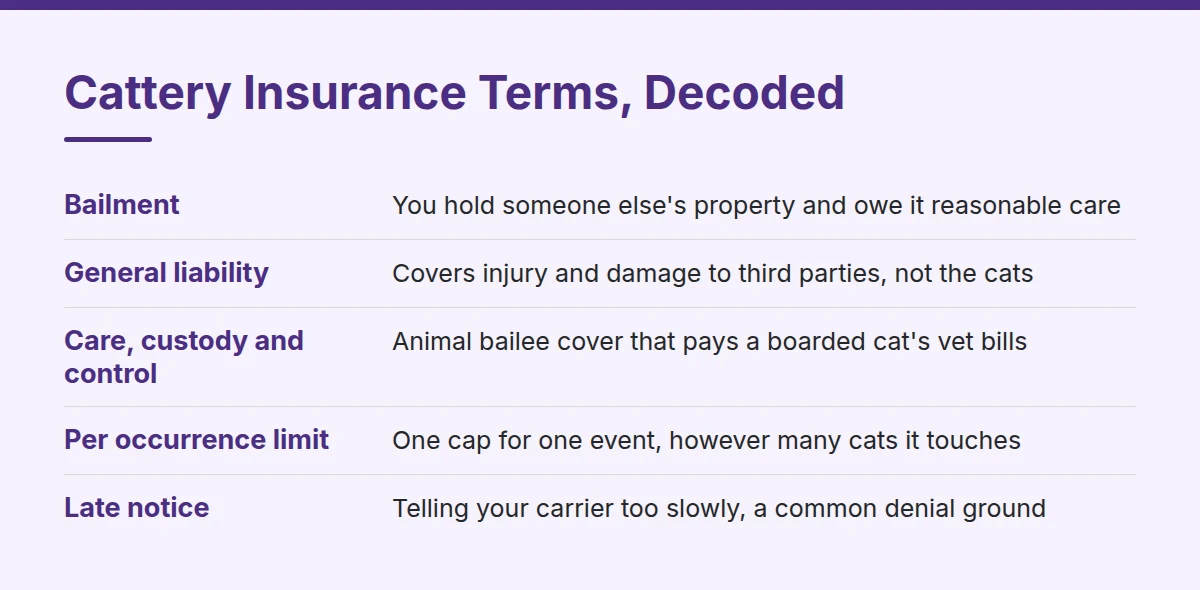
Start by giving up the fantasy that the word “waiver” creates. When an owner hands over their cat, the law in most states treats the arrangement as a bailment: you take temporary possession of someone else’s property and owe a duty of reasonable care over it. For a boarded animal, reasonable care has a well worn meaning that includes food, water, sanitation, observation, and obtaining medical attention when the animal needs it. Fall short on any of those and you are liable, and no signature on a form changes that.
What a signed agreement will not do is excuse gross negligence, fraud, a statutory violation, or a plain breach of your own contract. Enforceability of the release language itself varies by state and by the facts of what happened. In most states, damages for an injured or dead cat are still capped at the animal’s fair market value, which is a small number. That number is not what ends up on your Google profile or in a local news segment, though, and it is not what your staff have to live with.
So stop thinking of the agreement as armor. It has four real jobs: it sets expectations before the stay, it gives you authority to act when the owner is unreachable, it allocates who pays for what, and it creates a record that you behaved reasonably. A document that does those four things well is worth far more than one full of capital letters disclaiming everything.
What the Agreement Must Actually Say
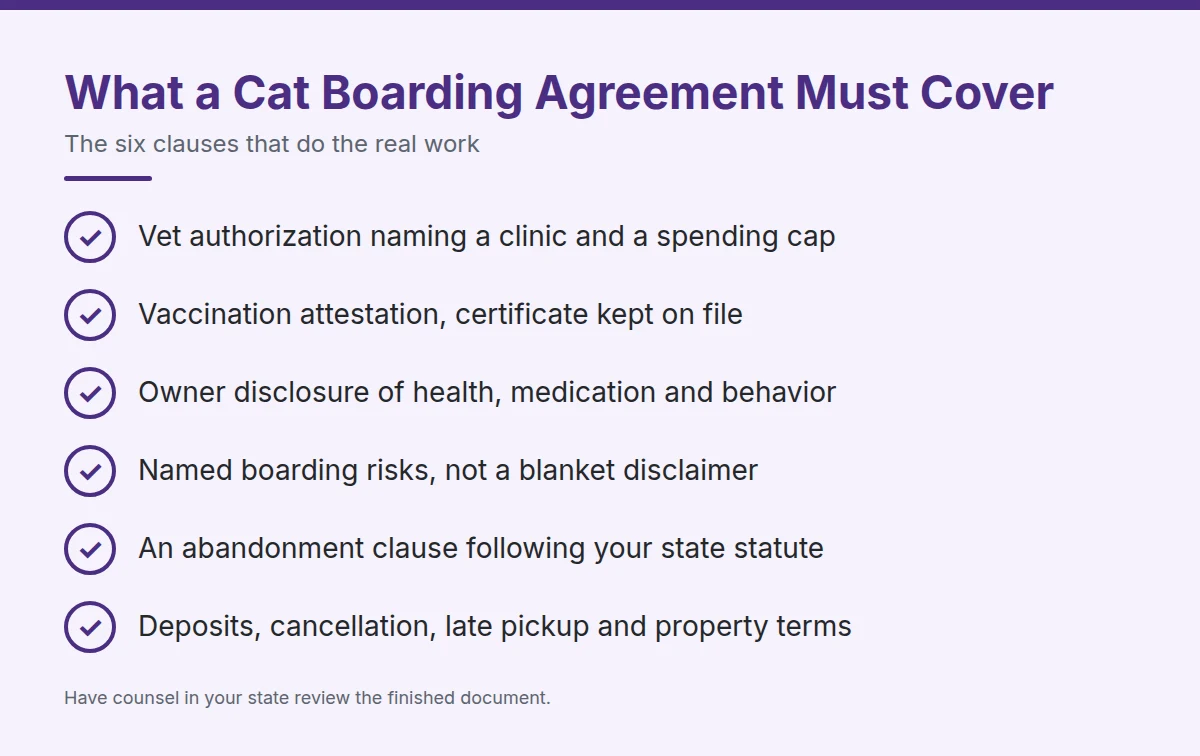
Veterinary authorization with a spending cap. This is the single most important clause. It should name the owner’s regular veterinarian and your default emergency hospital, authorize you to transport the cat and obtain treatment, and set an explicit dollar ceiling above which you have to reach the owner first. Then it must answer the question templates always skip: what happens when you cannot reach them. The honest answer is that you will authorize what the attending veterinarian considers necessary to relieve suffering, and the owner carries the cost. Decide now which emergency service you are driving to at 2am and confirm it is genuinely staffed overnight, because a referral hospital’s critical care service is a different thing from a clinic with a voicemail.
Vaccination attestation. The owner warrants the cat is current on whatever your policy requires, and you keep a copy of the certificate rather than accepting a verbal assurance. Our guide to cat boarding vaccinations covers what to ask for and in what format. The attestation earns its place twice over: it is your defense if an outbreak traces back to an undervaccinated arrival, and it is the reason an insurer pays rather than argues.
Health and behavior disclosure. The owner warrants that they have disclosed chronic conditions, current medications, dietary needs, bite and scratch history, and litter box problems. Then state what follows if they have not: undisclosed conditions shift treatment costs back to the owner and can end the stay early. This is not a gotcha clause, it is what makes honest disclosure the easier path. The traits most often left off a form are exactly the ones in our guide to behavior problems at the cat hotel, and staff get hurt by the ones nobody warned them about.
Named risks instead of a blanket disclaimer. Say plainly that cats can lose weight, stop eating, develop stress cystitis, or break with an upper respiratory infection during a stay or shortly after it, and that these are known risks of boarding even under attentive care. Specific named risks read as candor and hold up better than a paragraph disclaiming liability for anything whatsoever, which reads as bad faith and tends to be the first thing a court discounts.
An abandonment clause that points at your state’s statute. Every operator eventually gets the cat nobody collects. The contract should state the scheduled pickup date, the daily rate that keeps accruing past it, the notice you will send and by what method, and the point at which you will proceed under your state’s abandonment law. Do not invent the number. Connecticut treats an animal as abandoned five days after the scheduled pickup, then requires notice by registered or certified mail with return receipt and a further ten days after that receipt comes back before the animal can be transferred. New York’s Agriculture and Markets Law sets ten days after a registered letter when the stay had a specified end date, and twenty days when it did not. Florida lets a licensed boarding kennel turn an animal over to the nearest humane society or pound ten days after written notice. Three states, three different clocks. Look up yours, write it in, and follow it exactly, because proper notice is also what protects you when the owner resurfaces in month four.
The commercial terms. Deposits, cancellation windows, holiday and peak season rules, late pickup fees, and how you handle the owner’s property (carrier, blanket, bed) if it is lost or ruined. Add a photo and media release if you post guests on social media. A downloaded template is the start of a conversation with a lawyer, not the end of one. Have counsel in your state read the finished document once, then keep using it.
Insurance: Four Lines, and the Gap Between Them
General liability covers third party bodily injury and property damage: the client who slips in your lobby, the contractor’s van you reverse into. Here is the gap that catches new operators. A standard general liability policy excludes property in your care, custody, or control, and in that policy’s eyes the cats are property. General liability does not cover the cats.
Care, custody and control coverage, sold as animal bailee coverage, is the line that does. It pays veterinary costs when an animal in your care is injured or falls ill. Read the actual policy on three points. First, whether it covers illness as well as injury, because a contagion exclusion is the one that hurts a cattery specifically, where a respiratory outbreak can touch every suite in the building at once. Second, whether the limit is per animal or per occurrence, since a fire or an outbreak is a single occurrence with twenty cats inside it. Third, the deductible, which is sometimes applied per animal rather than per claim.
Property and business income. The building, the suites, the HVAC and filtration, and the part founders forget, the income you lose while closed for repairs. A cattery that cannot board for two months has lost far more than the drywall. This is where your fire safety decisions and your insurance file meet, because the sprinklers and monitored alarms that protect the cats also move the premium.
Workers’ compensation. Required by state law once you have employees, and genuinely needed. Cat bites are the routine claim in this business, they get infected quickly, and they put a person in urgent care rather than at a sink with a plaster.
Around those four sit professional liability for allegations of improper supervision, commercial auto if you ever transport a cat in a facility vehicle, and cyber cover if you store client card details. Then re-underwrite whenever the business changes. A second location opening in a neighbouring county is the ordinary shape of growth in this sector, and every new site, service, vehicle, or staff member is a change the carrier needs to hear about. Coverage does not follow you to a new address on its own.
Document the Incident Before You Need To
Write the report the same day, while the detail is still exact: the time, who found the cat, what they observed, what was done, who was contacted and when, and the veterinary outcome. Photograph injuries. Keep the invoice and the clinical records with the report rather than in a separate pile.
Routine logs are what make that report credible. Daily weight, food intake, litter tray output, and medication given, recorded for every cat every day. An incident report standing on its own looks like a document produced for a claim. The same report sitting on six days of feeding and weight entries looks like a facility that was watching closely and caught something. Insurers and attorneys read that difference immediately, and so do owners.
Never edit a record after the fact. Append a dated correction and initial it. One altered log destroys the credibility of every other log you keep, which is the same discipline that governs medication records when a dosing error happens.
Notify your carrier on the incident, not on the claim. Late notice is among the most common reasons a claim gets denied, and you can always close a notified matter that turns out to go nowhere.
The Call You Do Not Want to Make
Call. Do not text, do not email, and do not wait for pickup. The part owners describe as the worst of a boarding incident is almost never the incident itself. It is finding out late.
Give them, in this order: what happened, what you did, where their cat is right now, and what happens next. Then stop talking and let them react. Do not speculate about cause while a cat is still being treated, do not assign blame to a staff member, and do not promise an insurance outcome you do not control. Saying you are sorry this happened is empathy rather than an admission, and withholding it costs far more than it ever saves.
Follow up in writing the same day, offer the owner the incident report and the veterinary records, and be the one keeping them updated rather than the one being chased. Handled that way, a genuinely bad night usually does not become a bad review, and the review flywheel in our marketing and occupancy guide keeps turning. Handled badly, one incident undoes two years of it.
Put It on an Annual Reminder
Contracts drift out of date, statutes get amended, policy limits stop matching the replacement cost of a building, and the emergency hospital you named three years ago may have changed its overnight staffing. Review the agreement, the insurance schedule, and a sample of your daily logs once a year on a calendar reminder, not on the morning after something goes wrong. Cornell’s Center for Veterinary Business and Entrepreneurship exists on the premise that animal care does better when it is run as a business rather than as a vocation with invoices attached, and this is the clearest case of it anywhere in a cattery. The paperwork is not the grim part of loving cats for a living. It is what lets you carry on doing it after the worst night. Everything upstream of it, the plan, the licensing, and the build, sits in our founder’s playbook.
Further reading (sources)
- Animal Legal & Historical Center on how bailment law applies when an animal is left in someone’s care
- FindLaw for what an owner can actually claim against a boarding facility
- Time To Pet with a line by line breakdown of boarding business insurance
- Animal Legal & Historical Center on Connecticut’s lien and abandoned animal transfer rules
- Justia for the New York notice periods that define an abandoned boarded animal
- Animal Legal & Historical Center covering Florida’s procedure for animals abandoned at a kennel
- Litigation for Animal Welfare with the documentation an owner is told to demand after an incident
- Cornell University College of Veterinary Medicine on why animal care businesses benefit from real business discipline