Fireworks, Halloween and New Year's Eve at the Cattery: How Cat Hotels Handle Noise-Fear Nights
Published on October 30, 2026
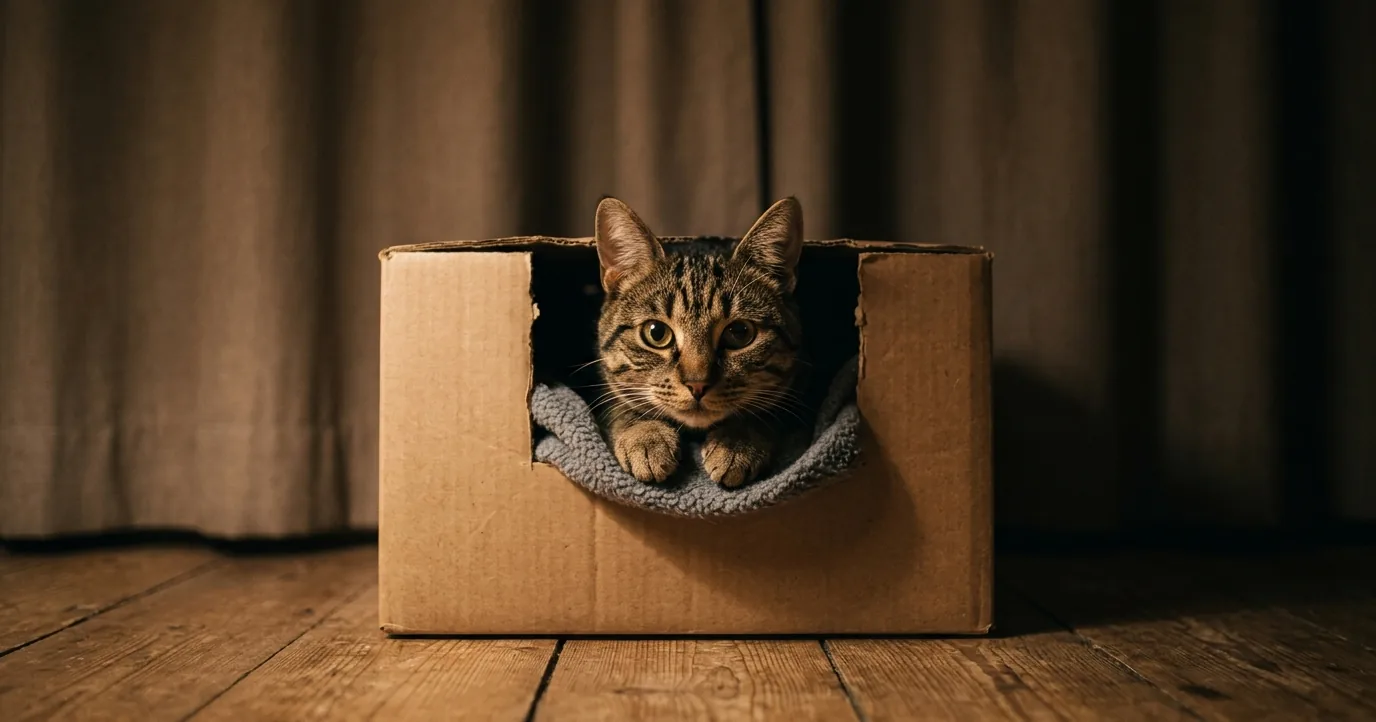
For most of the year, evening is the quietest part of a cattery’s day. Supper is done, the last owner has driven away, and the lights go down. Then come the weeks between Halloween and New Year, when rockets start at dusk and can run past midnight, and a building full of cats who are already away from home has to sit through them.
This guide is for owners boarding over Halloween, Bonfire Night, Diwali or New Year’s Eve, and for cat hotels planning those nights. It covers what frightens cats, what a well-run cattery does before, during and after a fireworks evening, when to involve your vet, and when a cat with a real fear of fireworks is better off at home. In the US, the same plan works for the Fourth of July.
Why Fireworks Frighten Cats So Much
Cats have one of the broadest hearing ranges of any mammal. When Heffner and Heffner measured the hearing of domestic cats, the range at 70 decibels ran from 48 Hz to 85 kHz. Fireworks are also impossible to predict. A bang comes without warning, then another from somewhere else, with flashes in between, and the cat has no way to tell where the danger is or when it will end. Cats Protection, the UK welfare charity, puts it plainly: cats are creatures of habit, so loud bangs and flashes take them by surprise and make them fearful.
Owners see the result. In a 2024 Utrecht University survey covering 622 cats, about three in four owners said their cat hid during or just after fireworks, and nearly two in three said it tried to flee. A third said the fear lasted more than half an hour after the noise stopped. About one in twelve said their cat had at some point gone missing after fireworks, for example by bolting. An earlier New Zealand survey by Dale and colleagues found that frightened dogs more often showed active fear, while frightened cats hid and cowered. Both surveys relied on owners who chose to take part, so read the exact figures with care. The pattern is the useful part: a frightened cat hides, and if it can, it runs.
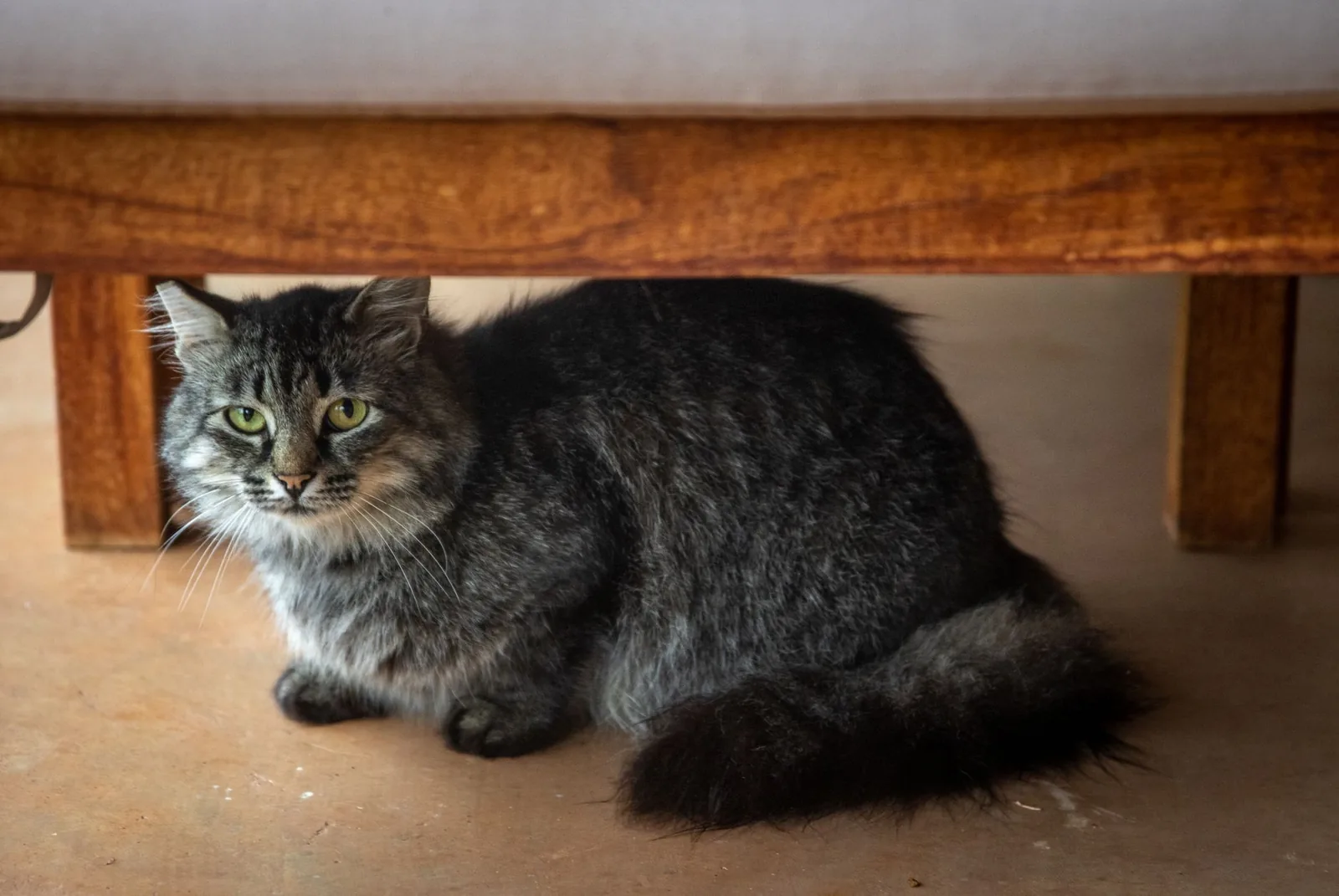
That pattern sets the job for a cattery on a noise night. Hiding needs somewhere to hide, and running needs an open door. A good cat hotel provides the first and removes the second.
Halloween brings a different problem. For a cat at home, the trouble is less the bangs than the front door. As a recent Catster piece put it, strange costumes, unfamiliar visitors and a doorbell that rings non-stop can overwhelm even cats that usually enjoy meeting people. In Britain, Halloween also opens the fireworks season.
The Nights, and Why They Stretch Into Weeks
In England and Wales, the law shapes the calendar. It is illegal to set off fireworks between 11pm and 7am, except that the cut-off moves to midnight on Bonfire Night (5 November) and to 1am on New Year’s Eve, Diwali and Chinese New Year. Apart from licensed specialist shops, sellers can only sell fireworks to the public from 15 October to 10 November, from 26 to 31 December, and around Diwali and Chinese New Year. Diwali follows the lunar calendar and falls between mid-October and mid-November, so in some years it lands in the same week as Bonfire Night.
The result is weeks of bangs rather than single nights, with private parties on the weekends around the fifth. The Dutch survey found the same spread: almost two thirds of owners heard fireworks from September onward, and nearly all of them in December. If you are boarding at any point from late October to mid-November, or over New Year, plan for fireworks whatever the date.
What a Well-Run Cattery Does on a Noise Night
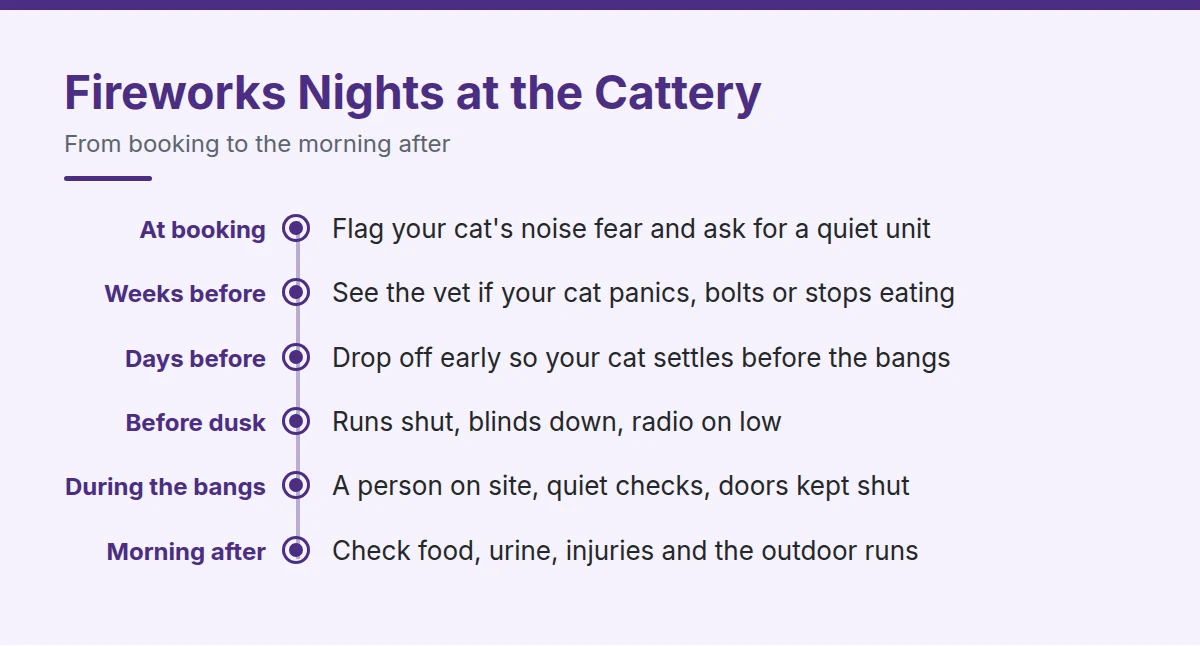
Cats in before dusk. Many catteries give each cat an outdoor run attached to its sleeping area. On a fireworks evening a good one shuts the runs before dark, so every cat is in the inner part of its unit when the first rockets go up. Keeping cats in after dark is the first fireworks tip Cats Protection gives owners, and the same logic applies to a mesh run, which lets in every flash and bang.
Blinds down, sound on. Drawn blinds or curtains cut out the flashes. Cats Protection also says steady background sound from a radio or TV can soften the impact of sudden bangs, as long as the program has no sudden loud noises of its own. The research on sound for cats is thin. In one trial, music composed for cats lowered stress scores during vet exams. A study of hospitalized cats found no difference in stress scores between cat music, classical music and silence, though it saw small gains on other measures. Treat sound as a cheap buffer, not a cure.
A hide in every unit. England’s licensing guidance requires every boarding cat to have a hiding place, and says it can be as simple as a cardboard box, an igloo bed or the cat’s own carrier. The evidence behind the rule is good. In a randomized trial, newly arrived shelter cats given a hiding box reached a lower, steady stress score about a week sooner than cats without one. On a noise night the hide is where a frightened cat will go, so it should be big enough to get right inside, with its opening turned away from the window.
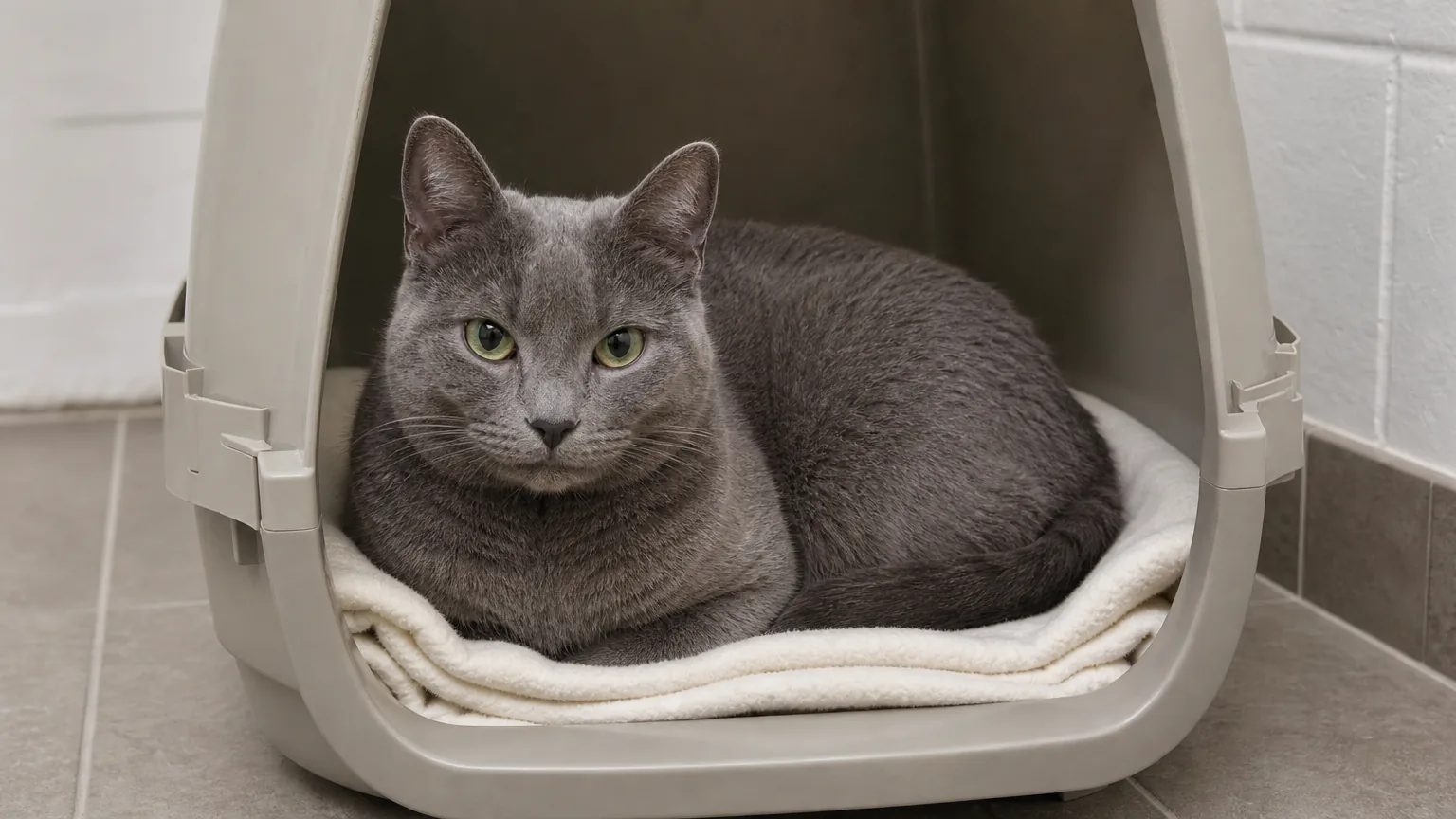
The quietest units for the most frightened cats. Ask at booking which cats fear fireworks, and give them the units furthest from the road, the front door and the nearest public display.
Cats out of earshot of dogs. Fireworks set dogs barking, and a cat in a suite cannot get away from the sound. When Furgala and colleagues played recorded clinic noise (people talking, kennel doors shutting, dogs barking) to cats, their heart and breathing rates rose, and cats free to move around an enclosure showed more signs of fear. England’s guidance says cats must not be exposed to excessive or continuous noise, and gives dogs barking as its example. A mixed facility should keep its cat building out of earshot of the kennels all year. On a fireworks night it matters most.
No front-door rush. Book drop-offs and collections for daylight on the big dates, and stop them before dusk. Keep reception away from the cat rooms, so visitors do not bring a stream of opening doors and outside noise with them. England’s rules require units to open onto a secure corridor or other secure area, and forbid propping access doors open, so there are always two closed doors between a cat and the outside. On a noise night that is the escape plan: never open the corridor door and a unit door at the same time, and never open a unit while the cat inside is panicking.
Leave a hiding cat alone. A cat pressed into the back of its box is coping. Pulling it out to check on it or comfort it adds a second fright. Cats Protection warns that picking up or cuddling a stressed cat may make it more fearful, and advises letting the cat come to you when it is ready.
Halloween stays at reception. Costumes, masks and decorations have no place in the cat rooms. Frightened cats need the people they know to look and sound like themselves.
A person on site through the peak. England’s minimum standard asks for checks no more than three hours apart between 8am and 6pm. Only the higher standard adds a check between 6pm and 8am, and a camera can do it. Yet the same guidance says cats must not be left unattended in any situation likely to cause them distress, and it is hard to think of a clearer case than a fireworks evening. A good cattery has someone on site from dusk until at least the legal cut-off (midnight on Bonfire Night, 1am on New Year’s Eve and Diwali), walking the corridors quietly with a low light rather than switching everything on, since the rules also require lights off overnight. These checks are for looking, not touching. Is every cat accounted for? Is any cat hurt, or frantic at the mesh?
The Morning After
Fear does not end with the last rocket. The first round the next morning should cover four things.
- Every cat present and unhurt. Look for torn claws, scrapes from the mesh, and any cat that has wedged itself somewhere it cannot get out of.
- Food and urine. In an Ohio State study of cats living in a research colony, ordinary upsets such as a change of caretaker or routine made the cats about nine times as likely to eat less, and six times as likely to go 24 hours without using the litter tray. Healthy cats were affected as much as cats with cystitis. Note who ate overnight and who has passed urine, and treat a male cat straining with nothing coming out as an emergency. Our guide to stress cystitis and urinary blockage at boarding explains why.
- The runs. Spent rockets and casings come down over fences. Walk every outdoor run before opening it, because the chemicals in fireworks can be toxic if chewed. A 2026 case report described an indoor cat that became gravely ill after chewing household “black snake” fireworks. It was put to sleep, and barium poisoning was confirmed afterward.
- Behavior. England’s guidance requires each cat’s behavior to be watched every day, with changes recorded and acted on where there are signs of fear or stress, including advice from a vet. A cat still hiding and refusing food by the evening needs that call.
Tell each owner at collection how the night went. It is the best information they will have for planning next year.
Before You Book: What Owners Can Do
- Say so at booking. Tell the cattery your cat is frightened of fireworks and how it shows it: hiding, bolting, soiling, going off its food. Ask for a unit on the quiet side, away from the door.
- Ask four questions. Are the runs shut before dusk on fireworks nights? Is a person on site in the evening, and until what time? Are dogs boarded on the same site, and how far away? When do drop-offs and collections stop on those days? In England, a four or five star rating means the cattery meets the higher standards, which include the overnight check. Our guide to reading a cattery inspection report shows where to find the rating.
- Arrive days before the noise, not on the night. Kessler and Turner followed 140 cats through two weeks in a boarding cattery and found that stress fell most sharply over the first few days. A cat dropped off on the afternoon of 5 November meets the bangs at its most unsettled.
- Pack familiar things. A worn T-shirt or a blanket from home, plus the cat’s own carrier, which England’s rules accept as a hiding place. Ask staff to leave it in the unit.
- Check the microchip. Cats Protection’s fireworks advice notes that spooked cats tend to flee. Make sure the chip registration has your current phone number, and give the cattery a local emergency contact.
- Book early for New Year. New Year’s Eve falls in the busiest boarding block of the year. Our guide to holiday and peak-season boarding covers how far ahead to book.
When to Ask Your Vet About Medication
Most cats need a good unit, not a prescription. Talk to your vet, though, if your cat panics rather than hides: if it claws at doors or windows trying to get out, hurts itself, soils in fear, stays frightened long after the noise stops, or goes off its food for a day. Fear like that is a behavior problem worth treating whether or not you travel, and cat owners rarely ask. In the Dutch survey, only 23 percent of owners of firework-averse cats had sought advice, against 54 percent of dog owners.
Start the conversation weeks ahead, not the week of the fifth. If your vet suggests a medicine for the worst evenings, the aim is a calmer cat, not a sedated one, and our guide to calming medication for boarding cats covers what the trials show and how a dose is timed. Ask for a trial dose at home on a quiet evening first, so you know how your cat responds before it matters. Then give the cattery written instructions: the drug, the dose, when to give it and what to expect. A cattery cannot prescribe or improvise, but it can give a prescribed dose exactly as written, and it should keep a medicated cat at floor level in case it is unsteady.
Pheromone products are widely recommended, but owners in the Dutch survey said they had a lasting effect for only 6 percent of the cats they were tried on. Treat a diffuser as an extra, not the plan.
Home With a Sitter, or the Cattery?
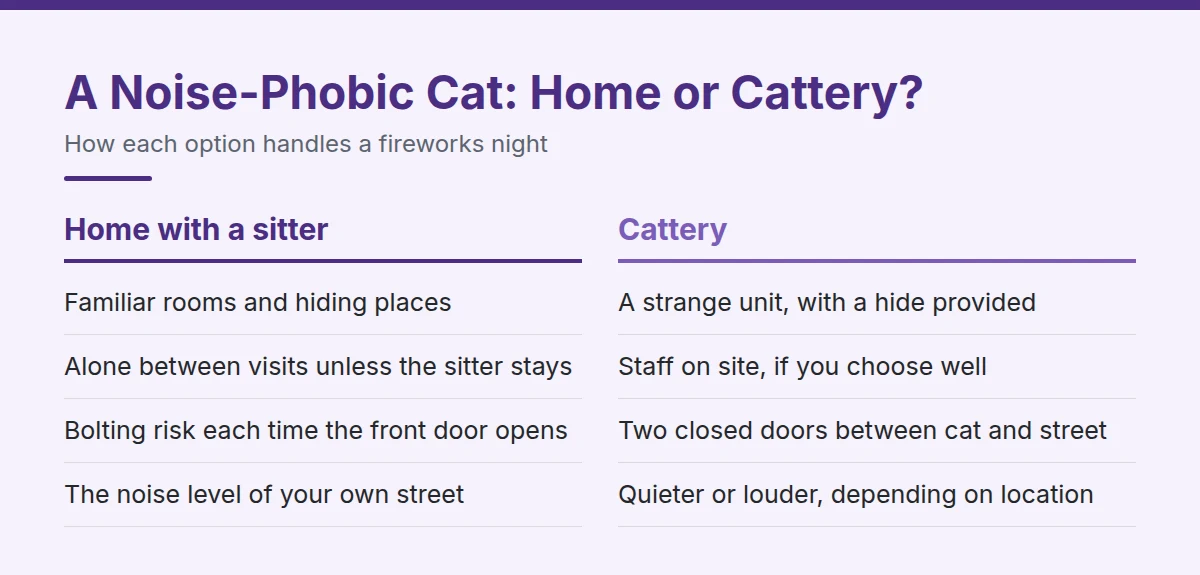
For a cat with a real fear of fireworks, the case for staying home is strong. The cat knows every hiding place, and nothing else about its world has changed. The weak spot is time. A drop-in sitter usually visits once or twice a day for 20 to 45 minutes, so unless someone stays through the evening, the cat spends the loudest hours alone. Cats Protection suggests not leaving a particularly anxious cat alone in the house during fireworks. There is also the door: a sitter arriving at dusk opens the front door just when a frightened cat is most likely to bolt. If your cat stays home, book a sitter who will stay through the evening of each big night, lock the cat flap, and agree that the cat comes in by late afternoon and stays in.
A cattery offers the reverse: an unfamiliar room, but staff on site, escape-proof units and two closed doors between the cat and the street. Location matters too. In the Dutch survey, moving an animal somewhere quieter, such as a holiday home, was the measure owners of cats and dogs most often credited with a lasting effect, though even that held for fewer than a third. A cattery in open country may be quieter than a house in town. One beside a park that hosts a public display will be louder. Ask.
As a rule of thumb:
- A cat that has boarded happily before and is merely startled by bangs will usually be fine at a well-run cattery.
- A cat that panics should see the vet first, then either stay home with a sitter who stays the evening or go to a quiet cattery it already knows.
- Not every cat settles. Kessler and Turner found about a third of boarding cats were still more than mildly tense in their second week, and 4 percent never settled at all. For a cat like that, a noise night away from home stacks one fear on top of another.
- Never make a fireworks night the first night a cat spends anywhere new.
Our comparison of an in-home sitter and a cat hotel covers the wider choice.
Further reading (sources)
- Heffner and Heffner on the hearing range of the domestic cat
- Van Herwijnen and colleagues with a survey of firework aversion in 622 Dutch cats and 3,009 dogs
- Dale and colleagues for owner reports of firework fear in New Zealand cats and dogs
- Furgala and colleagues on how recorded clinic and kennel noise affects cats
- Van der Leij and colleagues with a randomized trial of hiding boxes for newly arrived shelter cats
- Kessler and Turner for how stress changes over a two-week stay in a boarding cattery
- Hampton and colleagues on music composed for cats during veterinary exams
- Paz and colleagues about cat music and classical music for hospitalized cats
- Stella, Lord and Buffington with sickness behaviors after unusual events in healthy cats and cats with cystitis
- Fitzpatrick and colleagues for a case of barium poisoning in a cat that chewed fireworks
- Defra on England’s cattery rules for noise, hiding places, secure corridors and night checks
- GOV.UK with the fireworks curfew and sale dates in England and Wales
- Cats Protection for keeping cats calm and safe through fireworks season
- Catster on what Halloween at the front door does to cats