How to Read a Cattery Inspection Report: Public Records, Common Findings, and Which Ones Actually Matter
Published on October 20, 2026
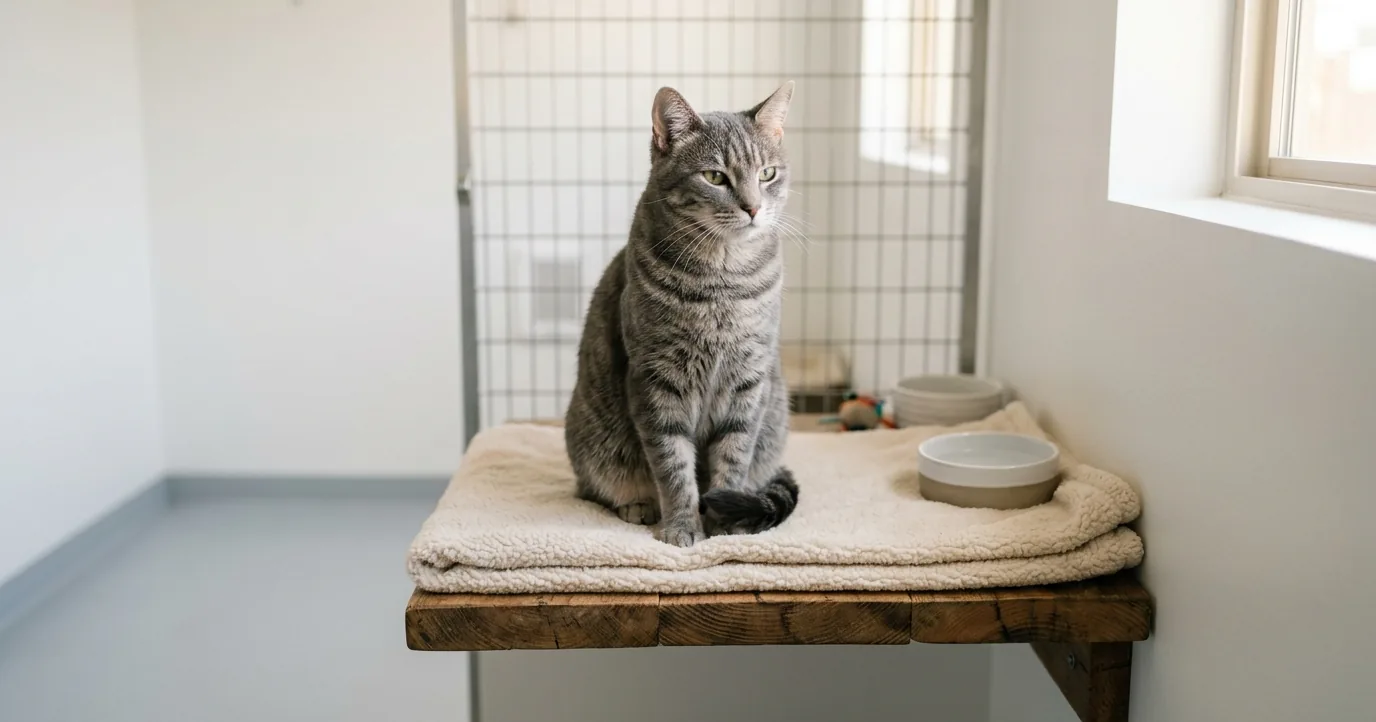
In July 2017 ABC11, the ABC station for Raleigh and Durham, published a list few cat owners would think to look for: the negative findings from more than two years of state inspections at boarding kennels in Wake County, North Carolina. It makes surprisingly dull reading. Kennel floors need resealing. Gate bottoms are rusting. A roof overhang leaks, a play yard needs more gravel, and a door frame has been chewed by dogs. Among them are two lines about cat housing. At one kennel, “some cat kennels need to have the rubber replaced or repaired”. At another, “the cats have scratched the plastic covering the wood and the kennel floor has areas that need to be resealed”.
That is what most inspection records look like, and it is why owners who find them tend either to panic or to shrug. Neither response is right. A worn seal on a cat kennel can be cosmetic, or it can be a gap where waste and a hardy virus sit out the daily clean. This guide covers where cattery inspection records are public, how to decode the codes and the star ratings, and how to sort findings into the ones about paint and the ones that bear on whether your cat comes home healthy. Operators get a list of the findings inspectors write up most at the end.
Where the Records Live
Every record starts with whoever licenses the facility, so that is the first question to answer, and the answer depends heavily on where you live.
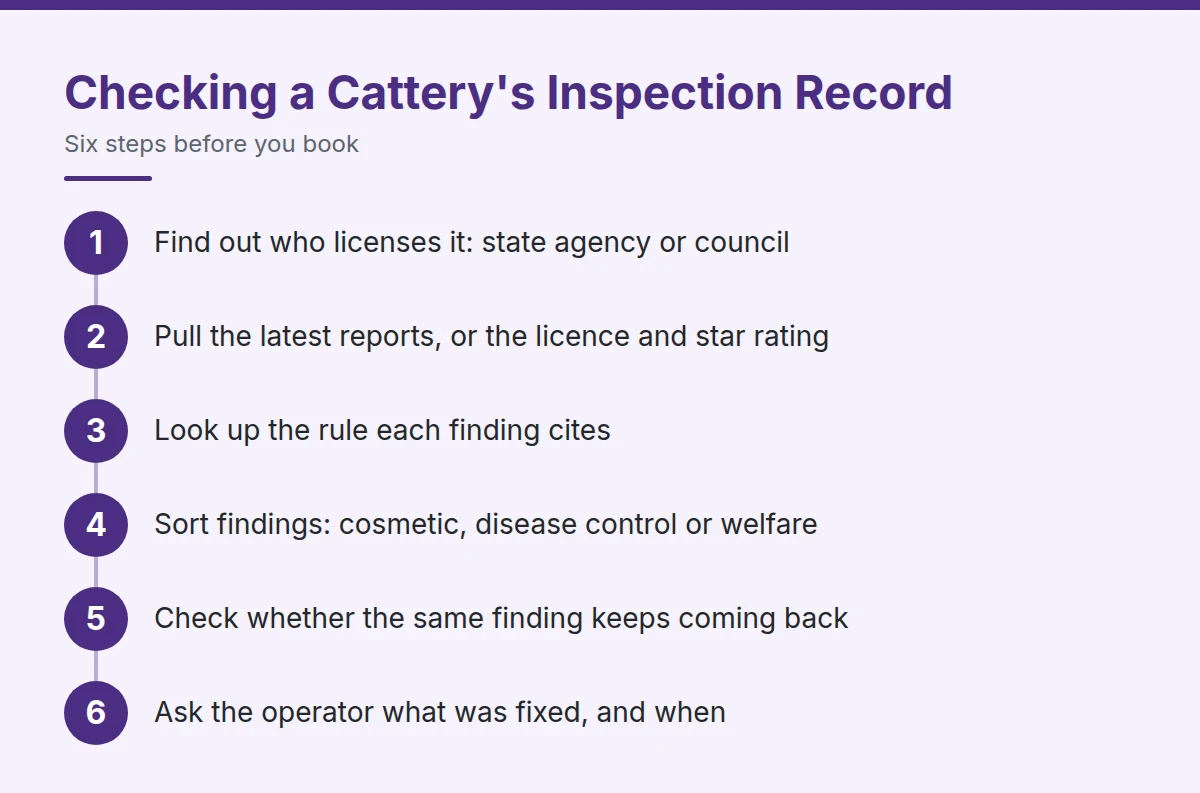
In the US, start with the state, not Washington. The USDA’s guide to licensing under the federal Animal Welfare Act lists boarding kennels among its exempt businesses, so the federal inspection database is the wrong place to look. Where boarding is licensed at all, it is usually by the state department of agriculture, sometimes with a city or county layer on top.
North Carolina is about as open as it gets. Its Animal Welfare Section publishes boarding kennel inspection reports online, searchable by facility name, and the state’s Animal Welfare Director told WRAL in 2025 that the section inspects each of the state’s 700-plus licensed facilities at least once a year. Iowa’s agriculture department says inspection reports for every state-licensed facility, boarding kennels included, are on its website.
Check what the law actually covers, though. Pennsylvania has a searchable database of kennel inspections, but it sits under the state’s Dog Law, which defines a boarding kennel as a place where “a dog or dogs are housed for compensation”. A cat-only cattery there has no Dog Law licence to look up, so an empty search result tells you nothing about it. If your state has no online search, ask the licensing agency for the facility’s last two or three reports. If no agency licenses cat boarding where you live, that is worth knowing too.
In England, the licence itself is public. Every commercial cat boarding business needs a licence from its council. Defra’s statutory guidance requires a copy to be displayed in a public-facing area such as the entrance, with the licence holder’s name and licence number on the business’s website. Each licence carries a star rating from one to five and states the maximum number of cats the premises may hold, and councils are expected to list licensed businesses and their ratings on their own websites.
The full inspection report is less visible. Under the same guidance it covers the operator, the premises, the records, the condition of the animals (Defra’s example is matted fur) and the inspector’s opinion on whether the licence conditions will be met. After the inspection, the council must explain the rating to the business in writing, including a list of the higher standards it does not meet, or of the minimum standards it is failing if it lands in the one-star category. A cattery that is comfortable with its rating can show you that letter, and asking for it is reasonable.
Star ratings are an English system: the 2018 regulations and Defra’s guidance apply in England only. Elsewhere in the UK, the useful questions are whether the council has licensed the business and when it last visited.
Reading a US Report: Codes, Comments, and the Outcome
North Carolina’s format is typical, and the ABC11 list shows it well. Each finding has three parts.
The code. A line such as “0204 Enclosures in sound repair - not acceptable” points to the state’s boarding kennel rules, Subchapter 02 NCAC 52J. The four digits are the rule number: 0102 covers boarding kennel records, 0201 general housing, 0202 indoor facilities, 0203 outdoor facilities, 0204 primary enclosures and 0207 sanitation. The words after the number compress one requirement in that rule. “0204 Drainage prev. cross contam.” means the enclosures were not built to stop waste and wastewater from animals in other enclosures reaching this one. “0202 Imperv./Sanitary surf., indoor” means surfaces the animals touch were not impervious to moisture and easy to sanitize.
The comments. This is where the inspector says what was actually wrong, and it matters more than the label. “Enclosures in sound repair” can mean chipped paint or a hole in a wall.
The outcome. Most write-ups simply list what needs fixing. Some end with “Inspection disapproved”, which means the facility failed; seven of the 55 write-ups on the ABC11 list did. Watch too for follow-up language such as “some of the inadequacies noted on 8/22/2016 had not been addressed”, which tells you an earlier visit found the same problem.
Two cautions. North Carolina readopted these rules in 2022, so check the current wording rather than assuming an old label means exactly the same thing today. And other states number their rules differently, but the method transfers: find the rule the code cites, read it, then read the inspector’s comment against it.

Reading an English Star Rating
A star rating compresses two separate judgements into one number. The first is risk: is the business low or higher risk, judged on its compliance history, complaints and how well it is managed? The second is standards: does it meet the minimum standards, the optional higher standards, or does it have minor failings?
- Five stars: low risk, higher standards. Three-year licence.
- Four stars: higher risk, higher standards. Two-year licence.
- Three stars: low risk, minimum standards. Two-year licence.
- Two stars: higher risk, minimum standards. One-year licence.
- One star: minor failings that must not compromise welfare. A one-year licence to get the business into compliance, which Defra says should not normally run longer.
Meeting the higher standards is the only route to four or five stars, and a cattery must meet every required higher standard plus at least half of the optional ones. For cats, the required list includes a check on every cat at least once overnight, by a person or by CCTV, and a sleeping area held between 18°C and 26°C. The minimum standard asks only that some part of the sleeping area stays between 15°C and 26°C and never drops below 10°C.
Three things trip owners up.
New businesses cannot start on five stars. An applicant without a year of compliance history is automatically rated higher risk, so four stars is the ceiling. A four-star cattery in its first year may be excellent. A two-star cattery that has traded for a decade is telling you something different.
Mixed businesses get one rating. A licence holder who boards dogs and cats receives a single star rating, rounded down to the weaker activity. Three stars at a kennel with a cattery attached might reflect the dog side or the cat side, and only the feedback letter will tell you which.
Ratings move. A rating can drop after an unannounced inspection, such as one made to investigate a welfare complaint. A business can appeal within 21 days of its licence being issued, or fix what was wrong and pay for a reinspection, which can move the rating up, down or nowhere. Ask when the current rating was awarded.
It also helps to know what “higher risk” is built from. The council’s risk table scores, among other things, whether the business plans its maintenance or lets buildings and equipment “deteriorate before action is implemented”, and whether its records are complete or “appear to be being manufactured”. So in England a run of small repair findings costs stars even when no single one would.
What Inspectors Write Up Most
The ABC11 list makes a useful sample because it is so ordinary: 55 write-ups from 2015 to mid-2017, each noting at least one problem. Counted by write-up, a structural repair problem appears in 20 of them, surfaces that are not impervious to moisture in 17, drainage that lets waste cross between enclosures in seven, record problems such as expired rabies records or missing owner signatures in four, and a temperature problem in exactly one.
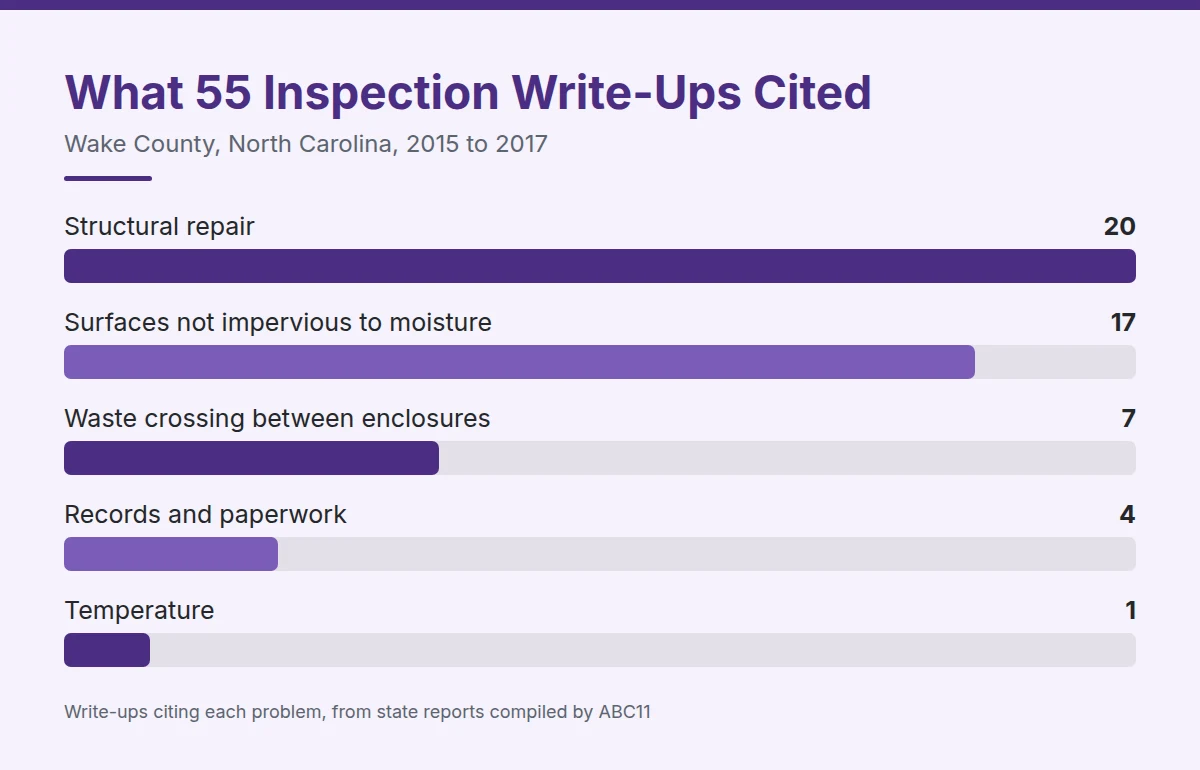
Plenty of those lines are about dogs: chewed door frames, holes dug in play yards, too few staff watching play groups. For a cat in a separate cat room they are mostly noise, though chewed woodwork left for months says something about repairs in general.
The recent picture looks similar. When WRAL went through North Carolina’s records in 2025, it found many of the findings related to kennel conditions: feces piling up, structures in disrepair and temperatures that were too hot. The most urgent violation, according to the state’s Animal Welfare Director, is “first and foremost, lack of water.”
Sorting the Findings: Cosmetic, Disease Control, or Welfare
The labels will not do the sorting for you, because “enclosures in sound repair” covers both peeling paint and a hole in a wall. The comments will. Put each finding into one of three groups.
Cosmetic, unless it keeps coming back. Paint, ceiling stains, a leaking overhang, gravel, chewed trim in a dog area. None of these on its own is a reason to cancel a booking.
Disease control: the group that matters most for cats. Surfaces that are not impervious, cracked or unsealed floors, worn rubber seals, gaps where a wall meets the floor, drainage that carries waste from one pen to the next, missing barriers between units, and vaccination records nobody checked. These matter because of what lives in the gaps. According to the European Advisory Board on Cat Diseases (ABCD), feline panleukopenia virus is shed in high concentrations in feces, stays infectious in the environment for months, and tolerates many common disinfectants.
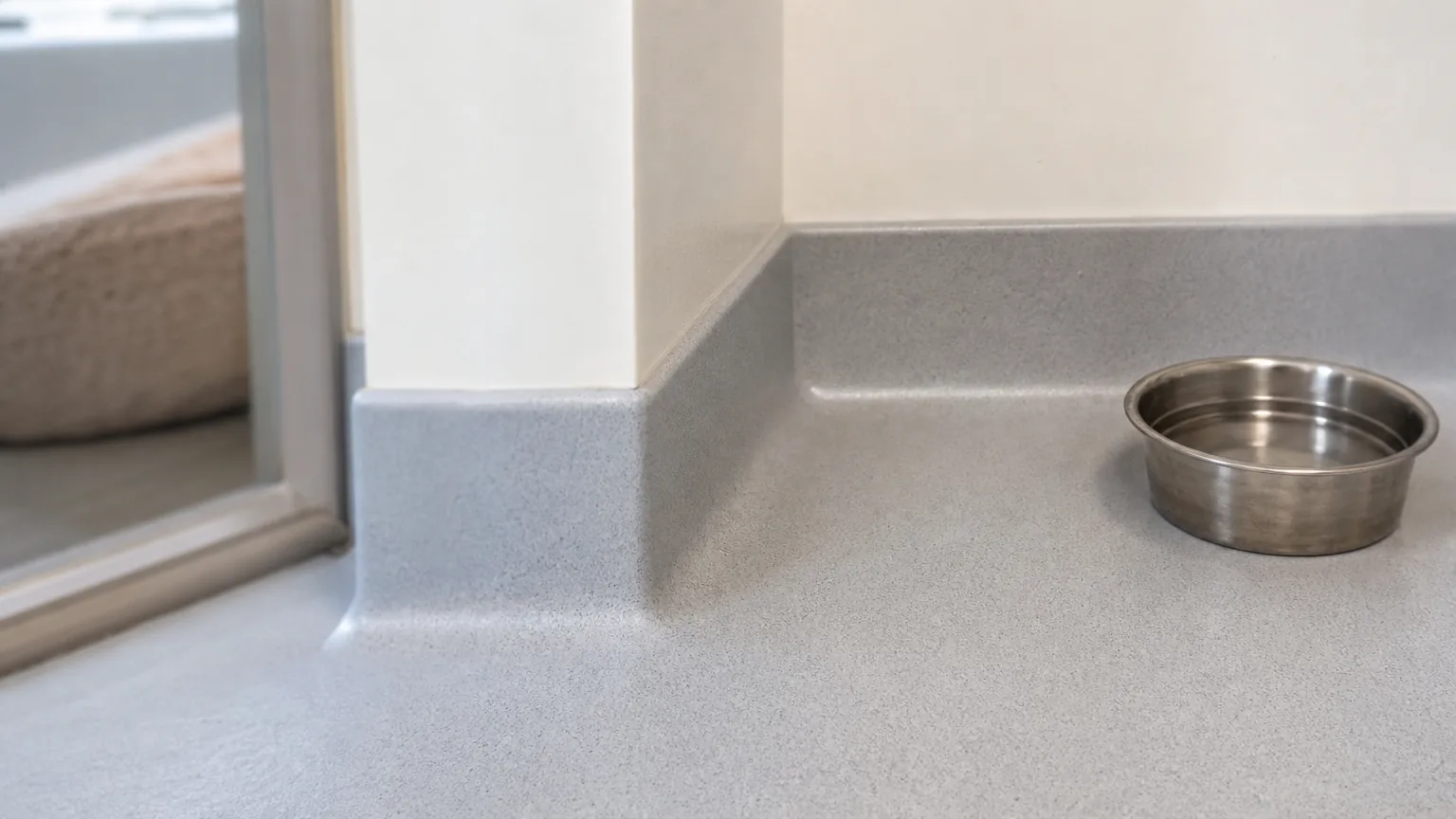
The Association of Shelter Veterinarians’ standards of care call for surfaces that can be fully sanitized, wall and floor junctions sealed against water and the buildup of organic matter and pathogens, and drainage that stops waste crossing between housing units. They warn that objects with scratched, damaged or porous surfaces are difficult or impossible to disinfect completely. England’s cattery rules say the same in licence language: smooth waterproof interior surfaces, junctions covered or sealed, no waste running into neighbouring units, and solid full-height barriers between adjoining units. So in an otherwise dull report, the line about rubber on the cat kennels is the one to ask about. The URI prevention guide covers the airborne side of the same problem.
Welfare and safety: one is enough. Water, temperature, a missing thermometer, escape risks such as loose wire or holes in walls, more cats than the licence allows, cats from different households sharing a unit, and injuries, deaths or escapes that went unrecorded. One of these deserves a direct question. Two in recent reports is a reason to book elsewhere.
At the far end, this is what losing a licence looks like. In 2023 North Northamptonshire Council suspended a cattery’s licence on the spot after an unannounced inspection carried out with the RSPCA, then revoked it. Officers found cats kept in a downstairs toilet, a spare bedroom and small crates stacked in an office, a pen licensed for one cat holding two, and cats from different households sharing space with no sneeze screens between them. Our guide to stocking density explains why overflow like that breeds disease, and what happens when officers remove cats covers the step beyond it.
Then look at the pattern, not the line. Three signals outweigh any single finding:
- The same code on consecutive visits. One kennel on the ABC11 list was cited for its indoor surfaces on six inspections in a row over 15 months, and for drainage cross-contamination on five of them.
- A deadline that slipped. Another was told in May 2016 that its outdoor runs needed barriers between kennels. In January 2017 the inspector noted that a 60-day window to start the work had passed with no barriers installed. By April the installation still had not started, and the inspection was disapproved.
- A failed inspection, or a note that earlier problems had not been addressed.
North Carolina’s Animal Welfare Director told WRAL that seeing a violation should not, on its own, be a red flag. What matters more is the type of violation, how many there are, and whether the facility corrects them. “If it’s cited and the next time they go back it’s fixed, OK. That shows a willingness to comply.”
What a Clean Report Does Not Tell You
A clean report means the facility met its jurisdiction’s minimum on the day of the visit. That is worth knowing, and it is less than it sounds.
The minimum varies enormously. North Carolina requires at least four square feet of floor space per adult cat, and elevated resting surfaces can count toward it. Its rules allow up to 12 cats in one enclosure, and cats from different owners may share if the owners agree in writing. England’s cattery rules allow a unit to be shared only by cats from the same household and ban communal exercise areas outright. A spotless North Carolina report is not evidence of a suite you would choose for your cat.
It is a snapshot. North Carolina says it inspects every licensed facility at least once a year. In England the licence conditions call for at least one unannounced visit within 12, 24 or 36 months, depending on the rating.
Inspectors mostly see buildings and paperwork. A report rarely tells you how a frightened cat is handled at feeding time, whether anyone notices that it has stopped eating, or how close the cat block sits to barking dogs. That is what a tour is for, and the first-time boarding guide has the checklist.
Questions to Ask Before You Book
- Who licenses you, and when were you last inspected?
- May I see the last report, or in England, the council’s letter explaining your star rating?
- What was cited, and what did you change? A good answer is specific and dated.
- In England, which higher standards do you not meet yet, and how long have you held a licence?
- If you also board dogs, does the rating reflect the dog side or the cat side, and where are the cats housed relative to the kennels?
An operator who answers these without flinching is usually one you can trust with the rest. If a stay does go wrong, the record you checked before booking becomes useful again, as our guide to complaining about a cattery explains.
For Operators: The Findings Inspectors Write Up Most
Most of what inspectors write up is maintenance, which means most of it is preventable.
- Floors and surfaces. Reseal before paint starts to lift, fill cracks, and cover or replace any damaged wood a cat can reach.
- Seals and junctions. Check door seals and wall-to-floor joints on a schedule, not when they fail. Worn rubber on cat kennels and missing sealant at the base of kennel walls both appear on the ABC11 list.
- Drainage and barriers. Keep drains clear and make sure wash water cannot reach the next unit. Defra advises a minimum gradient of 1:80 and says waste or water must not run off into neighbouring pens or units.
- Metal and mesh. Rusting gate bottoms, loose wire and exposed bolts are standard write-ups that a weekly walk-round catches first.
- Temperature. A working thermometer in every room. North Carolina’s indoor range is 50°F to 85°F. England’s minimum standard keeps part of each sleeping area between 15°C and 26°C, and four or five stars need 18°C to 26°C.
- Records. A current vaccination record for every cat, an incident log, and signatures at drop-off and pickup. In North Carolina a death or escape must be reported to the Animal Welfare Section within 48 hours.
- A written maintenance plan. In England it sits on the risk table, where a planned programme is the difference between a low-risk and a higher-risk score on that line.
When an inspector does cite something, fix it, photograph the fix, and point it out at the next visit. A finding that has gone by the following report is exactly the willingness to comply that North Carolina’s director describes.
The Short Version
Find out who licenses the cattery, then read its record before you read its reviews. Most findings are maintenance, and maintenance that gets fixed is normal. Findings about surfaces, seals, drainage and barriers bear on infection. Findings about water, heat, escape and overcrowding bear on safety. And the same finding on visit after visit says more about a business than any single line. In England, read the stars alongside the date they were awarded and the age of the business, and ask for the letter that explains them.
Further reading (sources)
- ABC11 published two years of negative findings from Wake County boarding kennel inspections
- WRAL on what North Carolina’s boarding kennel records show and how the state’s director reads them
- NC Department of Agriculture with its Animal Welfare Section search of boarding kennel inspection reports
- North Carolina Administrative Code for the boarding kennel rules behind each four-digit code, including the primary enclosure rule and its space allowance for cats
- USDA APHIS on why boarding kennels are exempt from federal Animal Welfare Act licensing
- Iowa Department of Agriculture and Land Stewardship confirms that inspection reports for state-licensed facilities are published online
- Pennsylvania Department of Agriculture runs the Dog Law kennel inspection search
- Animal Legal and Historical Center for the Pennsylvania Dog Law’s definition of a boarding kennel
- Defra on how star ratings are scored, published, appealed and reinspected and the surface, drainage and temperature conditions of a cat boarding licence
- North Northamptonshire Council reported the Burton Latimer cattery’s on-the-spot suspension and revoked licence
- Association of Shelter Veterinarians with standards for sealed surfaces and drainage that stops waste crossing between units
- ABCD on how long panleukopenia virus survives and which disinfectants kill it