When Welfare Officers Seize Cats From a Cattery: Cost-of-Care Bills, Appeal Deadlines, and Getting a Boarded Cat Back
Published on October 14, 2026
In August 2026 a cat rescue in St. Thomas, Ontario, received a statement of account for $198,165.28. It covered veterinary care and boarding for cats that the province’s Animal Welfare Services had taken into its care after a spring inspection: $125,640.50 for the vets and $72,524.78 for the boarding. About two weeks earlier, the rescue had learned that 17 of those cats had been euthanized without its consent. It was notified on July 22 that three had been put down, and on July 28 that fourteen more had. It had 10 business days to appeal the bill.
The rescue said it planned to appeal, and the province declined to comment on an active investigation, so nothing here is a finding about what happened inside that building. The case is worth studying anyway, because the law that produced the bill makes no distinction between a rescue, a breeder, a traditional boarding cattery and a luxury cat hotel. Each is a place where someone keeps cats, and whoever keeps them is first in line for the bill.
This article is for two readers: operators, who need to know their exposure and which deadlines start the day officers arrive, and owners whose cat is inside a facility that is raided or shut in the middle of a stay. (If you want to report a stay that went wrong, see our guide to complaining about a cattery and getting redress.) None of this is legal advice. The rules below come from the statutes themselves, but they change at every border, so anyone facing a removal should talk to a local lawyer quickly.
Removal Comes First, the Bill Later
The detail differs from place to place, but a removal follows the same broad pattern almost everywhere. An officer with statutory powers, often with police alongside, concludes that animals are suffering or at risk, usually backed by a veterinarian’s written opinion. In Ontario the grounds include a vet’s written advice that removal is needed, critical distress, or an ignored compliance order. In England and Wales an inspector or constable needs a vet’s certificate that the animal is suffering or likely to suffer, unless waiting for a vet is not reasonably practicable.
The cats then go somewhere else: a shelter, a veterinary hospital, a contracted boarding kennel. That is when the meter starts. Someone is now paying for housing, food, litter, staff time and veterinary work for every cat, every day, and in each of the systems below the law is built to send that bill back to whoever had the cats. For comparison, our cat boarding cost guide shows what a night of ordinary boarding costs.
Three questions follow: who pays, how long you have to object, and what can happen to the cats in the meantime.
Ontario: One Bill, Two Clocks
Ontario’s Provincial Animal Welfare Services Act, 2019 (the PAWS Act) is the clearest example of the modern model, because it builds the bill into the removal itself. Section 35 lets the Chief Animal Welfare Inspector serve a statement of account on “the owner or custodian” of an animal for the costs of relieving its distress, removing it and caring for it. Whoever receives one is liable for it, subject to appeal. The Act sets no ceiling, and statements can be served “from time to time”, so a long removal produces a series of bills rather than one. The St. Thomas rescue said it did not expect its first to be its last.
Two clocks then run from the day a statement is served, both counted in business days, which the Act defines as weekdays that are not holidays:
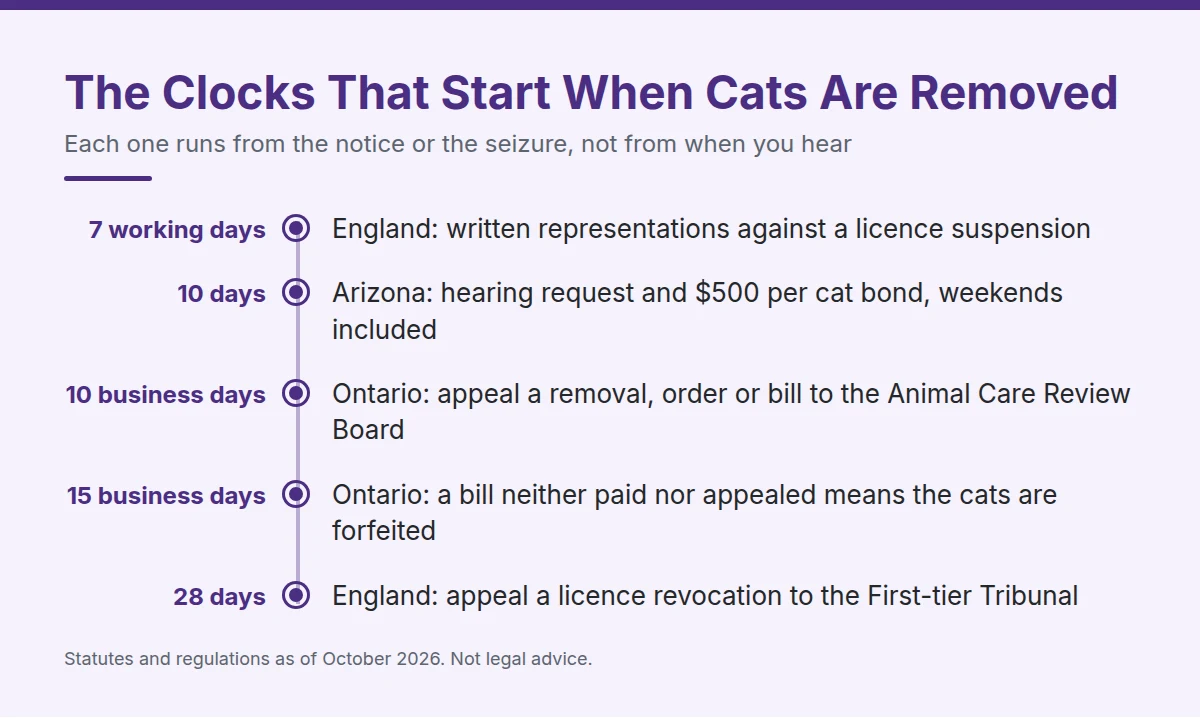
- 10 business days to appeal. Ontario Regulation 447/19 sets this window for every appeal to the Animal Care Review Board, whether against a statement of account, a compliance order, a decision to remove animals, or a decision to keep them in provincial care. The Board says each order, decision or statement must be appealed separately. There is no filing fee.
- 15 business days to pay. If you neither appeal nor pay within 15 business days, the animals are forfeited to the Crown. If you appeal and the Board confirms or changes the bill, you get another 15 business days from its decision to pay before forfeiture.
Two further provisions matter. Forfeiture does not end the debt: an unpaid balance becomes a debt to the Crown whether or not the animals have been forfeited, so giving up the cats does not make the bill go away. And the debt cannot be enforced while an appeal is under way. Before the deadline, the Chief Animal Welfare Inspector can also agree in writing to give more time to pay, or to accept less.
The Board must start proceedings within 10 business days of an appeal, often with a case conference by phone or video. What an appeal can achieve is shown by a November 2025 decision reported by the Kingstonist. Animal Welfare Services had removed 14 dogs from an owner near Kingston after the owner failed to comply with a care order, then issued two statements. On the second, the Board put the initial burden on the province to show that its costs were actually incurred and reasonable, before the onus shifted to the owner to show why the bill should change. That bill fell from $41,566.85 to $38,007.35, because both sides accepted that boarding should not be charged after the date the dogs could have gone home. The rest stood. That is the realistic shape of a cost appeal: a line-by-line check that trims a bill, not a hearing that makes it vanish.
Treatment and Euthanasia Without Consent
This is the part of the St. Thomas story that caused the most anger, so it is worth being exact about what the law allows.
Under section 32 of the PAWS Act an inspector may have an animal euthanized in two situations: with the owner’s consent, or where a veterinarian has advised in writing that it is the most humane course of action. The Act defines that phrase narrowly. Euthanasia qualifies only if immediate veterinary treatment cannot prolong the animal’s life, or if prolonging it would mean undue suffering. Notice goes to the owner or custodian afterwards. Inspectors may also take any reasonable steps to relieve an animal’s distress, and the cost of doing so goes on the statement of account. Whether the test was met for each of the 17 cats is not public. What the section means in practice is that the legal threshold is a written veterinary opinion, not the keeper’s agreement, and the keeper hears about it after the fact.
England and Wales draw the line in a similar place but add a court. Section 18 of the Animal Welfare Act 2006 lets an inspector or constable destroy an animal on a vet’s certificate that it should be destroyed in its own interests, or without one where there is no reasonable alternative and waiting for a vet is not reasonably practicable. Otherwise the future of animals taken into possession is for a magistrates’ court under section 20, which can order treatment, transfer to a named person, sale, other disposal or destruction. The owner must normally be given a chance to be heard, anyone with “a sufficient interest” in an animal can apply, and under section 21 nothing can be done under an order until the time to appeal to the Crown Court has passed or the appeal is decided.
In the United States the decisive moment is usually forfeiture. Once a seized animal is forfeited, typically for an unpaid bond, it belongs to the agency, and New York’s statute says plainly that a forfeited animal “shall be made available for adoption or euthanized”.
The lesson is the same in all three. If a cat in your care has a condition that makes it look worse than it is (a thin cat with managed kidney disease, an old cat on arthritis treatment), the receiving vet needs its records on the first day, not the tenth. Hand them over at removal, and ask in writing to be consulted before any decision that is not an emergency. The authority may not be obliged to agree, but the request costs nothing and creates a record.
England and Wales: Court Costs, Licences, and a Signature to Avoid
In England and Wales the bill arrives by a different route. Under section 18(13), whoever spent money acting under that section can ask a magistrates’ court to order reimbursement “by such person as it thinks fit”, with an appeal to the Crown Court. A court making section 20 orders can also order someone to repay the cost of carrying them out. It must have regard to avoiding increases in those costs, and it can deduct them from any sale proceeds due to the owner.
Much of the practical action happens without a hearing. The RSPCA, a registered charity, brings section 20 applications itself, and its leaflet for people served with one tells them they can “sign over ownership” of the animals at any time up to the hearing and avoid court altogether. A cattery operator should stop at that line. A boarding business is the keeper of its guests, not their owner. Resident cats the business owns are its own to decide about, but a client’s cat is not yours to give away, and you should not sign any document that lists one. Tell the officers in writing which cats belong to clients, and hand over the register.
A licensed cattery in England also answers to its council under the 2018 licensing regulations, and that is a second route by which boarded cats can be sent home in the middle of a stay. Defra’s guidance says a suspension, variation or revocation normally takes effect seven working days after notice, but the council can make it immediate where that is necessary to protect animal welfare. The licence holder has seven working days to make written representations. A revocation can be appealed to the First-tier Tribunal within 28 days, and the Tribunal can suspend the revocation while the appeal runs. Once a suspension takes effect, the guidance says, the business cannot trade.
One tribunal appeal decided in 2023 shows what that looks like from the inside. After two cats escaped through damaged units at a cattery licensed for 84, one of them never found, the council told the operators that the licence was revoked with immediate effect, that they could take no bookings from the next day, and that they must repatriate every cat being boarded. The Tribunal agreed that the breaches were real and the escapes serious, but held that revocation went further than welfare required and substituted a suspension. For owners whose cats were in residence that week, the distinction came too late. The stay was over either way.
United States: Bond or Forfeit
American law mostly settles the cost question with a blunter instrument. The Animal Legal Defense Fund, which supports these laws, counts 34 states with “bond or forfeit” statutes: the owner of seized animals must post security to cover their care while the case runs, or lose them. In most of those states, ALDF says, whoever asks for the bond does not have to prove the animals were criminally abused, because the bond is treated as a civil, remedial measure rather than a punishment, and every appellate court to examine these laws has upheld them.
The clocks are short, and they vary:
- Arizona requires the seizure notice to warn the owner that a hearing must be requested, by returning a signed declaration of ownership or right to keep the animal, within ten days “including weekends and holidays”, and that a bond of $500 per animal must be posted within ten days of the seizure. Miss either and the animal is deemed abandoned and becomes the property of the seizing agency. At a hearing the agency must prove cruel mistreatment or neglect by a preponderance of the evidence, and an owner who wins gets the bond back. For a rescue holding twenty of its own cats, that is $10,000 within ten calendar days.
- New York runs through the criminal court. Once charges are filed, the impounding organization can petition for security covering at least 30 days of medical care and boarding. The court must hold a hearing within ten business days, the security must be posted within five business days of that hearing, and failure to post can mean immediate forfeiture. The security comes back, along with the animals, on an acquittal or most dismissals.
If Your Cat Was Boarded There
Owners are the people most likely to be blindsided, because each of these systems serves notice on whoever is closest to the animals. Ontario’s notices go to the “owner or custodian, if known”. Arizona lets a seizure notice be posted “in a conspicuous place where the animal was found”. If you are on holiday when officers arrive, the facility is the custodian, and in some states the clock runs from the seizure itself rather than from the day you hear about it.
The better news is that client animals usually do go home. When police and the Arizona Humane Society removed 165 animals from a Phoenix boarding facility in 2018, the humane society told owners they could skip the court hearing and reclaim their pets directly. They had to describe the pet, say how long it had been boarded there, and bring proof of ownership: vet records, licensing, microchip details and photos. Animals went home once they were found medically fit. In September 2026, Memphis Animal Services returned all 20 client dogs removed from a groomer’s home after the groomer was charged with aggravated cruelty.
What gets a cat home fastest:
- Call the authority, not just the facility. Ask who holds your cat, where, and whether it is being kept as evidence.
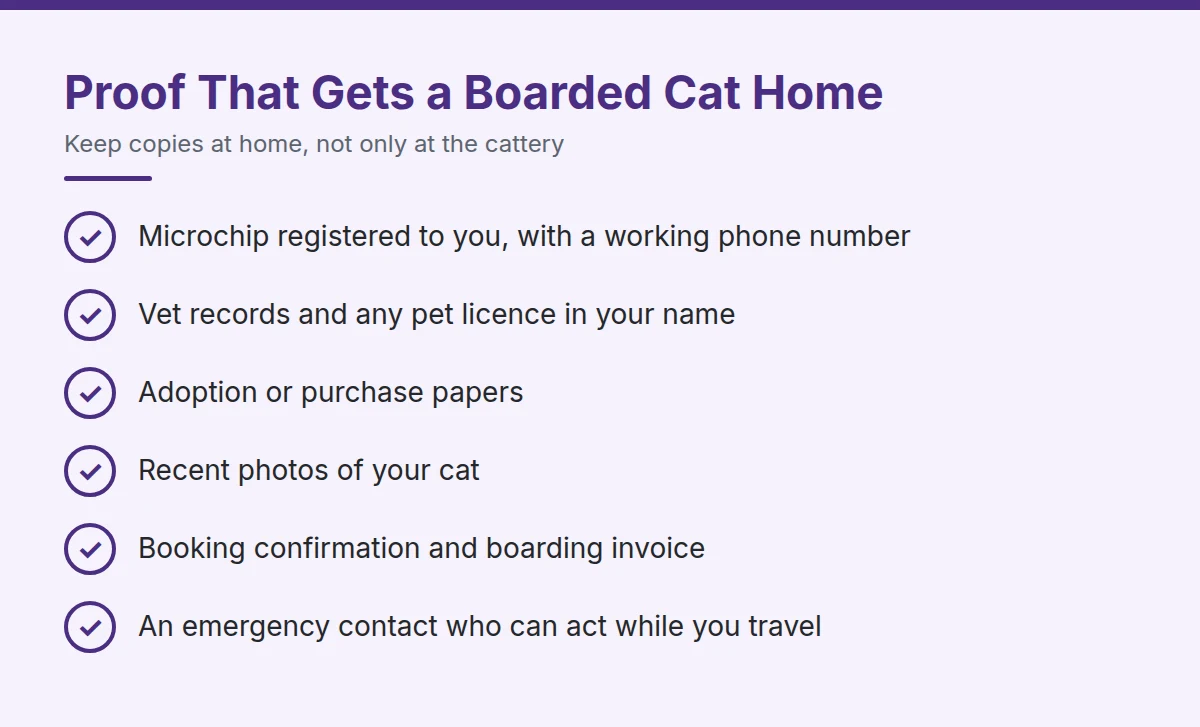
- Bring proof that does not depend on the facility’s records. Microchip registration, vet records, adoption papers and photos, plus the booking confirmation and invoice, which show the cat was a paying guest rather than the operator’s own.
- Have your vet send the cat’s history straight to the vet now treating it, especially medications and chronic conditions.
- Treat any bill, bond demand or petition with your name on it as real, even if you think it belongs to the facility. In Ontario an owner can appeal just as a custodian can, and can apply at any time for a cat’s return once the reasons for keeping it have ended. New York’s security petition must be served on any “interested person” with a financial stake in the animal, which can include the owner of a boarded cat. A deadline missed out of politeness is still missed.
- Prepare before you travel. Check your microchip registration, keep those documents in one folder at home, and leave the cattery an emergency contact who can act while you are away. English licence conditions already require the register to hold each owner’s details plus an emergency and a local contact. In the 2023 tribunal case, the owners of the cat that was never found were not told for three days, because the operator decided to wait until they got home.
For Operators: The File That Protects You and Your Guests
Most of what protects a cattery on the worst day of its working life is paperwork it should already have.
- A register that separates guests from residents. Every cat with its owner, microchip number, vet, medical notes and emergency contacts, and a clear line between client cats and any the business owns or fosters. Defra’s cat boarding guidance already requires most of this in England. It is the document that gets guests home, and it stops your own cats being mistaken for theirs.
- A plan for the day the licence stops. English licence conditions require written procedures “covering the care of the animals following the suspension or revocation of the licence”. If yours is boilerplate, rewrite it around who calls every owner, where cats go if an owner cannot collect, and who may move them. Elsewhere it is simply sensible, and the owner’s consent to a transfer belongs in your boarding agreement.
- Cooperation, on the record. Do not obstruct officers; in England, intentionally obstructing the section 18 powers is an offence in itself. Ask for the written notice and the veterinary advice or certificate the removal relies on, note who said what, and photograph the suites as they are if you can do it without getting in the way.
- Every deadline in the diary within the hour, counted in the right kind of day: business, working or calendar. In Ontario, file a separate appeal for each order and statement.
- No signature over a cat you do not own, and no appeal withdrawn on an informal understanding. The Kingston owner withdrew appeals against the order and the removal in the belief that this was needed to get the dogs back; the province said it had only asked whether the owner meant to.
- A capacity you can defend. Large removals often involve more animals than a building and its staff can properly handle, which is why stocking density deserves a hard ceiling, and why rescue cats belong behind the biosecurity line a rescue partnership should draw.
The Short Version

Removal comes first and the argument comes later, on the authority’s timetable rather than yours. Whoever has the cats will probably be billed for them, the windows to object are measured in days, and in most cases a written veterinary opinion, not the keeper’s consent, decides whether a seized cat is euthanized. Operators with a clean register and a real suspension plan come through better, and owners who keep their own proof of ownership get their cats back sooner. Both should act on the first day.
Further reading (sources)
- London Free Press on the St. Thomas rescue’s $198,165 bill and the 17 cats euthanized without its consent
- Provincial Animal Welfare Services Act, 2019 for the removal, euthanasia, statement of account and appeal provisions
- Ontario Regulation 447/19 with the prescribed appeal, payment and forfeiture periods
- Tribunals Ontario on how Animal Care Review Board appeals and hearings work
- Kingstonist reported a cost-of-care appeal that trimmed a bill for 14 seized dogs
- Animal Welfare Act 2006, sections 18 to 21 for powers over animals in distress, court orders and reimbursement
- RSPCA explains what a section 20 application means for the person served
- Defra on how councils suspend, vary and revoke animal activity licences and the cat register a licensed cattery must keep
- Animal Welfare (Licensing of Activities Involving Animals) (England) Regulations 2018 with the 28-day appeal to the First-tier Tribunal
- First-tier Tribunal in an appeal against a cattery licence revoked after two escapes
- Animal Legal Defense Fund sets out its position on bond-or-forfeit statutes
- Arizona Revised Statutes for the seizure notice, hearing request and $500 bond rule
- Animal Legal and Historical Center on New York’s security petition for seized animals
- ABC15 on how owners reclaimed pets seized from a Phoenix boarding facility
- Action News 5 with client dogs returned after a Memphis groomer’s arrest