Something Went Wrong at the Cattery: How to Complain, Escalate, and Get Redress
Published on September 20, 2026
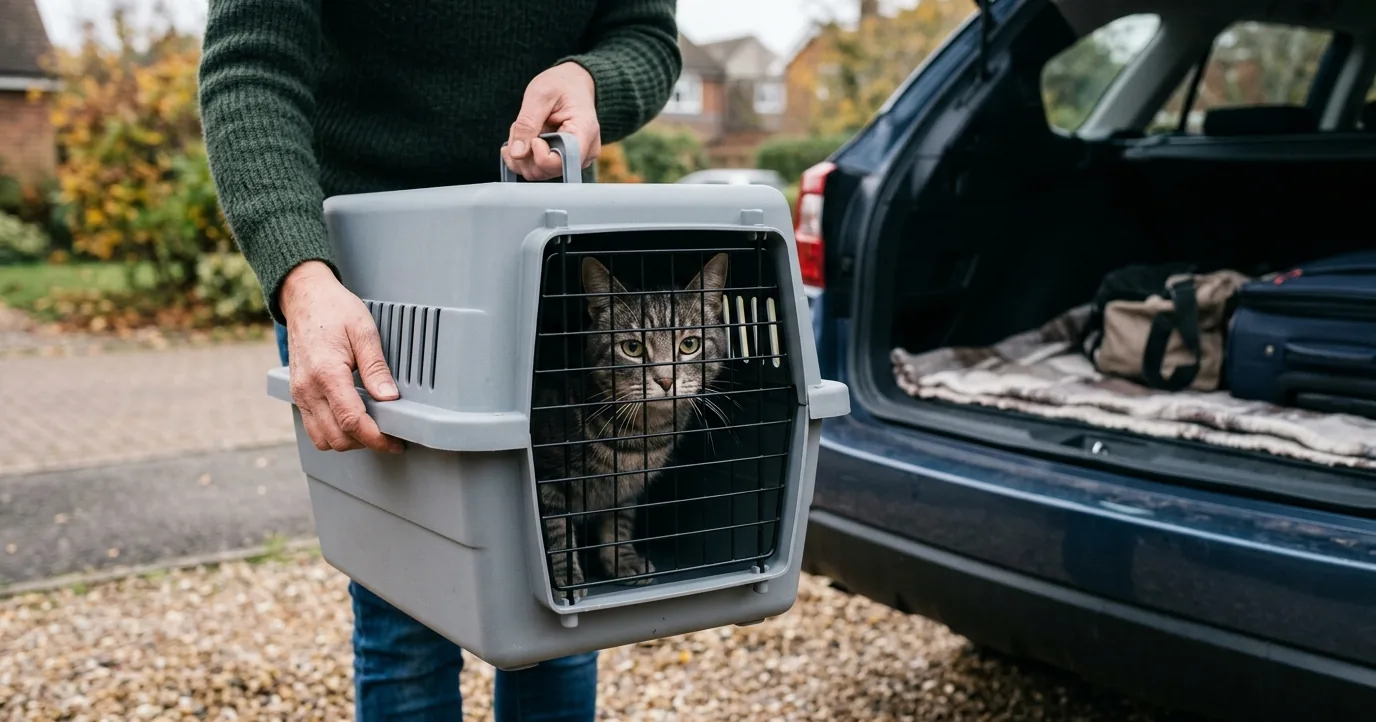
You are standing in a car park with a carrier on the back seat, and the cat inside it is not quite the cat you dropped off. Maybe she is sneezing hard enough to need a vet. Maybe there is a wound nobody mentioned at the desk. Maybe the conversation you just had felt less like an explanation and more like being managed.
What you can recover over the following weeks is mostly decided in the next few hours, and almost nobody gets the order right. The instinct is to reach for the loudest available channel, a one-star review or a post in a local group, and then work backwards toward evidence that has already evaporated. The sequence that actually produces redress is duller: treat the cat, capture the evidence, complain to the facility in writing, and only then approach the body that genuinely holds jurisdiction. Which body that is depends on where you live, and it is rarely the one owners expect.
The First Few Hours Decide Everything Else
Go to your vet, today if you can. That is the right call for the cat, and it also happens to be the only way to generate the single most useful document in any complaint: a contemporaneous clinical record written by someone with no stake in the argument.
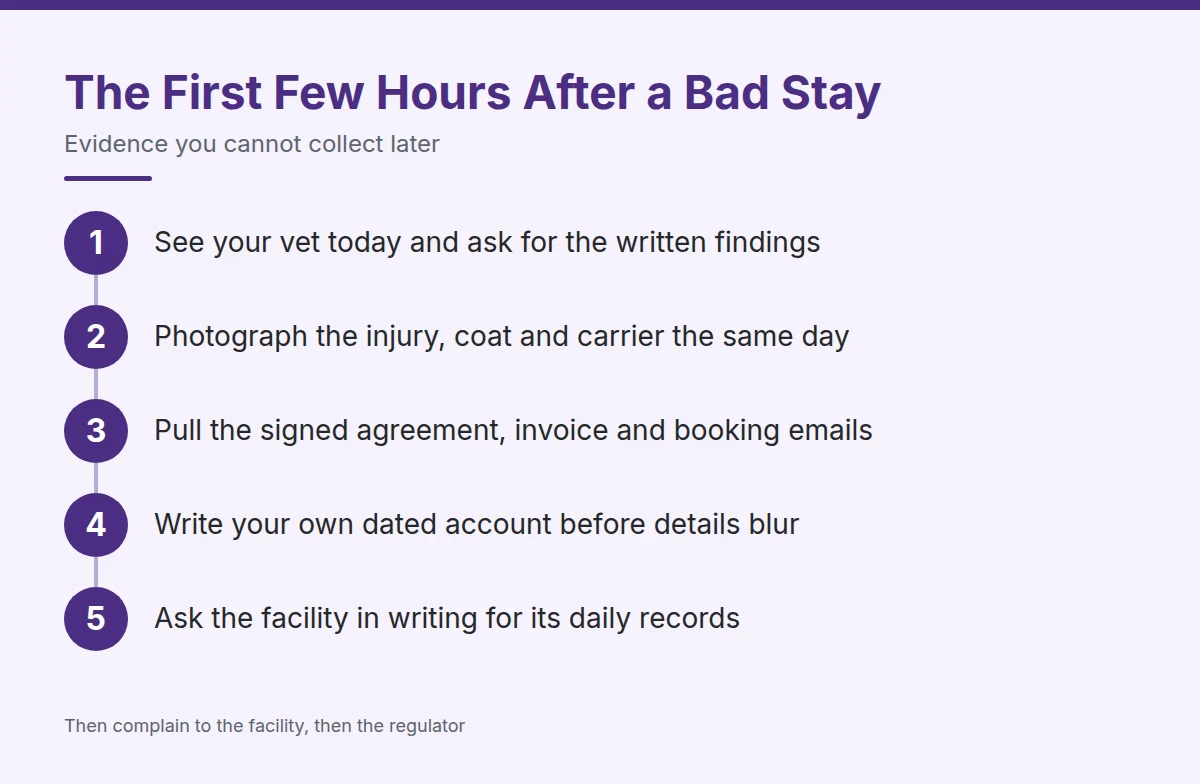
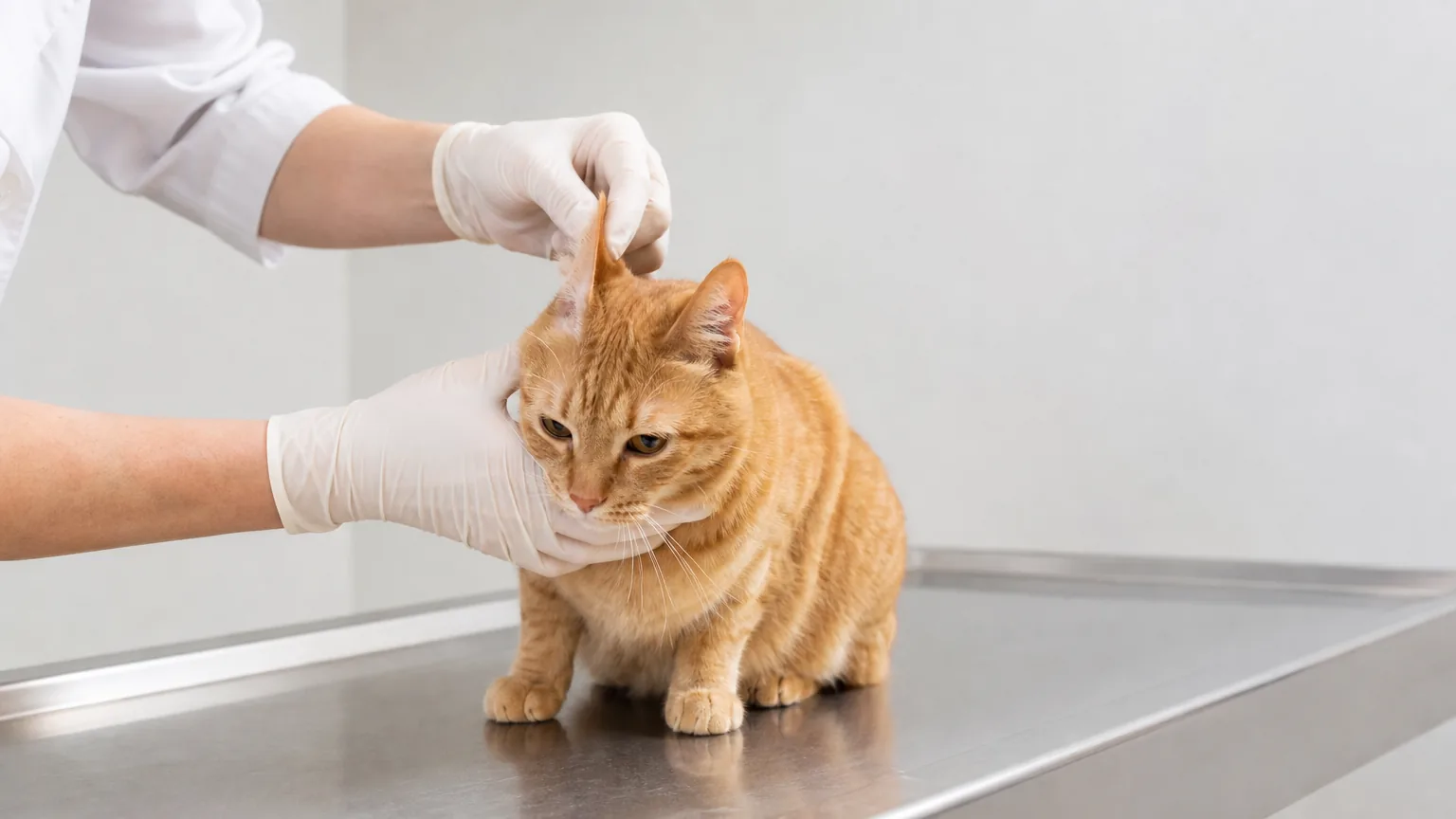
Ask the practice for a written copy of the findings. Vets will not usually apportion blame, and you should not ask them to. What you want is description and timing: the size and apparent age of a wound, the degree of dehydration, the weight. Weight is quietly powerful. If the cat was weighed at the same practice before the stay, you have an objective number rather than an impression, which matters when a facility tells you she “ate fine”. Losing condition over a stay is common enough to have its own set of causes, but a significant drop nobody flagged to you is a conversation worth having.
Then photograph, the same day. The injury, the state of the coat, soiled fur, the carrier if it came back dirty. Phone photographs carry timestamps, which is exactly why the same-day part matters.
Gather the paperwork while you are at it: the signed boarding agreement, the booking confirmation, the invoice, the feeding and medication instructions you supplied, and any texts or emails exchanged during the stay. Then write your own account before the details blur, with dates, times and names.
Finally, ask the facility in writing for its records. In England, statutory guidance requires a licensed cat boarding business to keep records and retain them for at least three years, so the daily log, feeding and medication entries, and any contact with a vet during the stay should all exist. Asking for them is reasonable. A facility that produces them promptly is usually one you can resolve things with. A flat refusal tells you something too.
Complain to the Facility First, and Do It in Writing
Not purely out of fairness, though most operators deserve the chance. Every route after this one will ask whether the business was given an opportunity to put it right, and a written complaint forces a written answer you can use later.
Keep it flat and factual: dates of the stay, what you found, what the vet found, what you want, and a date by which you would like a response. Name a number. “Please refund the 214 pounds boarding fee and the 186 pounds vet bill, invoices attached” gets answered far faster than “I would like some compensation”, because the second one requires the recipient to make a decision you have not made for them.
If the tone of the replies suddenly turns cold and legalistic, that is often the insurer rather than a change of heart. More on that below.
Who Actually Holds Jurisdiction
This is where owners lose weeks. “Reporting a cattery” is not one action. It is two or three different actions, aimed at different bodies with different powers, and no single one of them does the whole job.
England and Wales
The council licenses the premises, so the council is your first call. Under the Animal Welfare (Licensing of Activities Involving Animals) (England) Regulations 2018, a local authority may vary, suspend or revoke a licence at any time and without the holder’s consent, where licence conditions are not being complied with, the regulations have been breached, the information supplied was false or misleading, or it is necessary to protect the welfare of an animal. That is the sharpest instrument in the whole system, and it sits with a council licensing officer.
It does get used. In summer 2023, North Northamptonshire Council inspected a Burton Latimer cattery unannounced, accompanied by an RSPCA inspector, and issued an on the spot suspension notice. Cats were found in the downstairs toilet, a spare bedroom, and small crates stacked in the office, with one licensed pen holding two cats where it was licensed for one. The council revoked the licence that September. Its leader noted that the RSPCA inspector had found the cats in good health, and described that as fortunate rather than by design.
Note which body did the closing. The RSPCA is a charity, and it says so plainly: it holds no statutory powers to investigate or prosecute animal welfare offences, its prosecutions are private prosecutions that anyone could in principle bring, and where powers of entry or seizure are needed its inspectors work alongside the police or the local authority. Reporting to the RSPCA is still worth doing, and cruelty as opposed to poor boarding belongs there. But if you want someone with a legal right of entry inside that building this month, ring the licensing team.
United States
Licensing is largely a state function, and it usually lives in the department of agriculture rather than anywhere with “pet” in the name. North Carolina is a representative model: its Department of Agriculture and Consumer Services runs an Animal Welfare Section that licenses and inspects boarding kennels, including in-home services, alongside shelters and pet shops, and opens complaint investigations on top of its routine inspection schedule.
Read the filing rules before you write, because they are strict and fairly typical. North Carolina requires the complaint in writing, requires firsthand observation rather than something you were told, does not accept anonymous complaints, and asks for the facility name and address, your contact details, the dates of the incident, and the relevant documents. That last requirement is the whole reason the evidence step comes first. Note also that material you submit may become a public record.
Cruelty is a different door again: local animal control or the sheriff’s office, with a state hotline in many places. Some cities license kennels separately from the state, so check both layers.
New Zealand and Australia
Here the formal layer is thinnest. Consumer NZ mapped it and found the Animal Welfare Act sets a welfare code with minimum standards, but no requirement that pet care facilities be routinely audited against it. They are generally visited only after somebody complains. Of twelve city councils contacted, only Wellington required catteries to register, with site visits and annual inspections attached. The SPCA had taken 56 complaints about pet care facilities in two years, roughly one a fortnight, covering dirty premises, inadequate security, lack of veterinary care and too few staff, and no boarding facility had been prosecuted since the code took effect in October 2018.
That is a bleak picture, but read it the other way round: in a system where inspection is complaint-driven, your complaint is the mechanism. Complaints go to the local SPCA, to the Ministry for Primary Industries as the administering agency, and to the council if it registers facilities at all.
The Welfare Route Will Not Pay Your Vet Bill
Two tracks run in parallel and neither substitutes for the other. A regulator can inspect, condition, suspend or revoke. It cannot order the facility to reimburse you. Money comes from consumer law, so run both at once.
In the UK, section 49 of the Consumer Rights Act 2015 treats every contract to supply a service as including a term that the trader must perform it with reasonable care and skill. Boarding is a service. The question is never whether the cattery guaranteed you a healthy cat, because no one can. It is whether reasonable care was taken. Unresolved claims go to the county court money claim service, where mediation is offered first and usually worth taking.
In New Zealand the Consumer Guarantees Act does the same job, covering refunds and out of pocket expenses caused by the failure, with the Disputes Tribunal as the escalation when a business refuses. Since 24 January 2026 the Tribunal hears claims up to 60,000 dollars, doubled from 30,000, and a lawyer cannot represent you at the hearing, which keeps a small owner and a large business on roughly level ground.
In the US you are looking at small claims court, with limits set state by state. The uncomfortable part is valuation. Companion animals remain personal property in almost every state, so the default measure is fair market value plus reasonable veterinary expenses, and the fair market value of a beloved mixed breed cat is close to zero. Non-economic damages for grief or loss of companionship are generally unavailable, though Tennessee and Illinois have statutes permitting some recovery and several other states have enacted provisions reaching past pure market value, usually capped. In practice the recoverable figure is the vet bill and the boarding fee, which is one more reason to keep every receipt.
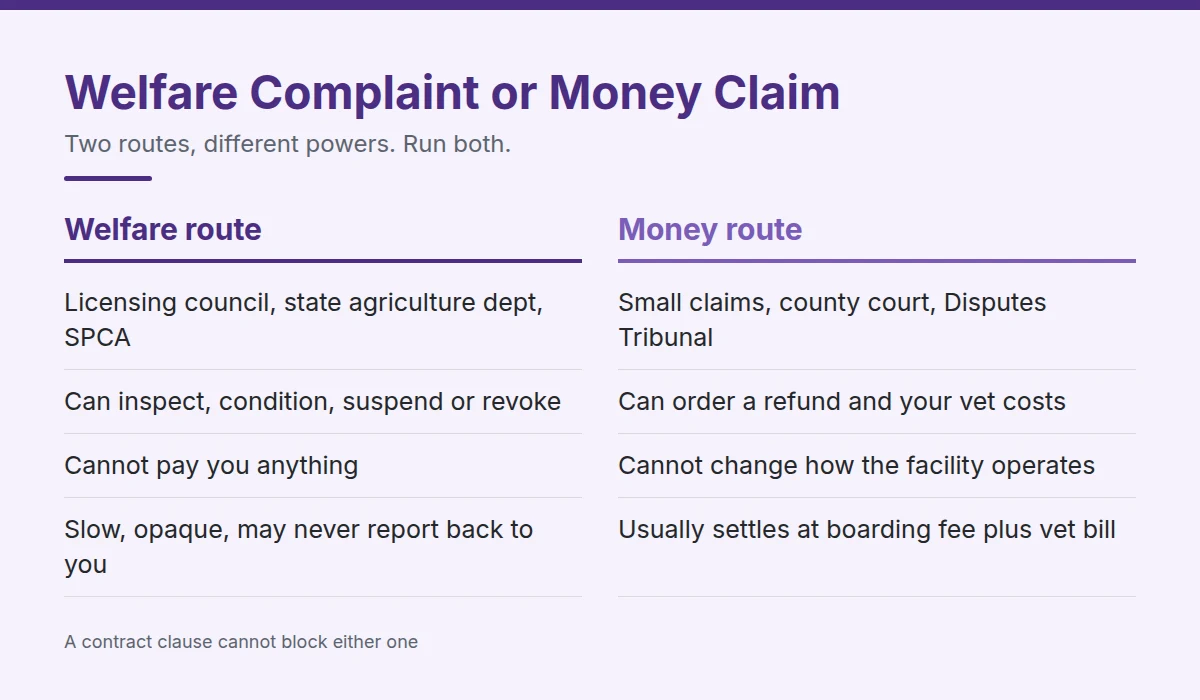
What the Contract Can and Cannot Disclaim
Nearly every boarding agreement contains a clause saying the facility accepts no liability for injury, illness, escape or death, however caused. Owners read it and stop reading.
In the UK it does not work as drafted. Section 57 of the same Act provides that a term is not binding on the consumer to the extent that it would exclude the trader’s liability under section 49, and that terms cannot restrict that liability so as to prevent recovery of the price paid, cannot make a remedy conditional on onerous steps, and cannot exclude rules of evidence or procedure. In the US, enforceability is a state question and waivers are read narrowly: ordinary negligence is often waivable, gross negligence and recklessness usually are not.
Everywhere, though, the same point holds. A contract clause is a private arrangement between you and a business. It has no bearing whatsoever on a licensing authority’s powers. You cannot sign away a council’s right to inspect, and an operator who points at your signature when you mention reporting them has misread what they are holding. The operator’s side of this material, including what a waiver is actually good for, is covered in the boarding agreement and liability guide.
When the Facility’s Insurance Pays
A properly insured cattery carries care, custody and control cover. That is the line that responds when an animal in the business’s keeping is injured, lost or killed, and it exists precisely because general liability policies tend to exclude damage to property in your care.
Two practical consequences. First, it is fair to ask early whether the facility is insured and whether it has notified its insurer, because a business that has done so is behaving correctly and your claim has somewhere to land. Second, do not read the resulting silence as an admission of guilt. Insurers routinely instruct policyholders not to admit liability, so a warm and apologetic operator can turn formal overnight. That is frustrating rather than incriminating. Keep everything in writing and let the claim run its course.
An Honest Review Is Not Defamation
Owners get threatened with defamation surprisingly often, and the threat works surprisingly often, which is why it keeps getting made.
In England and Wales a claimant has to clear the serious harm threshold in section 1 of the Defamation Act 2013 before anything else, and the Ministry of Justice’s own review of the Act notes that a body trading for profit only meets that test if it can show actual or likely serious financial loss. A cattery is such a body. Truth is then a defence under section 2, and honest opinion under section 3 protects a statement of opinion that indicates its basis, in general or specific terms, and that an honest person could have held on the facts existing at the time.
In the US, the Consumer Review Fairness Act voids contract terms that bar or restrict a customer from reviewing a business, impose a penalty or fee for leaving one, or require the reviewer to hand over intellectual property rights in it. Businesses can still act against reviews that are libellous, obscene, harassing, off topic or clearly false, but the FTC’s own guidance is explicit that a customer assessment the company simply disagrees with does not meet that bar.
So write the review the way you wrote the complaint. State what happened to you, with dates. Keep the verifiable facts verifiable, and attach nothing you cannot evidence. Label opinion as opinion. Avoid alleging a criminal offence you cannot prove: “my cat came home with an untreated wound and the facility could not explain it” is a different sentence, legally and practically, from “they abused my cat”. And do not report a complaint as upheld until it has been.
What Realistic Redress Looks Like
Set expectations honestly. On the money side, a refund of the boarding fee plus documented veterinary costs is the usual ceiling, and reaching it without a hearing is a good outcome. On the regulatory side the process is slow, largely opaque, and not really about you. You may never be told what came of your complaint. It is still the part that protects the next cat through the door.
It is also worth separating the things that happen from the things that happen because nobody was watching. A cat that comes home sneezing has not necessarily been neglected, because respiratory infection spikes after transport and rehousing even at well run facilities. The fair question is not whether your cat got ill, but whether anyone noticed, told you, and acted. The same test applies to physical injuries, most of which trace back to ordinary suite fittings rather than anything exotic.
And when you next book, spend the tour on the things a complaint would later turn on: written daily records, the vet arrangement, who is on site overnight, and how they have handled incidents before. The tour checklist is a far cheaper instrument than any of the routes above.
Further reading (sources)
- Consumer NZ on who to approach when a cattery or kennel fails your pet
- Animal Welfare (Licensing of Activities Involving Animals) (England) Regulations 2018 for the council’s power to vary, suspend or revoke a licence at any time
- Consumer Rights Act 2015, Part 1 Chapter 4 with the implied term of reasonable care and skill and the liabilities a service contract cannot exclude
- Ministry of Justice on how the Defamation Act raised the bar to serious harm and renamed the fair comment defence
- Federal Trade Commission explains which review-gagging contract terms the Consumer Review Fairness Act voids
- NC Department of Agriculture lists what a written complaint about a licensed boarding kennel must contain
- NC Animal Welfare Section also describes which facilities it licenses and inspects under the state Animal Welfare Act
- RSPCA on why its prosecutions are private prosecutions and it holds no statutory powers
- Animal Legal and Historical Center for why fair market value still governs what a companion animal is worth in court
- New Zealand Ministry of Justice with the increase in the Disputes Tribunal claim limit to 60,000 dollars
- Defra on the record-keeping conditions a licensed cat boarding business must meet
- Northants Live reported the Burton Latimer cattery losing its licence after an unannounced inspection