What Asian Cat Hotels Do Differently: Design and Service Ideas Worth Borrowing
Published on October 6, 2026
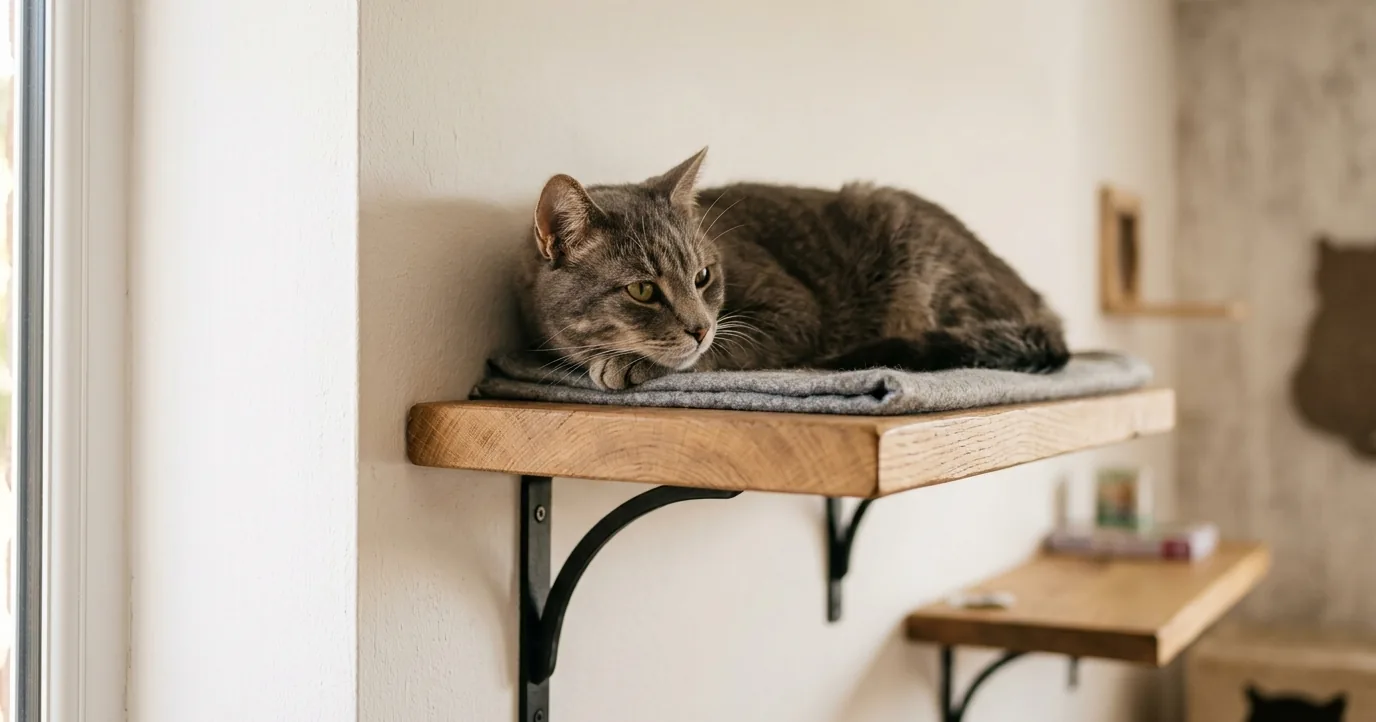
Singapore’s cat hotels mostly live upstairs. Of the eight in one 2023 roundup of the city’s cat hotels, six gave an address on the second or third floor of their building, and a seventh kept its location secret and collected every guest with its own transport. Floor space is expensive, the air is hot and wet all year, and the customers expect a hotel: named room tiers, a camera feed, a pickup service. In Qatar, boarders working under different pressures publish price lists that arrive at several of the same answers.
Not all of it belongs in a converted barn in Kent or a retail unit in Ohio. Some of it is good design under pressure, some is service thinking that Western catteries have been slow to adopt, and some would fail a licence inspection in England on the first visit. This guide sorts the three for operators planning a build, a refit or a new price list. It draws on what the hotels publish about themselves and what local roundups report, read against licensing standards and feline welfare guidelines, so treat it as a study of ideas rather than a verdict on any business.
Why the Market Looks Different
Space is vertical, and rented. A cat hotel on an upper floor pays for every square metre, so it cannot spread into outdoor runs and wide corridors the way a rural cattery can. Licensing follows the premises. To board pets in Singapore, an operator needs the planning authority’s written permission for the change of use, then layout plans for the Animal and Veterinary Service that show the number and dimensions of the cages and where the quarantine area, ventilation system and waste discharge sit. The premises are inspected before any animal is boarded, and the applicant must first pass a course on pet welfare and animal management. That is a different problem from the rural planning fights many Western catteries face, but it rewards the same habit of drawing everything before you build.
The climate never lets up. Singapore’s weather service puts mean relative humidity at around 82 percent, above 90 percent before sunrise, with nights that rarely fall below 23 to 25°C. In that climate air-conditioning is the building, not an extra, and the hotels sell it as part of the room: a “fully air-conditioned capsule”, 24-hour air-conditioning, a promised constant 25 to 28°C. In Qatar, one cat hotel writes air-conditioning into its nightly fee alongside food, litter and cleaning.
Two things transfer from that. Treat climate as part of the promise: state the range, keep a log, and plan for the plant failing, which England’s rules already demand through a written emergency plan that covers breakdowns of essential heating and ventilation. And check any borrowed figure against your own rules. England requires at least part of every sleeping area to be held between 15 and 26°C, so a room kept at a constant 28°C would fail there.
The cats come from flats, and so do the expectations. Since September 2024 Singapore has required pet cats to be licensed and microchipped, with limits on how many a household may keep, and licensed owners must take reasonable steps to keep their cats safe, such as fitting mesh or grilles so the cats cannot roam or fall from height. The transition period ended on 31 August 2026. A client whose cat lives behind window mesh high up in a block of flats expects a hotel that is at least as safe as home, and as easy to check on.
Build Up, Not Out
The clearest lesson is in the room sizes. One Singapore hotel publishes the dimensions of its four suites: a standard suite of 1.2 by 0.6 metres and just 0.6 metres high at S$48 a night, a deluxe 1.2 metres high at S$68, and premier and imperial suites 2.4 metres tall at S$98 and S$128, the first fitted with climbing platforms and a tree, the second with a window. From standard to premier the floor area grows by less than double, the height quadruples, and the price roughly doubles. The hotel is selling height.
Others make the same bet in different words: loft-style rooms with high perches, a high-ceilinged room with climbing perches fixed to the wall, a 7.4 square metre room with built-in perches, shelves and beds for up to six cats. In Qatar, one pet centre offers 32 multi-storey “cat condos”, and a kennel and cattery lists a two-floor unit among its 25 for cats. Shelf area is the cheapest space a cattery can add, and cats use it. The AAFP and ISFM feline environmental needs guidelines describe meeting a cat’s environmental needs as essential, not optional, for its wellbeing.
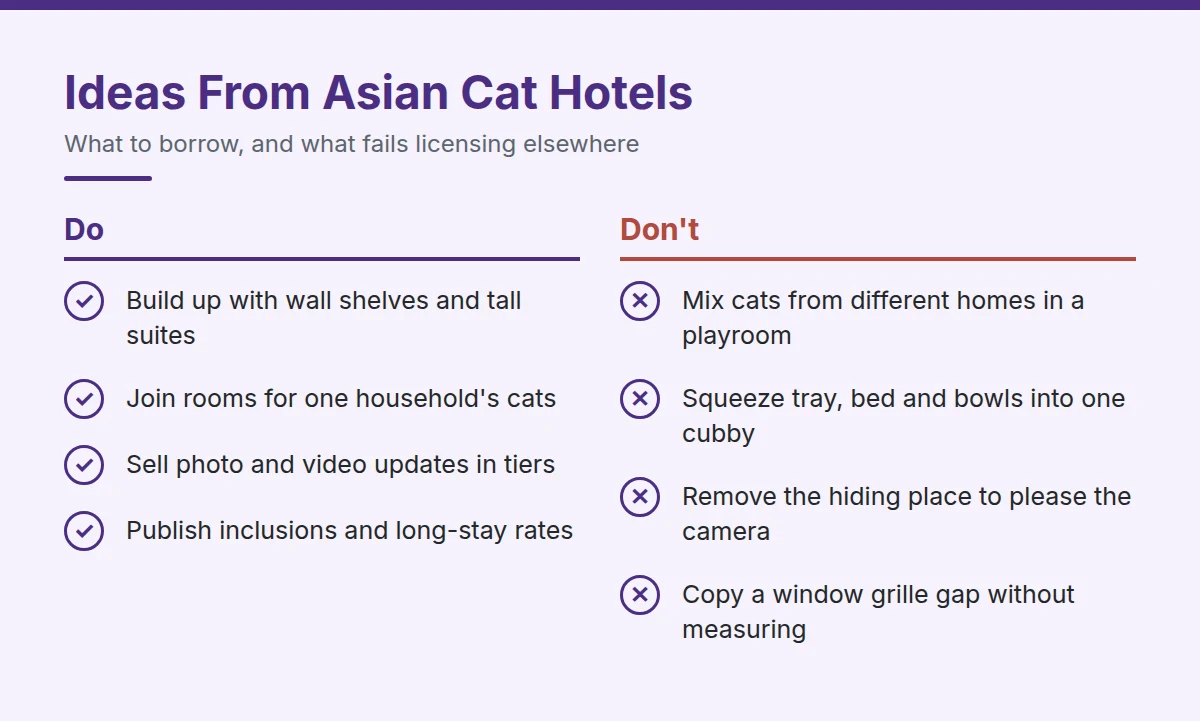
Two space ideas deserve copying outright. The first is the room that joins its neighbour: a cabin that can be connected to the next one for extra space, chambers with an interconnecting door, adjoining deluxe suites sold to multi-cat families. A run of single units becomes flexible capacity for a family of three, without a dedicated family suite that sits empty outside the holidays (joined rooms are for one household only). The second is space for cats that cannot use the height. One luxury hotel offers a special room for nursing or mobility-challenged cats. A tall suite is wasted on a cat that cannot climb, so keep low routes and ground-level beds for the cats described in our guide to boarding an overweight cat.
There is a limit, and it is the floor. England’s licensing guidance lets raised areas count toward the larger units its higher standard requires, so the principle is accepted there too, but every unit must still be at least 1.8 metres high, meet a minimum floor area, and leave 60 centimetres between the litter tray, the bed and the food. Small footprints also tempt an operator to fit more units into the same room, and more cats sharing one airspace is the problem covered in our guide to stocking density and disease risk.
Windows, Grilles and Sightlines
Singapore’s hotels sell the view. Rooms come with a window onto a garden, a corner suite looks over the street, and the top suites at one hotel add “cat solariums for sunbathing”. On an upper floor every one of those windows is also a fall risk, and that hotel installed “invisible” safety grilles with a 1.5-inch gap, the hotel version of the mesh that Singapore’s licensed cat owners are expected to fit at home.
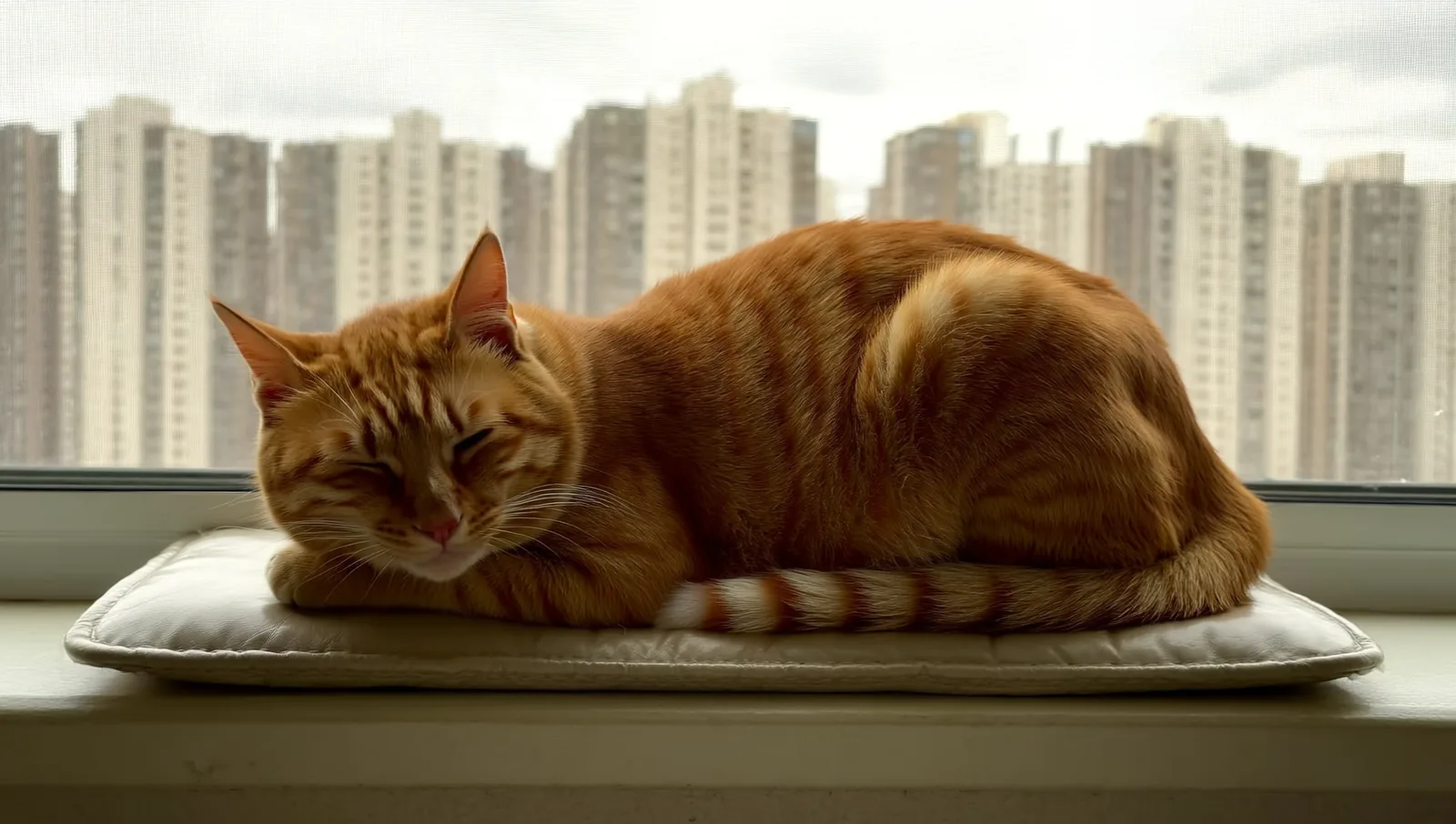
Borrow the window, and check the numbers before you copy the grille. A 1.5-inch gap is about 38 millimetres, half as wide again as the 25 millimetre maximum mesh opening England allows on cat runs. Our guide to entrapment and gap hazards explains why a gap that stops a fall can still catch a head or a leg.
Clear fronts cut both ways too. Glass lets an owner see the whole height of a suite on a tour or through a camera, and it wipes clean. But a view of another cat is a stressor, not enrichment. England requires solid, full-height barriers between adjoining units. In new builds they must be at least translucent, letting light through without letting neighbours see each other clearly, and opaque barriers are the higher standard. Facing units across a corridor narrower than 1.2 metres need barriers on their fronts, and every unit must include somewhere the cat can avoid seeing other cats and people. Clear to the corridor, frosted or solid between neighbours, and a hiding place inside: that combination keeps the showroom look without the staring contest.
Transparency Sold as a Service
Singapore’s hotels treat an owner’s peace of mind as a product with its own price list. Daily text updates are common. One hotel sells three photos or one video a day for an extra S$5; another gives owners round-the-clock camera access, one streams a live feed with audio at no charge, and some offer video calls or booked visiting hours. In Qatar the same habits show up at veterinary clinics that board: 24-hour video surveillance, a webcam, photos and video calls for long stays.
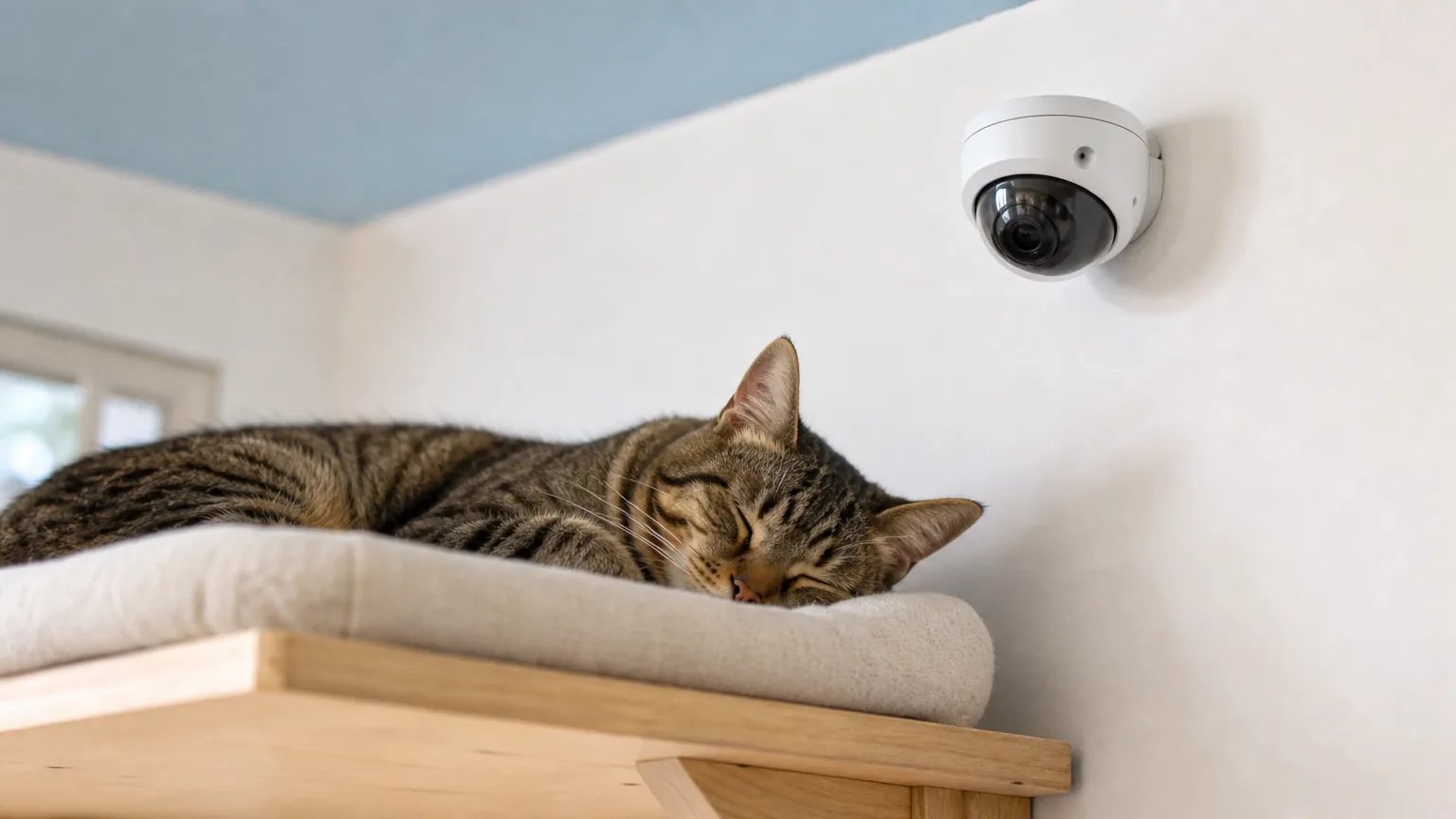
Borrow the tiers. A free daily message plus a paid photo or video package costs little to run and gives an anxious owner a reason to book you rather than the cattery that goes quiet for a fortnight. Then make the camera do real work. England’s higher standards accept a CCTV check as the out-of-hours look each cat must get, which turns a marketing feature into a welfare record.
One caution. A cat that spends the day in its bed makes a dull feed, and owners watching on a phone will ask to see more of it. Resist that. England’s rules say a cat must never be forced to interact with people and must have somewhere to get out of sight of other cats and people, and hiding is how a frightened cat copes. Point the camera at the room, and tell owners before the stay that a cat tucked out of sight is doing exactly what it should.
Clinical Backing as a Selling Point
Five of the twelve boarders in a Qatar roundup are veterinary clinics or hospitals, and the roundup says most facilities there ask for a veterinary check on arrival as well as current vaccinations. In Singapore, one hotel lists a vet, a nurse and a cat nutritionist on its team, and at least two say they designed their rooms around the AAFP and ISFM environmental needs guidelines. Most of the Qatar list take dogs as well, and the clearer descriptions stress that dogs and cats are housed apart, which should be non-negotiable anywhere.
Few catteries can afford a clinic on site. The transferable part is visible clinical judgement: a health check at arrival by someone trained to do it, a named vet partner, and a published design standard that owners can look up for themselves.
Coffee, Visits and the Front of House
The crossover with cafes runs both ways. One Singapore hotel invites owners to play with their cat over cake and coffee while it sniffs out the room it will sleep in, on the reasoning that having the owner nearby helps the cat settle. Another runs boarding, daycare and home visits as one business, so the same client can buy a sitter for a weekend and a suite for a fortnight. A front room that serves coffee, sells food and litter, and gives owners somewhere to sit at drop-off earns money from people who are already on the premises.
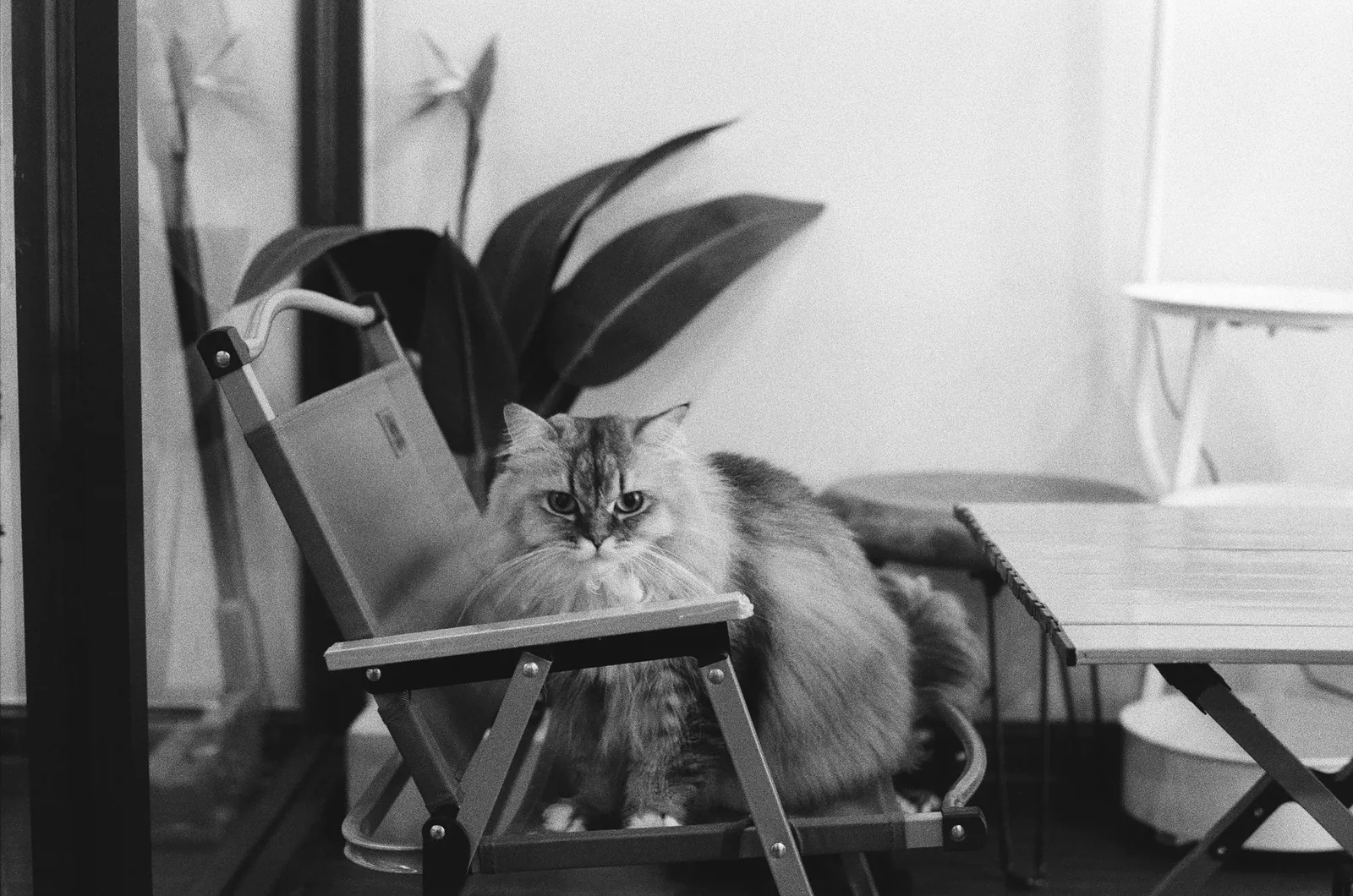
What should not cross over is the cat cafe itself. A room of resident cats on show to paying customers is a different business with its own welfare rules. Japan barred pet sellers and animal exhibitors from displaying dogs and cats after 8pm from 2012. Cat cafe operators objected, and in 2016 the environment ministry settled on a rule that lets adult cats stay on show until 10pm only if each is at least a year old, can move freely to a place to rest, and spends no more than 12 hours a day on display. Boarders should never share a lounge with resident cats or with each other. In England, a boarded cat may not leave its unit except in an emergency or for veterinary treatment, so even an owner’s play session belongs inside the suite.
Room Tiers and the Psychology of the Price List
Singapore’s price lists read like hotel rate cards, and they share a shape. The entry room is cheap and the first step up is small: one operator charged S$30 for its classic cabin and S$33 for its deluxe in 2023, and S$49 and S$53 by 2025. The top of the ladder is a showpiece for multi-cat families, a suite for three or four cats at two to four times the entry price, and some rates move with demand as a human hotel’s do. That operator’s premier suite now runs S$108 a night on Monday and Tuesday, S$118 midweek and S$128 from Friday to Sunday. Another hotel’s ladder runs S$98, S$128 and S$188 for a chamber, a corner suite and a mansion.
Behavioural research suggests why the shape works. In 1989 the consumer researcher Itamar Simonson described the “compromise effect”: when a choice gains a more extreme option, the option in the middle wins more buyers. A showpiece suite makes the deluxe room look moderate, and a deluxe room a few dollars above the classic makes the classic look like false economy. Use the shape honestly. Each step up should buy something a cat can use, such as more height, a window or a door to a sibling’s room, not just a grander name.
Two more pricing habits travel well. Inclusions are spelled out: one hotel makes no extra charge for special diets, another includes grooming and accepts the owner’s own food free, and a Qatar cat hotel quotes a nightly fee that covers food, litter, air-conditioning and cleaning. Long stays and peak dates are priced openly too. Qatar boarders list week-long and 30-day rates 10 to 20 percent below the standard night, and a holiday-season rate about 20 percent above it. Publish your rules, because an itemised quote is what our cat boarding cost guide tells owners to ask for.
What Does Not Travel
Some of what the roundups describe would fail a licence inspection elsewhere, and some would fail a cat anywhere.
Play between households. Singapore listings include a playground where sociable cats mix with other guests for S$15 a day, shared rooms where boarders have “other cat pals around to socialise with”, and a common playroom where cats mingle with their neighbours. England bans communal exercise areas outright and lets only cats from the same household share a unit. Mixing strangers spreads respiratory infection and stresses a species that copes by keeping its distance, so a cat that likes company should get it from its own housemates.
Everything in one cabinet. Compact cubbies that hold a perch, a litter tray and bowls within the cat’s reach are easy to clean and quick to fit out, and they are where the separation rule gets lost. The AAFP and ISFM guidelines treat separated key resources as a basic need, and England requires 60 centimetres between tray, bed and food. Measure before you buy the furniture.
Low cabins. A suite 0.6 metres high would fail England’s standard on height alone. Every cat unit there must be at least 1.8 metres high, and even a raised sleeping pod at least a metre. Harper’s Bazaar Singapore described “small pods” as a common sight in local cat boarding. A pod can be a sleeping box inside a licensable unit, but it cannot be the unit.
A secret address. One hotel keeps its location private for the cats’ safety and requires every guest to use its two-way transport. Whatever the motive, an owner who cannot visit cannot inspect, and a tour is the best check an owner has. Offer collection as a service, never as the only way in.
Luxury that is really handling. Daily face cleaning, ear cleaning and tooth brushing for every guest, or a buffet of premium foods for fussy eaters, sound generous. For a stressed cat in a strange room they mean extra handling and a sudden change of diet. England’s rules require new foods to be introduced gradually and say a cat must never be forced to interact with people, and the 2023 Singapore roundup itself told owners to send their cat’s usual food to avoid stomach upsets. Offer grooming as an option for cats used to it at home, and feed what the cat already eats.
Borrow the Habits, Not the Floor Plan
The ideas worth taking home are habits: build up when floor space is dear, make rooms that join for one family, write the climate and the updates into the price, publish your rules and your design standard, and make every step up the price list buy the cat something real. The things to leave behind are the shortcuts that small rooms and big promises invite: strangers sharing a playroom, everything in one cabinet, a camera that wins out over the hiding place. Before copying any layout, check it against your own licensing standard. In Singapore that means layout plans an inspector signs off; in England it means a page of minimum dimensions. And whatever the building looks like, ask owners to bring a blanket or toy from home, the one luxury that works in every market.
Further reading (sources)
- TheSmartLocal on eight Singapore cat hotels, their room tiers, prices and addresses
- SETHLUI.com with a Singapore pet hotel guide listing suite dimensions and day-of-week rates
- Harper’s Bazaar Singapore for the pods, villas, live feeds and temperature promises of the city’s cat hotels
- ILoveQatar.net on where Qatar’s pet boarders house cats and what they charge
- Animal and Veterinary Service sets out what Singapore requires before a pet boarding licence is granted
- National Parks Board on the end of the cat licensing transition and the mesh or grille condition
- Meteorological Service Singapore describes the island’s year-round temperature and humidity
- Defra sets England’s cat boarding rules on unit size, barriers, temperature and shared units
- Japan’s Ministry of the Environment on the 2016 rule on how late and how long adult cats may be displayed (in Japanese)
- Central Environment Council with the briefing paper on cat cafes’ objection to the 8pm display ban (in Japanese)
- Ellis and colleagues for the AAFP and ISFM feline environmental needs guidelines
- Itamar Simonson on the attraction and compromise effects in consumer choice