Buying an Existing Cattery: Valuation, Lending, Licence Transfer, and What the Seller Is Not Telling You
Published on September 23, 2026
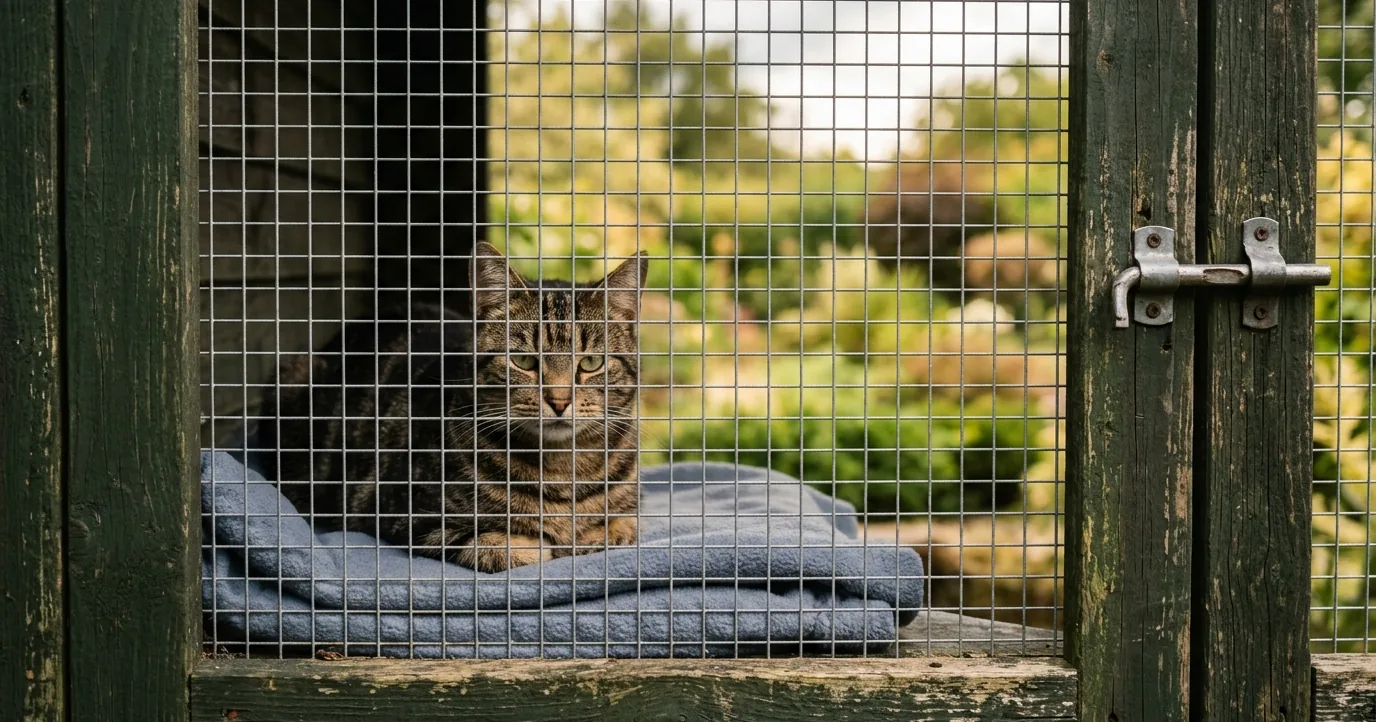
In August 2025 a regional paper in the north of Scotland rounded up five pet boarding businesses on the market at the same time, strung out between Aberdeenshire and the Highlands. One was a cattery near Inverness whose owners were ready to retire after 22 years. Another came with bookings already secured into the following year. This month a building society refined its mixed-use mortgage to court people buying, expanding or refinancing kennels and catteries. If you want to run a cattery, buying one that already trades looks like the shortcut: units built, customers on the books, a licence on the office wall.
Sometimes it is. But one purchase buys three quite different things: a house, a set of buildings worth almost nothing to anyone who does not board cats, and a trading history that is partly the seller’s personal relationships. The seller has every reason to blur them together. This guide separates them, covering how the price should be built, why ordinary mortgage underwriting stumbles, what happens to the licence and its star rating, how to read the accounts, and the physical surprises a standard survey tends to miss. If you are still weighing this against building your own, the founder’s playbook covers that route.
What You Are Actually Buying
Start by splitting the asking price in your head, because the market will split it for you later.
The house is the easy part. It can be compared with other houses nearby, and in many rural sales it accounts for much of the price. The units are the awkward part. A cat unit is a sleeping area, a mesh exercise run, solid sneeze barriers and a heater, built to a licensing standard for a single purpose. Nobody else wants it. If the business stops, the block adds little to what the property would fetch, and a buyer who does not board cats may see only the cost of taking it down.
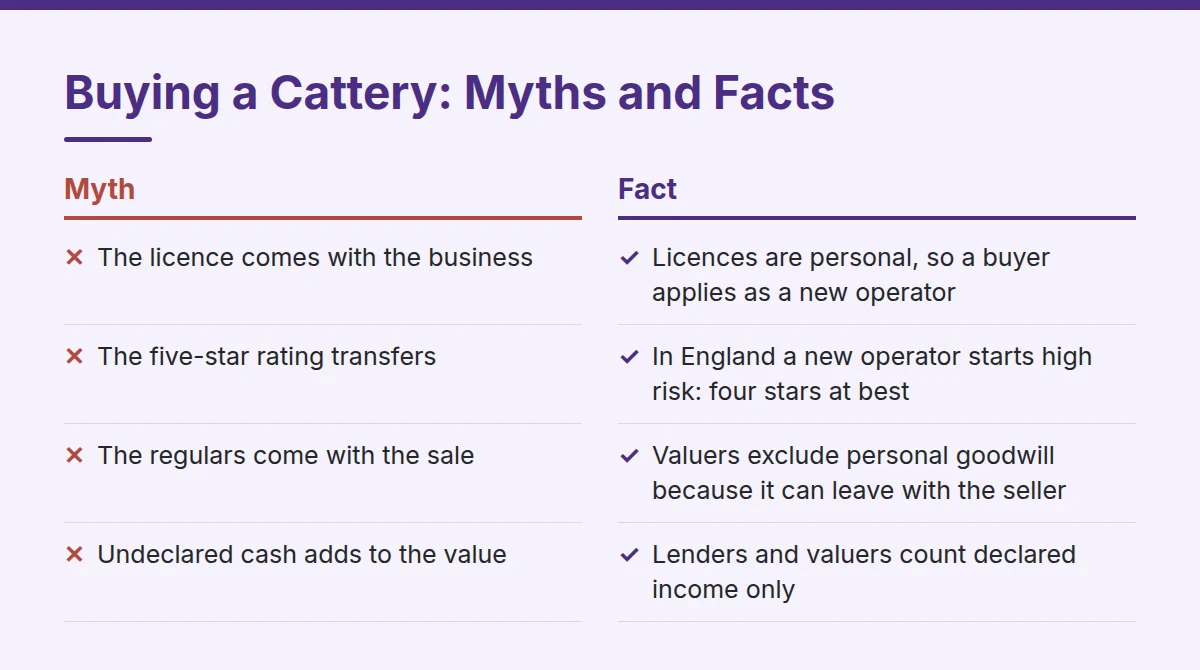
The trade is the slippery part: the client list, the reviews, the phone number, the booking diary, and above all the regulars who book because they know the owner. And one thing you are not buying at all, whatever the particulars say, is the licence. More on that below.
How a Cattery Should Be Valued
Surveyors have a name for this kind of asset. The Royal Institution of Chartered Surveyors defines a trade related property as “any type of real property, designed or adapted for a specific type of business, where the property value reflects the trading potential for that business”, and contrasts it with generic property that almost any business could occupy. A purpose-built cattery fits that description closely.
Two parts of the RICS approach matter to a buyer. First, the valuer estimates the trading potential a reasonably efficient operator could achieve, which “could be above or below the recent trading history of the property”. Second, that estimate excludes personal goodwill, which RICS describes as profit above market expectations that “would be extinguished upon sale”. In plain terms, the regulars who come back because they trust the seller are not part of what a lender’s valuer will count. If the asking price only makes sense with them included, the difference is money you are paying for something that may leave with the seller.
So build your own number in three layers:
- The house and land without the business. What would they fetch as a home with outbuildings? That is your floor.
- The units, valued on their remaining life. Never at what it would cost to build them new. A tired block with a few years left is a bill you will be paying soon.
- The trade that survives a handover. Price it off profit after paying a market wage for every hour the seller and their family currently work for nothing.
That last adjustment is where most small cattery valuations fall apart. A couple working seven days a week without drawing a wage can show a healthy profit that is, in reality, their salary. Once you pay yourself or a manager for the same hours, the surplus is often small. Industry rules of thumb for goodwill multiples vary widely, and any multiple applied to an unadjusted profit figure is meaningless.
A useful cross-check: add the value of the house on its own to the cost of building and licensing the same number of new units. If the asking price sits well above that total, ask what exactly the premium is buying.
Lending: Why a House With a Business Confuses Underwriters
Ordinary mortgage underwriting is built around a house, a salary and comparable sales down the road. A cattery breaks all three: the income comes from the business, the valuer struggles to find comparables, and a large part of the plot is in commercial use.
In the UK there is also a hard legal line. A loan is a regulated mortgage only if at least 40% of the land is used as, or in connection with, a dwelling. Below that, it is commercial lending on commercial terms. The Financial Conduct Authority’s guidance gives an example that maps neatly onto rural boarding: a loan on a farmhouse with farmland, where the house and garden make up less than 40% of the land, is not a regulated mortgage, because the farmland is not really used in connection with the house. A cottage with a cattery block, a paddock and a car park can land on either side of that line depending on the plot.

Specialist mixed-use lenders exist for exactly this. The building society mentioned above lends up to 75% of the value on a repayment basis and 65% on interest only, up to £750,000, provided at least 40% of the property remains the borrower’s main residence. Read those numbers as a planning guide: expect to put down a quarter of the price or more, and keep separate cash for working capital through the first winter. Remember too that lenders advance money against the valuation, not the asking price, so any premium for personal goodwill comes out of your own pocket.
In the US, the Small Business Administration’s 7(a) programme lists changes of ownership among its eligible uses, with loans of up to $5 million that can combine the business and its buildings in one facility. Whatever the country, expect a lender to weight filed tax returns and accounts far above the seller’s own summary.
The Licence Does Not Come With the Keys
This is the part sellers skip most often, usually because they have never had to think about it.
In England, the Animal Welfare (Licensing of Activities Involving Animals) (England) Regulations 2018 have councils grant a licence to an operator after an inspection, taking into account whether the applicant is a fit and proper person to run the activity. Nothing in the regulations transfers a licence to a buyer. The only automatic hand-on is to a dead licence holder’s personal representatives, and even that lasts three months. So expect to apply as a new operator, with the council inspecting before it grants.
The star rating is where it stings. Defra’s statutory guidance tells councils that a new applicant without at least a year of compliance history must automatically be rated high risk. On the scoring table, a high-risk business that meets the optional higher standards gets four stars and a two-year licence; one meeting only the minimum standards gets two stars and a one-year licence. Five stars requires a low-risk rating, and that needs a track record you do not have yet. So a five-star cattery bought this year will, at best, be a four-star cattery under you, and any marketing built on the seller’s fifth star needs changing on completion day.
Scotland and Wales still license boarding under the Animal Boarding Establishments Act 1963. There, too, a licence is granted to a person for particular premises, runs to the end of the year it relates to, and passes on only to personal representatives after a death. The Scottish Government consulted in 2023 on replacing the Act with the framework it already uses for other animal businesses, but at the time of writing boarding has not moved across, so each council still sets its own conditions. Read yours before you offer, not after.
In the US, licensing is mostly a state matter, and the pattern is similar. Iowa’s agriculture department puts it bluntly: licenses are non-transferable, any change of ownership needs a new application and fee, and a compliant inspection must be completed before the new owner can start operating.
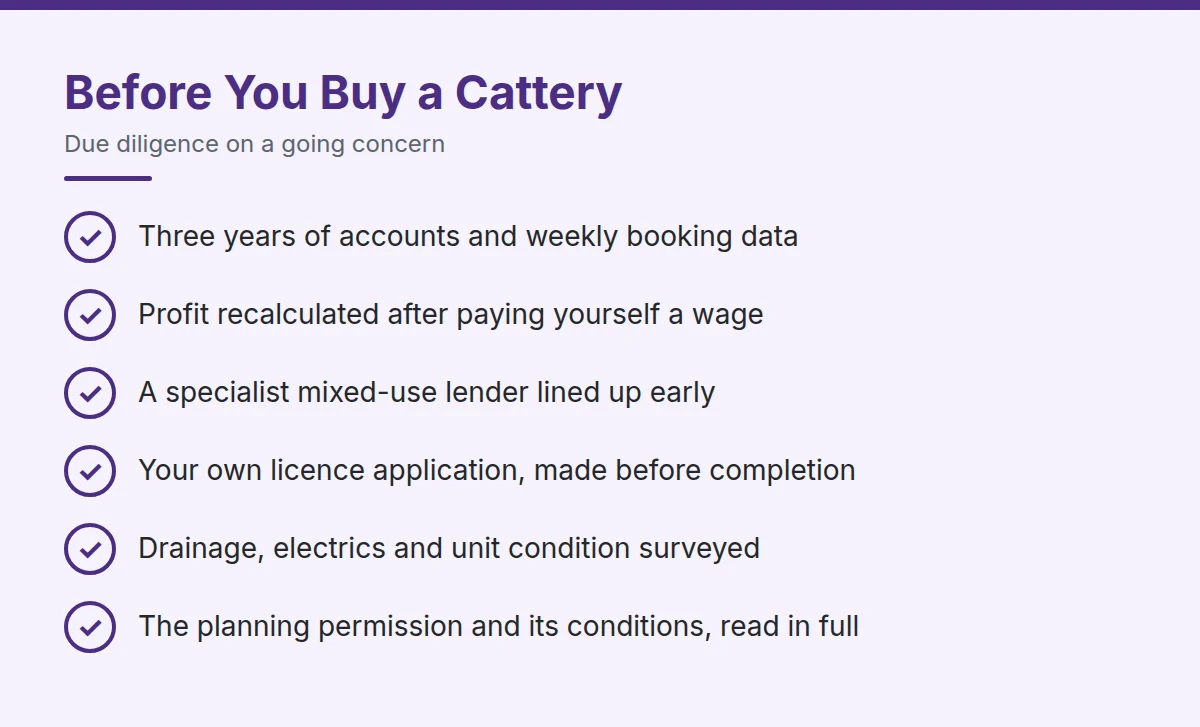
Three practical steps follow. Make the purchase conditional on your licence being granted. Ask the council early how long a new application takes, and time completion around the answer. And ask the seller for the last two inspection reports. In England the inspector’s report must cover the operator, the premises, the records and the condition of the animals, which makes it the nearest thing you will get to an independent survey of the business. A seller who will not share them has answered a different question. Ask as well whether any complaint to the council has been upheld in the last three years; the council weighs exactly that when it scores a business’s risk, and so should you. Our guide to how owners escalate a complaint about a cattery shows what that process looks like from the other side.
Reading the Accounts: Occupancy Padding and Holiday-Week Concentration
“We are always full” is a sentence without a denominator. Ask for the booking system’s own export: units sold per night, week by week, for three years, alongside the number of units open each week. The honest measure is unit-nights sold divided by unit-nights available across the whole year, including any weeks the cattery closed.
Common ways the figure gets flattered:
- counting two cats sharing a family unit as two units sold
- including the owners’ own cats, or friends boarded free
- booking next year’s deposits as this year’s revenue
- quoting August or December as if it were a typical month
Then look at the shape of the year. Boarding demand clusters around school holidays and Christmas, as our guide to peak-season booking describes from the owner’s side. Work out what share of annual revenue the busiest ten weeks produce, and who books them. Peak weeks tend to go to repeat clients who book a year ahead, and repeat clients are loyal to the person who handles their cat. That is the personal goodwill a valuer strips out, and it is the revenue most at risk in your first year.
“Bookings already secured” deserves the same scrutiny. Forward bookings are only worth something if those clients stay with you. And deposits already paid for stays after completion are money for a service you will deliver, so they should be credited to you in the completion accounts rather than kept by the seller.
Two more things rarely appear in the particulars. If a seller hints that the business “does more than the books show”, treat it as a warning rather than a bonus: undeclared income is not evidence, no lender will count it, and it tells you how the seller treats paperwork. And check turnover against the £90,000 VAT registration threshold. Plenty of small catteries sit just under it, a growth plan that tips you over it changes your margins, and a transfer of a going concern can alter the VAT position on the day you complete, so take accounting advice before you do.
Costs deserve the same suspicion as income. In England, Defra’s guidance requires part of every cat’s sleeping area to stay between 15°C and 26°C and never drop below 10°C, so the heating runs whether the block is full or empty. The Isle of Wight shows where that can lead: a couple who took over a licensed kennel and cattery there in January 2025 announced that October that it would close, saying high and rising fixed costs had made the established operating model unviable, alongside personal reasons. Ask for three years of energy bills, and get your own insurance quote rather than relying on the seller’s long-standing premium. If there are staff, TUPE rules move their contracts to you on the same terms, with their holiday entitlement, continuity of service and any claims against the previous employer, so read the employee information the seller must provide at least four weeks before the transfer.
Drainage, Planning and Building Surprises
Plenty of rural catteries are not on a mains sewer, and drainage is where a cheap purchase becomes an expensive one.
In England, the Environment Agency’s general binding rules for septic tanks and small treatment plants apply only to domestic sewage. Where a significant share of what a commercial premises sends down the drain differs from a normal home’s, the regulator treats it as trade effluent, which needs a permit. Pen wash-down water, dosed with disinfectant, is exactly the thing to ask about. If the property has a septic tank discharging straight into a watercourse, the regulator expects buyer and seller to agree, as a condition of sale, who will replace or upgrade it, and the seller must tell you in writing what system is installed, where it discharges and how it has been maintained. In Scotland, a property that cannot connect to the public sewer needs authorisation from SEPA to discharge, and SEPA runs a registration check you can use before you offer.
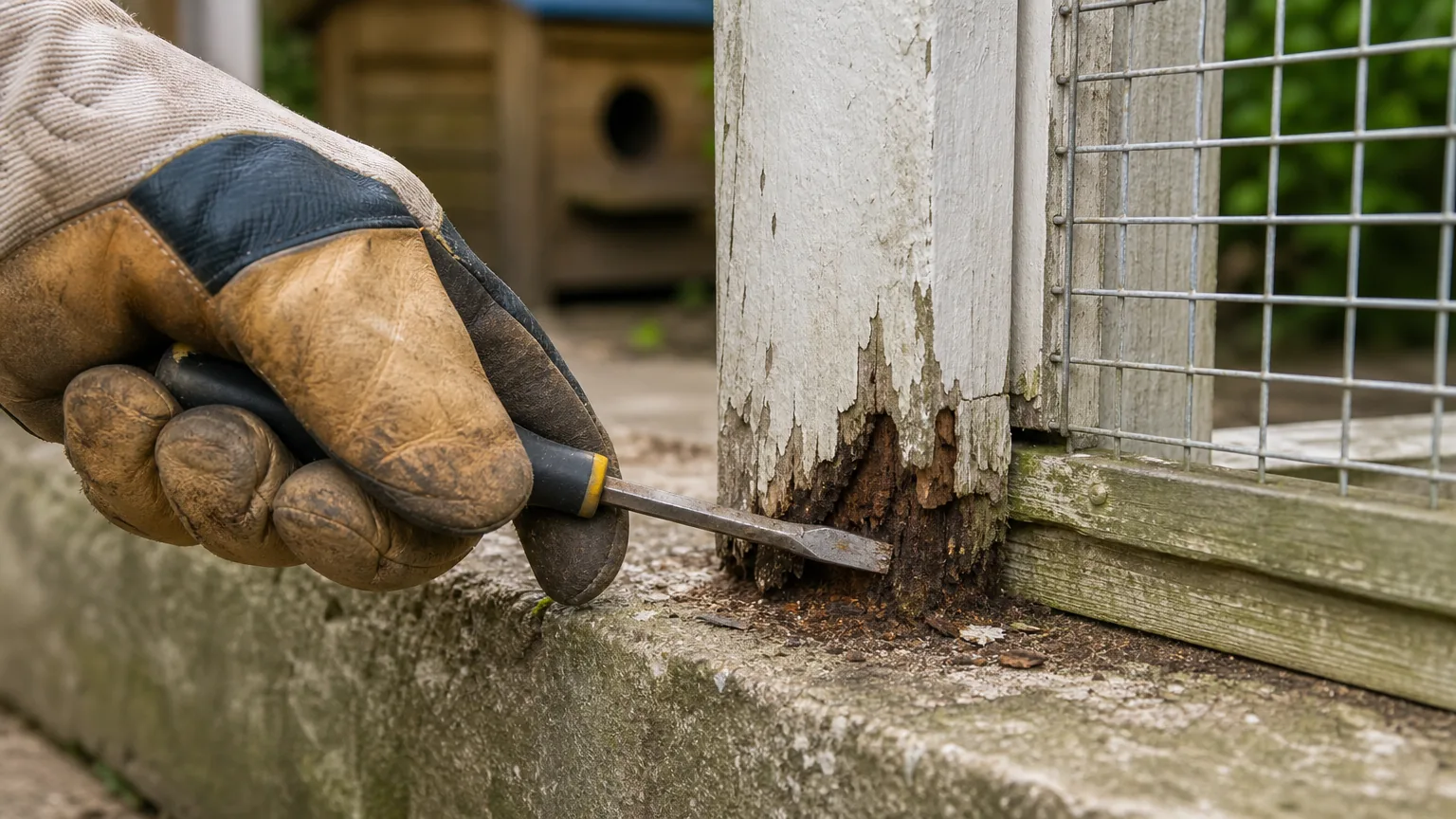
Next, the units. Defra’s cat boarding guidance accepts that older catteries have one-cat units and shorter runs, but new builds must use the larger dimensions and drop the one-cat option altogether. So when a tired block is replaced, the same footprint may hold fewer units than the seller’s capacity figure suggests. Check the condition of timber, roofs, mesh and heaters. The same guidance requires electrical installations to be fitted by a qualified person and kept safe, so commission your own electrical inspection rather than relying on the seller’s word. Heaters and wet cleaning in a timber building are also a fire question, and our cat hotel fire safety guide lists what a well-run site should have.
Finally, read the planning permission itself, not the agent’s summary of it. Conditions can cap the number of cats, restrict hours or tie the business to occupation of the house, and a block added later without consent becomes your problem on completion.
The Honest Reasons Small Catteries Sell
Most catteries sell for ordinary reasons, and the ordinary reasons are usually told honestly. Retirement after decades in the job is a common one, and often the best. Burnout is another: the cats need care every day of the year, and the busiest weeks are everyone else’s holidays. Health, divorce and relocation account for plenty more. Rising costs, as on the Isle of Wight, can push a business over the edge even when the owners have done nothing wrong.
The useful test is not the reason but whether the figures agree with it. A retiring owner with a flat or rising three-year trend is selling a business. An owner “looking for a new challenge” whose bookings have fallen for two years may be selling a problem. The reasons that are rarely volunteered are worth checking independently:
- a new cattery with planning permission a few miles away
- a star rating that fell at the last inspection, or an upheld complaint
- a neighbour dispute over noise or smells
- a drainage upgrade or unit rebuild the council has asked for
Search the local planning register for new boarding applications nearby, and read the reviews in date order, looking for the point where the tone changed.
Negotiate the Handover, Not Just the Price
Personal goodwill does not have to walk out entirely. Negotiate a handover period in which the seller works alongside you and introduces you to the regulars, ideally spanning one busy holiday so clients see a familiar face during the change. Ask for a restrictive covenant that stops the seller opening a competing cattery nearby for a reasonable period. And plan your first year’s marketing on the assumption that some regulars will drift away regardless; our occupancy and marketing guide covers how a cattery rebuilds its client base.
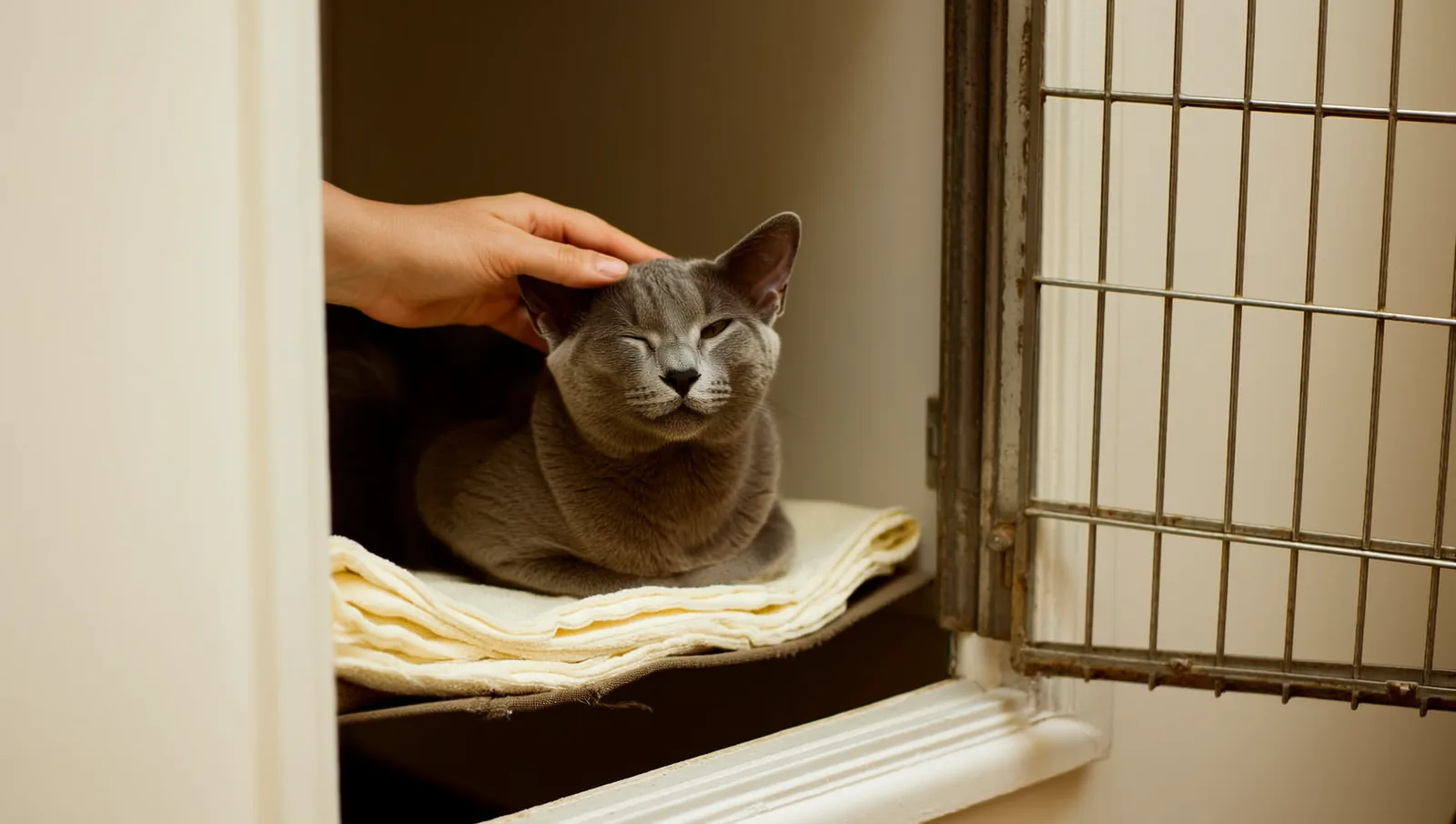
Bought carefully, a trading cattery can be the quickest honest route into the business. The price should cover what survives the change of hands: the house, the useful life left in the units, and the trade a competent stranger could hold on to. Everything else leaves with the seller.
Further reading (sources)
- The Press and Journal on five pet hotels on the market between Aberdeenshire and the Highlands
- Isle of Wight County Press reported a kennel and cattery closing months after a change of owners
- IFA Magazine with a building society’s mixed-use lending criteria for kennels and catteries
- Financial Conduct Authority on the 40% dwelling test and why farmland with a farmhouse falls outside it
- RICS Valuation, Global Standards for how valuers treat trade related property and personal goodwill
- Animal Welfare (Licensing of Activities Involving Animals) (England) Regulations 2018 for how a licence is granted to an operator and what happens on a holder’s death
- Defra on why new applicants are rated high risk and how star ratings are scored
- Defra cat boarding guidance with unit sizes for older catteries and new builds, heating and electrics
- Animal Boarding Establishments Act 1963 on the licence term and personal nature of boarding licences in Scotland and Wales
- Scottish Government on its proposal to replace the 1963 Act for animal boarding
- SEPA explains when a private sewage system needs authorisation and how to check a registration
- Iowa Department of Agriculture and Land Stewardship sets out why a change of ownership needs a new license and inspection
- US Small Business Administration lists changes of ownership among eligible 7(a) loan uses