What Feline Veterinary Guidelines Mean for Cat Boarding: A Cattery Operator's Roundup of the FelineVMA and ISFM Standards
Published on November 3, 2026
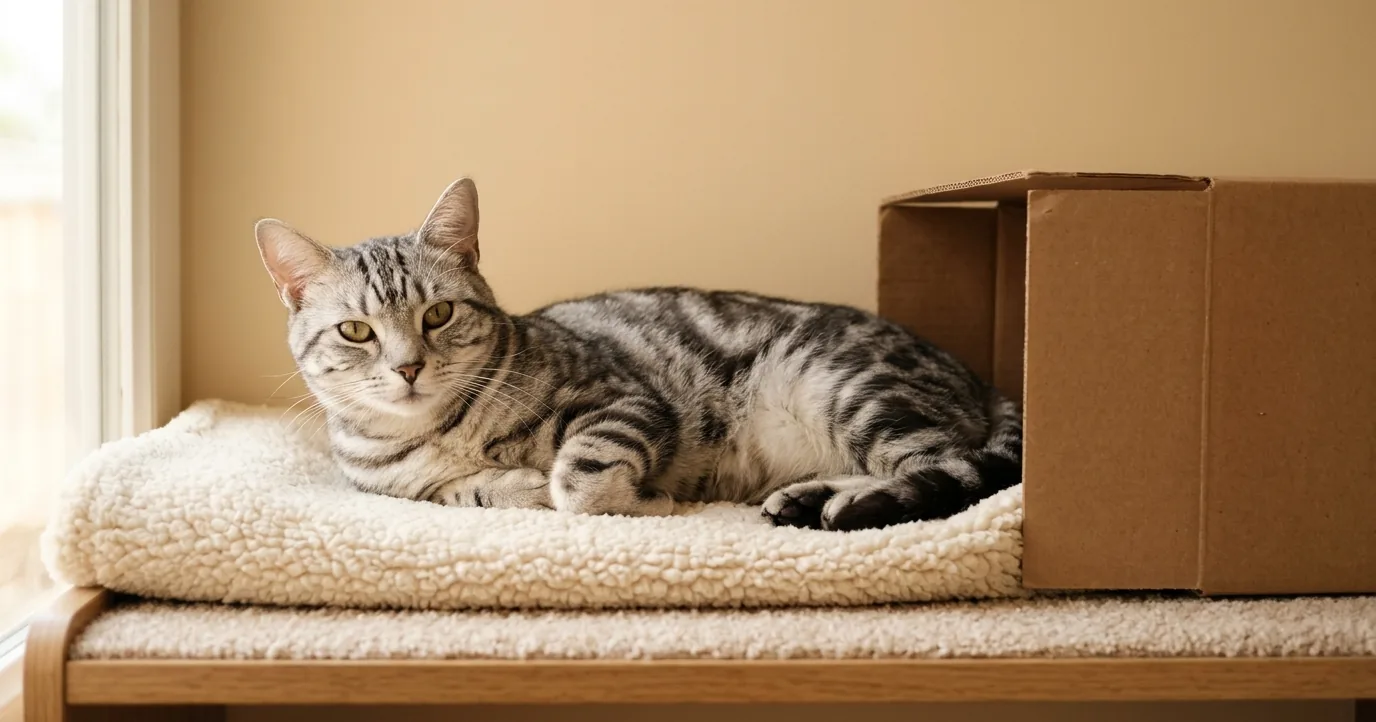
The vets who treat your boarders work from a shelf of feline consensus guidelines. They sit behind the vaccination record an owner hands over at drop-off, the medication plan that arrives with an older cat, and the questions a vet asks when a cat comes home from a stay off its food. Hardly any of those documents mention boarding, and none was written for a cattery. Even so, they are where feline medicine sets down what good care looks like, and a cattery that knows them can write house rules a vet will recognize.
This roundup is for operators. It takes the guidelines from the Feline Veterinary Medical Association (FelineVMA) and the International Society of Feline Medicine (ISFM) that bear on boarding, sums up in a few lines what each one actually says, and maps it to the policy it should shape: the intake form, the suite, handling and cleaning, isolation, and the moment staff pick up the phone to a vet. Where this site already has a full guide to a topic, the roundup points to it instead of repeating it.
Who Writes Feline Guidelines, and How Much Weight They Carry
Two bodies produce most of them. The FelineVMA is the American Association of Feline Practitioners (AAFP) under a new name. The ISFM was the veterinary membership division of the charity International Cat Care until January 2025, when the charity renamed it the iCatCare Veterinary Society. The guidelines keep their original AAFP and ISFM titles, and that is how your vet will refer to them. Several are joint efforts with other groups: the American Animal Hospital Association (AAHA) on vaccination, pain and life stages, and the EveryCat Health Foundation on FIP.
Each is written by a panel of specialists, and most appear in the Journal of Feline Medicine and Surgery, which International Cat Care publishes jointly with the FelineVMA. The charity describes the journal as open access, free for anyone to read, and the FelineVMA keeps the current list of guidelines on its practice guidelines page.
They are recommendations, not law. The FelineVMA says so itself: its guidelines should be used as recommendations, and each practitioner decides on treatment by professional judgment, case by case. The legal floor for a cattery comes from licensing. In England that is Defra’s statutory guidance on cat boarding, and in the US it is whatever your state requires. The two often point the same way. England requires a hiding place for every cat and bars cats from different households from sharing a unit, while the guidelines ask clinics for a hiding place in every cage and no direct contact between hospitalized cats.
They are written for clinics. The nearest any of them comes to a cattery is a line in the 2022 Cat Friendly Veterinary Environment Guidelines noting that a clinic’s cat ward may also be used for boarding in some circumstances. Translating the rest is the operator’s job, and one line holds throughout: the guidelines tell you what to provide and what to watch for, while diagnosis and treatment stay with the vet.
Intake: What the Booking Form Should Ask
Most of what the guidelines say about boarding lands on the intake form, because that is where a cattery learns what the cat’s own vet already knows.
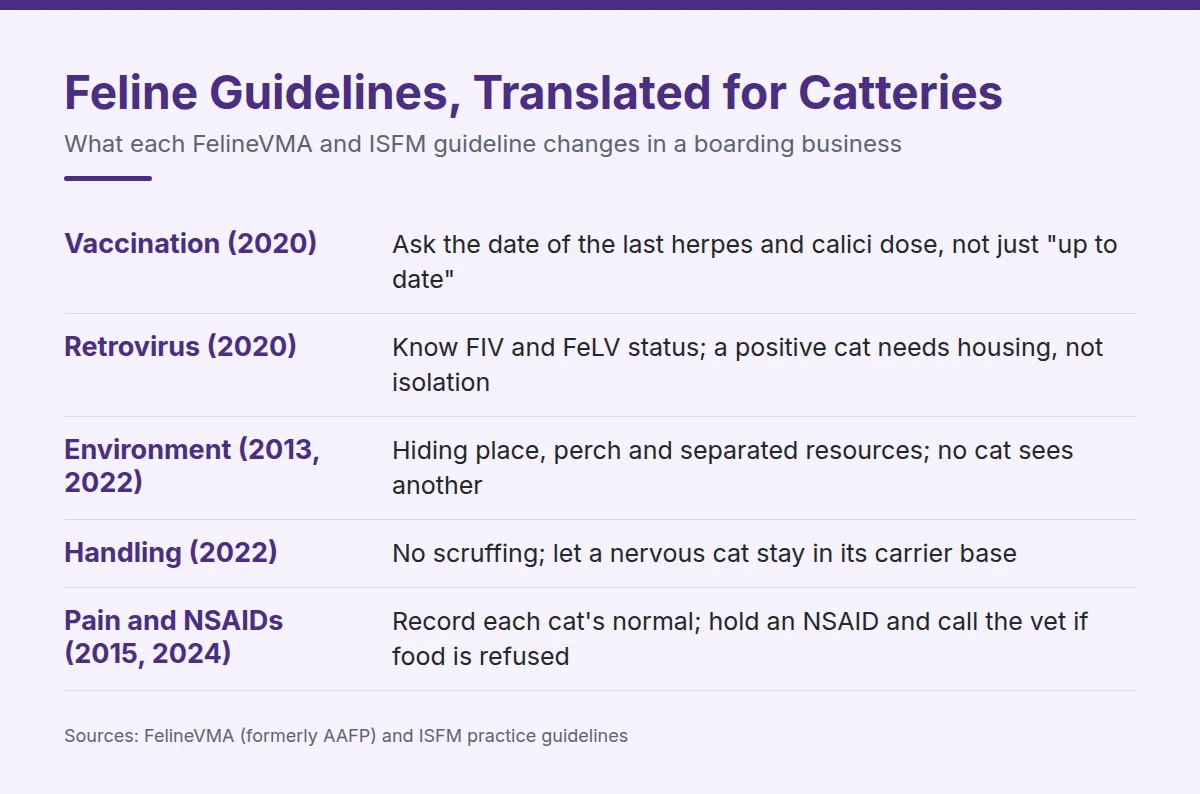
Vaccination (2020 AAHA/AAFP). The guidelines class vaccines against panleukopenia, feline herpesvirus (FHV-1), feline calicivirus (FCV) and rabies as core for every cat, plus feline leukemia virus (FeLV) for cats under a year old. FeLV for older cats, Chlamydia felis and Bordetella are non-core, given according to each cat’s risk. Boarding counts as a risk. The guidelines say cats entering boarding, breeding, foster or shelter settings face more disease exposure as well as systemic stress, and they list cats kept in commercial breeding or boarding facilities among their higher-risk groups. For the combined panleukopenia, herpesvirus and calicivirus vaccines, they add that revaccination 7 to 10 days before boarding may be warranted, particularly if the cat has not been vaccinated in the preceding year.
Policy: ask for the date of the last herpesvirus and calicivirus dose, not just a tick box for “up to date”, and remind owners about a month before the stay if that date is more than a year old, so their vet has time to decide on a booster. England’s rules already require a vaccination record covering panleukopenia and both respiratory viruses, and a vet’s certificate of a recent protective titer test may be accepted instead of a booster. Our boarding vaccination guide covers timing and proof in detail.
Retrovirus status (2020 AAFP). “The retrovirus status of every cat at risk of infection should be known,” the guidelines say. They are just as clear that a positive result is no reason for quarantine. Hospitalized cats with FeLV or FIV need no infectious disease ward and can stay on the general ward, though, like every hospitalized cat, without direct contact with other cats. Because their immune systems may be weakened, they should never go into isolation beside cats with respiratory infections or panleukopenia. Disinfectants inactivate both viruses quickly.
Policy: ask whether the cat has been tested, when, and with what result, and treat a positive answer as housing information rather than an automatic refusal. Our guide to boarding FIV and FeLV positive cats sets out a fair acceptance policy.
Life stage and senior care (2021). The life stage guidelines divide a cat’s life into kitten (birth to 1 year), young adult (1 to 6 years), mature adult (7 to 10) and senior (over 10), with an end-of-life stage that can come at any age. They recommend a vet examination at least once a year, and at least every six months for seniors. The senior care guidelines go further: examinations twice a year from 10 to 15, and every four months for healthy cats over 15. They also ask vets to consider pain in every senior cat.
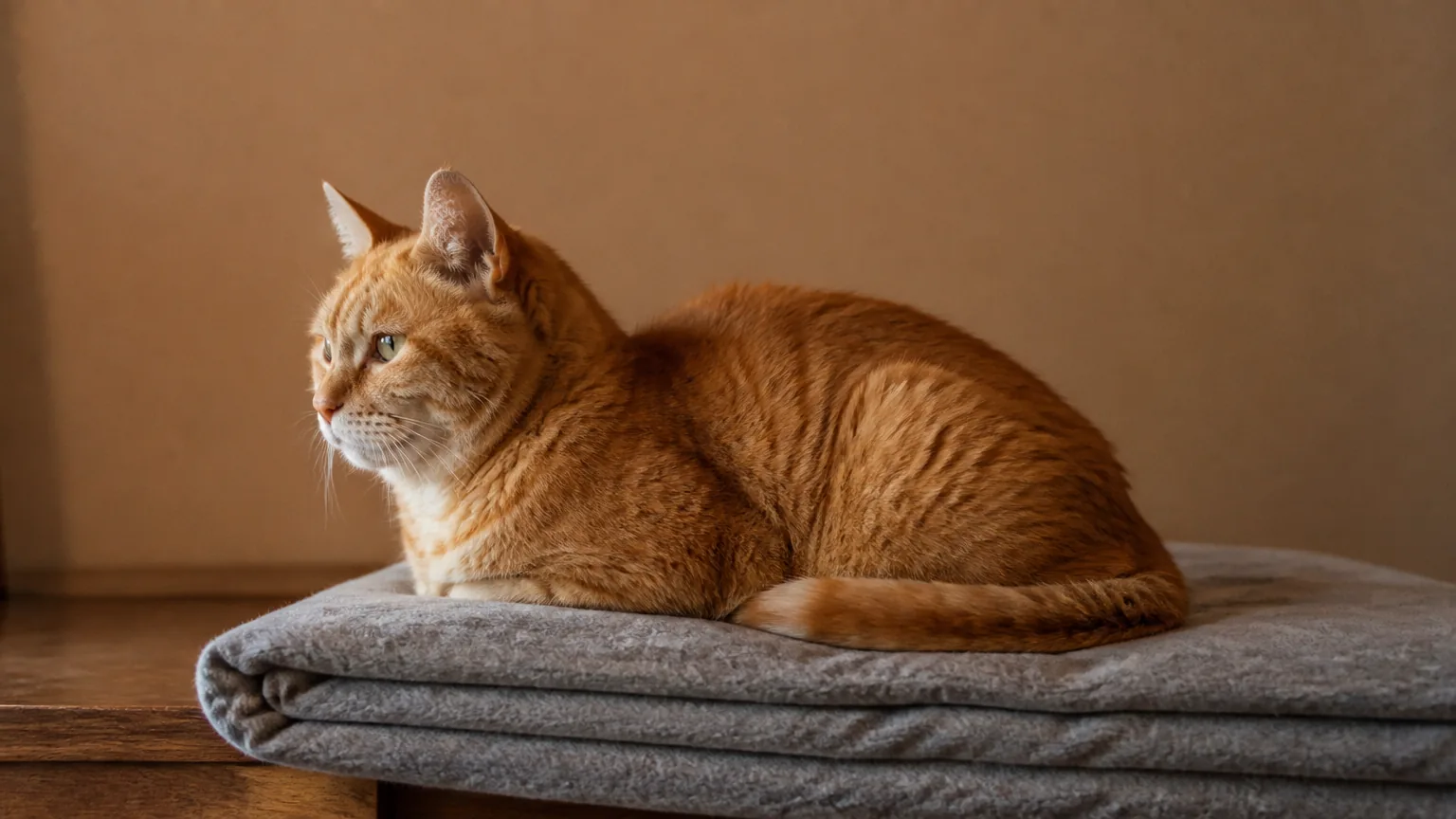
Policy: borrow those intervals as an intake rule. For a cat over 10, ask for a checkup within the last six months, and for a cat over 15, within the last four, along with a full medication list. Our guide to boarding a senior cat covers the rest of the stay.
Long-term medication (2024 ISFM/AAFP). Some older boarders arrive on a daily non-steroidal anti-inflammatory drug (NSAID), such as meloxicam, for arthritis. The 2024 NSAID guidelines name gut upsets, including loss of appetite, as the most common side effect, and their instruction is direct: if the cat refuses food, withhold the NSAID and seek veterinary advice. They suggest offering a little food first to check the appetite is normal, and they note that dehydration raises the risk of side effects.
Policy: every medication sheet needs a line on what to do if the cat will not eat. For a cat on an NSAID, staff should offer a small amount of food before each dose and log its water intake.
The Suite: Five Pillars and a Ward Checklist
The 2013 AAFP and ISFM Feline Environmental Needs Guidelines call meeting a cat’s environmental needs “essential (not optional)” and organize them into five pillars:
- Provide a safe place.
- Provide multiple and separated key resources: feeding, drinking, toileting, scratching, play and resting areas.
- Provide opportunity for play and predatory behavior.
- Provide positive, consistent and predictable human-cat social interaction.
- Provide an environment that respects the importance of the cat’s sense of smell.
The 2022 Cat Friendly Veterinary Environment Guidelines turn those pillars into ward design, and most of their cage rules transfer directly to a boarding suite:
- No cat sees another. Cages should face in one direction, never toward each other or at an angle that allows visual contact.
- Core resources in every unit. Bedding, a hiding place, food, water and a litter tray, set as far apart as the space allows, with double-compartment housing as the ideal. A perch is desirable, particularly for cats hospitalized or boarding for longer than 24 hours. Hiding, in the guidelines’ words, is “critical to the cat’s coping ability to reduce distress”.
- Real bedding. Cages without blankets, or lined only with paper, “are not considered cat friendly”.
- Away from dogs. Ideally cats have a ward of their own.
- Warmth. The guidelines put a cat’s thermoneutral zone at 30 to 38°C (86 to 100°F) and want cat wards kept warmer than the rest of the hospital.
- Trays and bowls. Trays 1.5 times the cat’s length from nose to base of tail where space allows, low-sided or with a low entry, with unscented clumping litter. Bowls flat and low-sided.
The 2014 AAFP and ISFM house-soiling guidelines fill in the tray: fine, unscented clumping litter at least 3 cm (1.25 inches) deep, no liners or deodorizing powders, open trays rather than covered ones where possible, and scooping every day. Feeding follows the same logic. The AAFP’s 2018 consensus statement on feeding describes cats as solitary hunters that “prefer to eat often and alone”, warns that competition for food can cause conflict, and recommends frequent small meals, puzzle feeders and foraging.
Policy: write the suite standard down as a checklist built from these lines and audit every unit against it. Shared suites need a full set of resources for each cat, which England’s rules also require, with feeding stations out of each other’s sight. Our article on how cats sleep at a cat hotel shows how boarders actually use a hiding place and a perch through the day and night.
Handling, Cleaning and Shared Suites
Handling (2022 AAFP/ISFM Cat Friendly Veterinary Interaction Guidelines). These guidelines dropped the old phrase “minimal restraint”, reasoning that restraint implies the cat has no control or consent, and they cite evidence that interacting without restraint is more efficient and effective. Heavy restraint and scruffing, they say, are still common in practice, but cats show fear and anxiety during them, and they should be avoided. In one study they cite, every restraint method tested, scruffing included, increased objective signs of fear compared with minimal handling. At the clinic, a cat’s preferred place is often the bottom half of its own carrier.
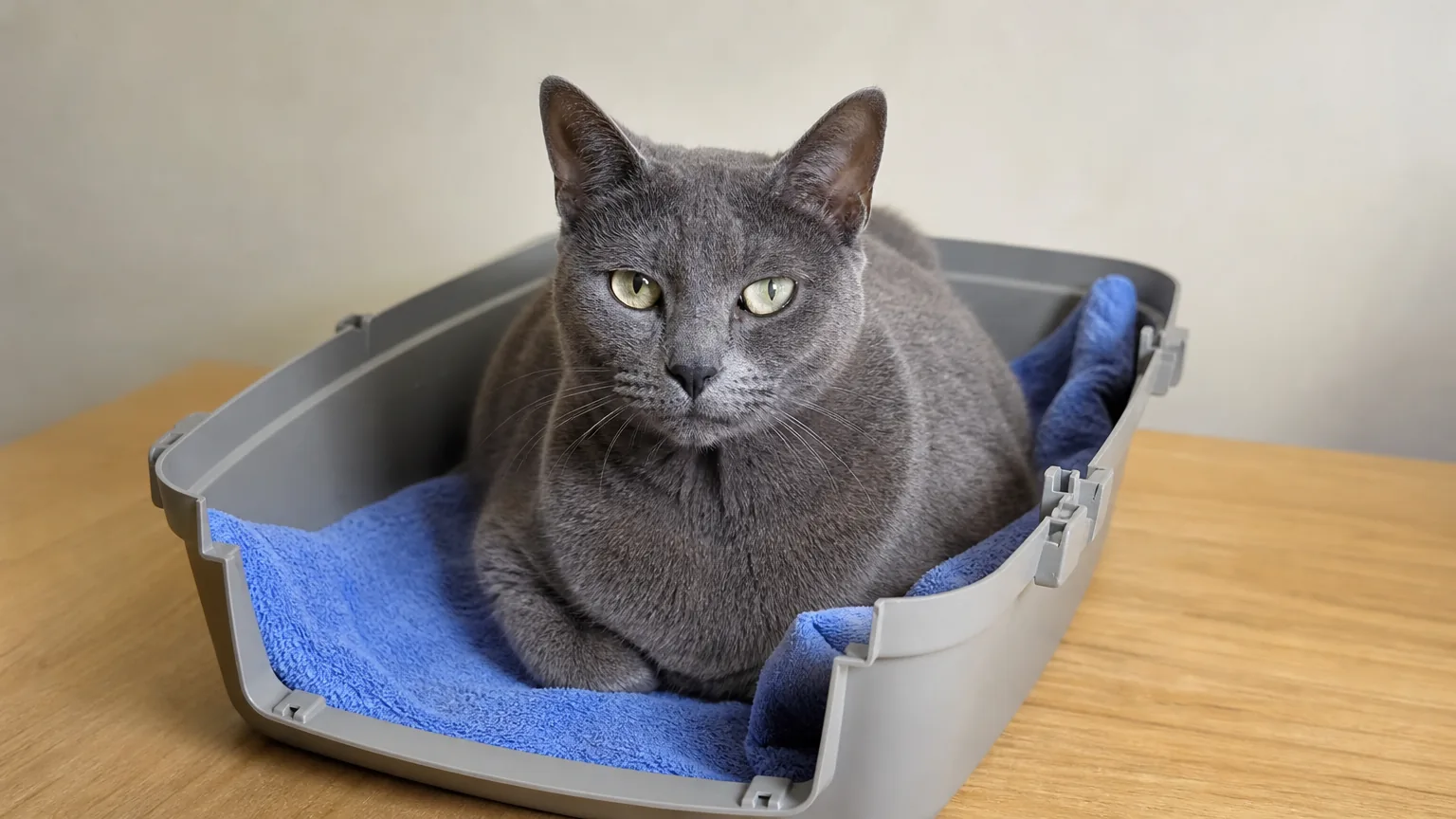
Policy: a written handling standard with no scruffing, the cat allowed to stay in its carrier base after arrival until it chooses to come out, and medicine hidden in treats where the vet’s instructions allow. The same guidelines note that the anxiety medication vets prescribe before clinic visits can also be used for boarding patients, with lower doses considered where it is repeated. That is a decision for the cat’s vet, and our guide to calming medication for boarding cats explains what the trials show.
Cleaning (2022 Cat Friendly Veterinary Environment). “A full daily clean is rarely required and will remove pheromone markings and familiar reassuring scents,” the guidelines say. They prefer spot cleaning of soiled areas, suggest two layered blankets so a soiled top layer can come off without disturbing the cat, and want a cat kept in the same unit, with its bedding moving with it if it has to move. They encourage owners to bring unwashed bedding and favorite treats, and, if the cat is staying overnight, its usual food and litter, with a labeling system so nothing is lost.
Policy: spot clean during the stay and save full disinfection for check-out. Ask every owner for one unwashed item from home, and label it on arrival.
Shared suites (2024 AAFP Intercat Tension Guidelines). The guidelines describe domestic cats as “socially flexible” rather than “socially obligate”, and one of the ten myths they debunk is that cats get lonely and need a companion. Bonded cats are often seen sleeping huddled together, and allogrooming, allorubbing and nose touching mark a friendly relationship.

Policy: offer a shared suite only to cats from the same household that show those signs at home. England’s rules require the owner’s written consent, including authority to separate the cats if problems arise. Our guide to boarding bonded pairs covers the resource maths.
Staff safety (2019 AAFP Feline Zoonoses Guidelines). Written by physicians and vets together, these note that roughly 28 to 80 percent of cat bites become infected, sometimes seriously, and they recommend techniques that lower a cat’s stress to help protect staff. Of the fungal infections cats share with people, ringworm is among the most common to pass by direct contact, and in an experimental model, flea control blocked the spread of Bartonella, the bacterium behind cat scratch disease, between cats.
Policy: a bite protocol (wash, report, and seek medical advice the same day), plus a skin and flea check at intake.
Health Watch: Pain, Appetite and FIP
Pain (2015 AAHA/AAFP and 2022 ISFM). The 2015 pain guidelines call behavior change the principal indicator of pain, and degenerative joint disease one of the most significant and under-diagnosed diseases of cats, found at all ages. The FelineVMA has since endorsed AAHA’s 2022 pain guidelines as well. The ISFM’s 2022 acute pain guidelines add that pain has long been under-recognized in cats, that its signs may be subtle, and that nursing care, the environment and cat friendly handling all belong in the pain plan. The senior care guidelines list changes owners can learn to spot: jumping less, avoiding high places, a change in favorite resting spots, more sleep and less play.
Policy: the intake form should ask how the cat normally moves, jumps, grooms and uses its tray, because staff can only spot a change against a baseline. The senior and NSAID guidelines encourage owners to film short clips of their cat walking and jumping at home for the vet, and a cattery can ask for the same clip. A cat that stops using its perch during a stay is worth a note to the owner, and a vet call if anything else changes with it. For a cat recovering from an operation, see our guide to boarding a cat after surgery.
Appetite (2022 ISFM). The ISFM’s guidelines on hospitalized cats that stop eating say cats are prone to stress in a clinic, which can cut how much they eat, and that delaying intervention can let a cat deteriorate, because poor nutrition slows recovery and wound healing and harms immunity. The Cat Friendly Veterinary Environment Guidelines want each patient’s food intake monitored and measured against its daily energy needs.
Policy: log how much of each meal is eaten, not just that food was offered, and agree a vet trigger. England’s rules require veterinary advice once a cat has gone 48 hours without appetite, and sooner for cats with specific concerns or known health problems, so 48 hours is a ceiling, not a target. Our guide to cats that won’t eat at boarding has the practical playbook.
FIP (2022 AAFP/EveryCat). Feline coronavirus spreads efficiently by the fecal-oral route and is common wherever many cats live together. The guidelines say cats that have recently been through a stressful event are more likely to develop FIP, and that cats under two are especially vulnerable. Their list of recent stressful events for a vet to ask about includes travel, boarding and cat shows, and in one study they cite, stressful events were documented in 56.7 percent of cats diagnosed with FIP. On testing they are blunt: antibodies show only that a cat has met the virus, healthy cats and cats with FIP often have similar antibody levels, and up to 10 percent of cats with FIP test negative.
Policy: do not ask for a coronavirus antibody test at intake, because the result cannot tell you what you want to know. Keep each tray to one household, scoop daily, and if a young cat turns lethargic, stops eating or loses weight during or after a stay, make sure its vet knows about the stay. Our article on feline coronavirus and FIP at cat hotels covers the newer research.
Isolation Triggers and When to Call the Vet
Put the guidelines beside the licensing rules and the house rules almost write themselves.
Isolation. England’s rules require a self-contained isolation facility for any cat that is injured, sick, infectious or carrying a serious infectious disease. The Cat Friendly Veterinary Environment Guidelines add that isolated cats should be attended to last and never taken out of the isolation area, and because stress affects the immune system, isolation cages should be furnished like any other, with bedding and a hiding place. One group does not belong there: a healthy FIV or FeLV positive cat, which the retrovirus guidelines say should never share isolation with cats carrying contagious disease.
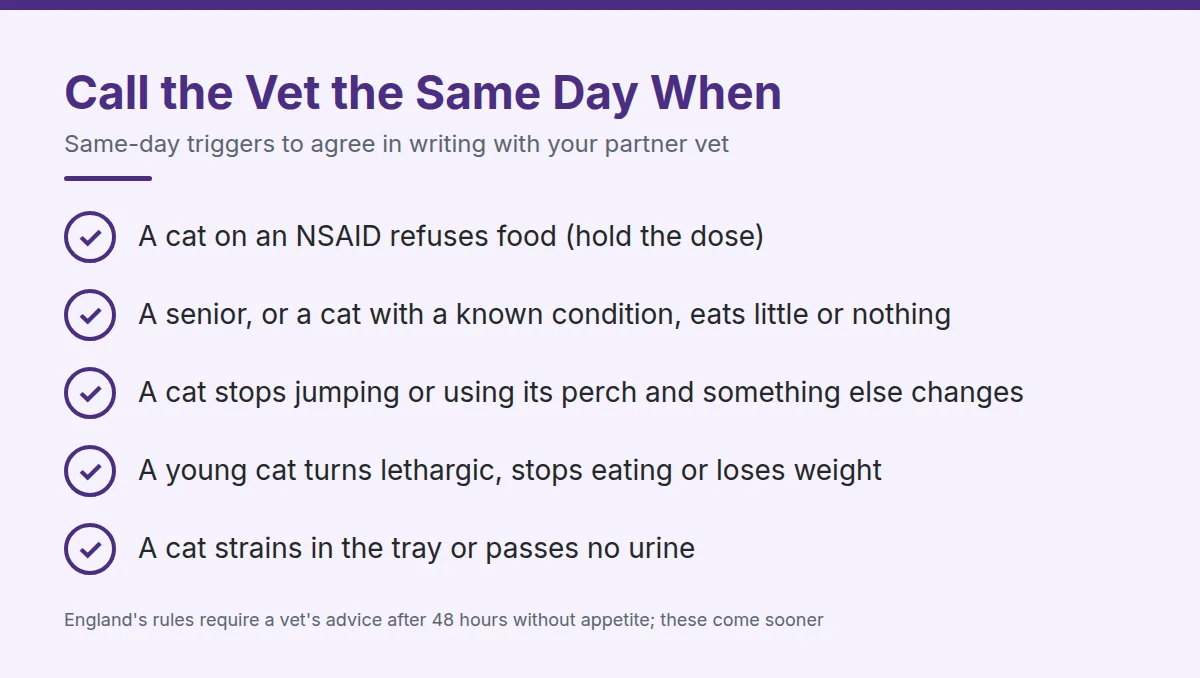
Call the vet the same day when:
- a cat on an NSAID refuses food (hold the dose until the vet has advised)
- a senior, or a cat with a known condition, eats little or nothing, well before England’s 48-hour limit
- a cat stops jumping or using its perch alongside any other change, such as hiding more or eating less
- a young cat turns lethargic, stops eating or loses weight
- a cat strains in the tray or passes no urine, which in a male cat can mean a blocked bladder, an emergency
England’s guidance also requires that when a trained first aider suspects a cat is ill or injured, staff contact a vet for advice immediately, record the instructions and tell the owner. A well-run cattery anywhere works the same way.
Choosing a Partner Vet Who Works to These Standards
These guidelines are easiest to follow alongside a vet practice that already works to them. International Cat Care runs Cat Friendly Clinic, an accreditation built to raise the standard of feline care in veterinary clinics, and the FelineVMA runs a Cat Friendly Practice program of its own. Whichever practice you partner with, ask it to read your intake form, isolation protocol and medication policy once a year and tell you where they fall short of the guidelines.
The Bottom Line
None of the feline guidelines was written for a cattery, but between them they describe almost everything a good one does: the questions on the intake form, a suite with a hiding place and separated resources, handling without scruffing, cleaning that leaves a cat’s scent alone, and clear points at which staff stop and call a vet. Read the ones that touch your work, turn each into a written house rule, and ask your partner vet to check the result. Your policies will then match the standard the vet treating your boarders already works to.
Further reading (sources)
- Feline Veterinary Medical Association for its list of current practice guidelines and how vets should use them
- International Cat Care on renaming the ISFM as the iCatCare Veterinary Society
- International Cat Care with its veterinary society, the open access JFMS and Cat Friendly Clinic accreditation
- Stone and colleagues on the 2020 AAHA and AAFP feline vaccination guidelines
- Little and colleagues for the 2020 AAFP retrovirus testing and management guidelines
- Quimby and colleagues with the 2021 AAHA and AAFP feline life stage guidelines
- Ray and colleagues on the 2021 AAFP feline senior care guidelines
- Taylor, Gruen and colleagues for the 2024 ISFM and AAFP guidelines on long-term NSAID use in cats
- Ellis and colleagues on the five pillars of the AAFP and ISFM environmental needs guidelines
- Taylor, St Denis and colleagues with the 2022 cat friendly veterinary environment guidelines for wards and cages
- Carney and colleagues for the AAFP and ISFM house-soiling guidelines on trays and litter
- Sadek and colleagues on the AAFP consensus statement on how cats prefer to eat
- Rodan, Dowgray and colleagues with the 2022 cat friendly interaction and handling guidelines
- Rodan, Ramos and colleagues for the 2024 AAFP intercat tension guidelines and their ten myths
- Lappin and colleagues on the 2019 AAFP feline zoonoses guidelines
- Epstein and colleagues with the 2015 AAHA and AAFP pain management guidelines
- Feline Veterinary Medical Association on its endorsement of AAHA’s 2022 pain management guidelines
- Steagall and colleagues for the 2022 ISFM guidelines on managing acute pain in cats
- Taylor, Chan and colleagues on the 2022 ISFM guidelines for hospitalized cats that stop eating
- Thayer and colleagues with the 2022 AAFP and EveryCat FIP diagnosis guidelines
- Defra for England’s cat boarding licensing rules on vaccination, isolation, appetite and shared units